

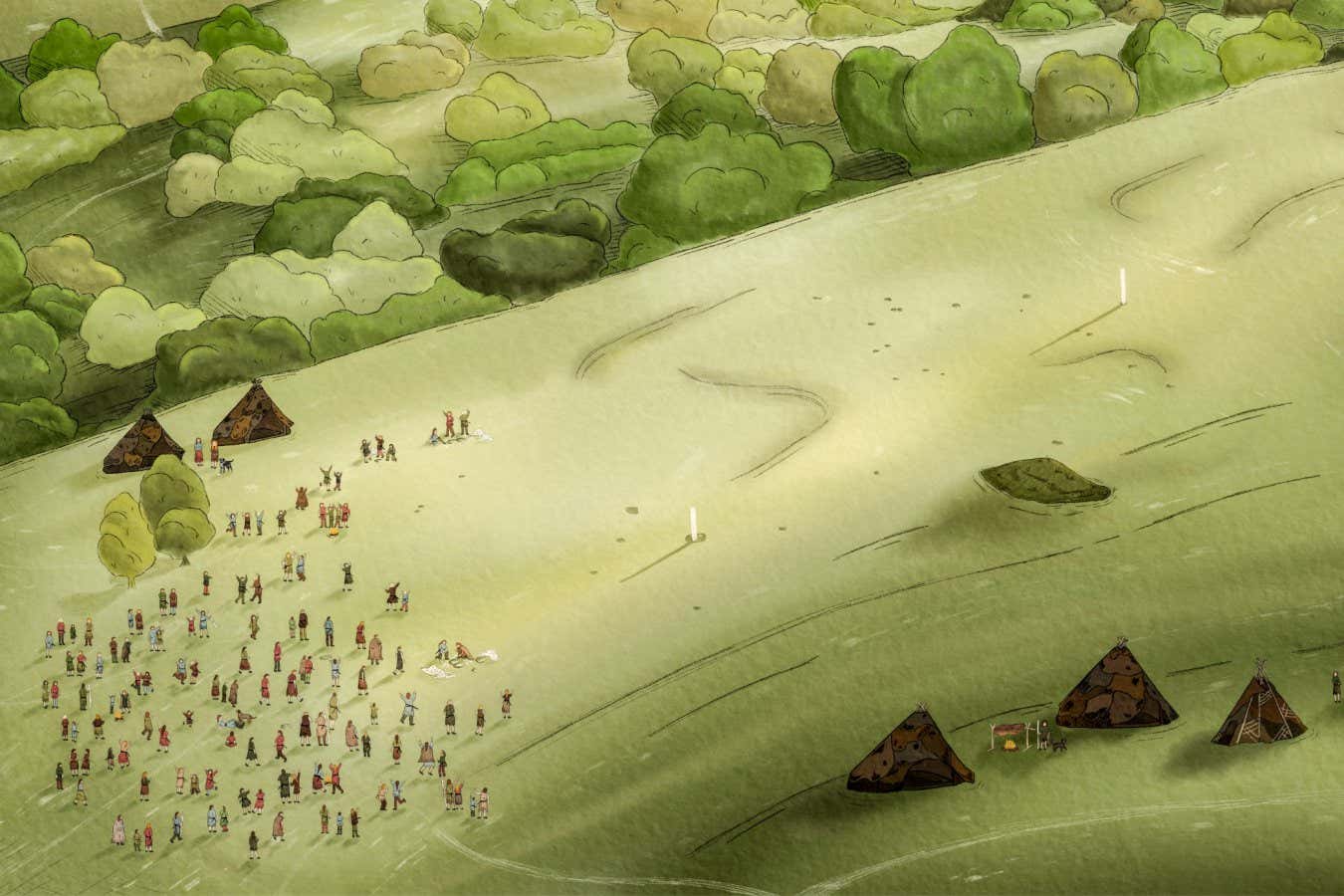
A reconstruction of the summer solstice celebrations as they might have appeared at Bulford thousands of years ago
Marijane Porter, Wessex Archaeology
Stone Age peoples in Britain built a wooden monument to mark the summer solstice, 500 years before they began building the stone circle at Stonehenge.
Stonehenge is also aligned to the summer solstice, and the wooden monument may have been an early prototype of this. It is one of the earliest examples of a monument aligned to an astronomical phenomenon in the British Isles.
“What we have now, for the first time, is actual proof that these people were capable of capturing the movement of the sun,” said Phil Harding at Wessex Archaeology, who led the excavations, at a press conference announcing the discovery.
Stonehenge is a monument built during the Neolithic, the very end of the Stone Age. Situated on Salisbury Plain in the UK, it consists of an outer ring of vertical sarsen stones topped by horizontal lintels, a smaller inner ring of vertical bluestones and several other stones. These are surrounded by an earth bank and a ditch. This is the oldest part, built around 3100 BC, with the stones being placed over the centuries up to 1600 BC.
Some of the standing stones seem to have been carefully aligned to point to the spot on the horizon where the sun rises on the summer solstice, and to the opposing spot where the sun sets on the winter solstice. The relevant stones were erected about 2500 BC.
Harding and his colleagues have found the remains of a nearby monument that is 500 years older. About 5 kilometres north-east of Stonehenge, there is a village called Bulford, where the UK’s Ministry of Defence wanted to house about 5000 army personnel. Before construction began, Wessex Archaeology excavated Bulford from 2015 to 2017.
The team found a cluster of pits containing grooved ware pottery, which was made by late Neolithic peoples. Radiocarbon dating suggested the pottery was from about 2950 BC. The researchers obtained 40 dates, all tightly clustered in time. “This site was being occupied for a relatively short period of time,” said Harding. “It could be something like a decade.”
“It’s a really important Middle Neolithic settlement,” says Susan Greaney at the University of Exeter, UK, who wasn’t involved in the study.

A piece of pottery found at Bulford, UK
Wessex Archaeology
Two of the Bulford pits were a different shape to the others. Instead of having vertical sides, they tapered towards the bottom, going from about 1.2 metres across to just 0.5 metres. They also didn’t contain pottery, but were filled with chalk rubble. Harding and his colleagues concluded that they were postholes: they had once housed timbers a few metres tall, which were held upright by the rubble. In line with this, one of the postholes contained charcoal from an ash tree.
The two postholes are about 120 metres apart. Harding realised that a line drawn through them would point roughly north-east, at 48.1 degrees: about the direction of the midsummer sunrise. “I got really, really excited about that,” said Harding.
Wessex Archaeology recruited Fabio Silva, a skyscape archaeologist at consultancy Stone x Sky, to study the alignment of the postholes more carefully. Using a 3D reconstruction of the landscape with modern buildings removed, plus data on the sun’s shifting path across the sky, Silva determined that the postholes were neatly aligned with the past summer solstice sunrise.
Strictly, the alignment was about 1 degree out, but Silva said this makes sense once you realise that the wooden posts could have been up to 50 centimetres across. “You have to take that width into account,” he said at the press conference, in which case the alignment is “bang on”. “The odds of this being by chance are less than 0.5 per cent,” he said.
“Probably a rough orientation is good enough for the ritual that you are supposed to carry out in these sites,” says A. César González-García at the Spanish National Research Council in Santiago de Compostela, who wasn’t involved in the study. “It looks like there is a broad understanding and interest in the sky.”
Older sites in the area also show evidence of people tracking the sun, albeit with less precision. “From the earliest times that we have Neolithic people present in that landscape, they are incorporating the sun into their ceremonial architecture,” said Matt Leivers, also at Wessex Archaeology.
“We’ve got loads of timber monuments that have those kind of alignments,” says Greaney. The Bulford monument “is adding another one to that, potentially, but much earlier”.
For instance, at nearby Larkhill, there is a Neolithic enclosure from around 3700 BC, well before Bulford and Stonehenge. Its entrance faces roughly north-east. If you stand in that entrance and look at Sidbury Hill (the highest point on the horizon) on midsummer morning, “you see the sun rise dead ahead of you over Sidbury Hill”, said Leivers.
Topics: