

With about 6,300 exoplanets discovered so far and more than 10,000 candidates awaiting confirmation, it’s easy to forget the ones that started it all: the very first exoplanets discovered and announced in 1992. These worlds were not orbiting stars like the sun. Instead they circled a pulsar, the dead remains of an exploded star. This is one of the last places in the universe astronomers expected to find planets—a pulsar is the remnant from a supernova, after all—and it’s still unclear how these worlds formed.
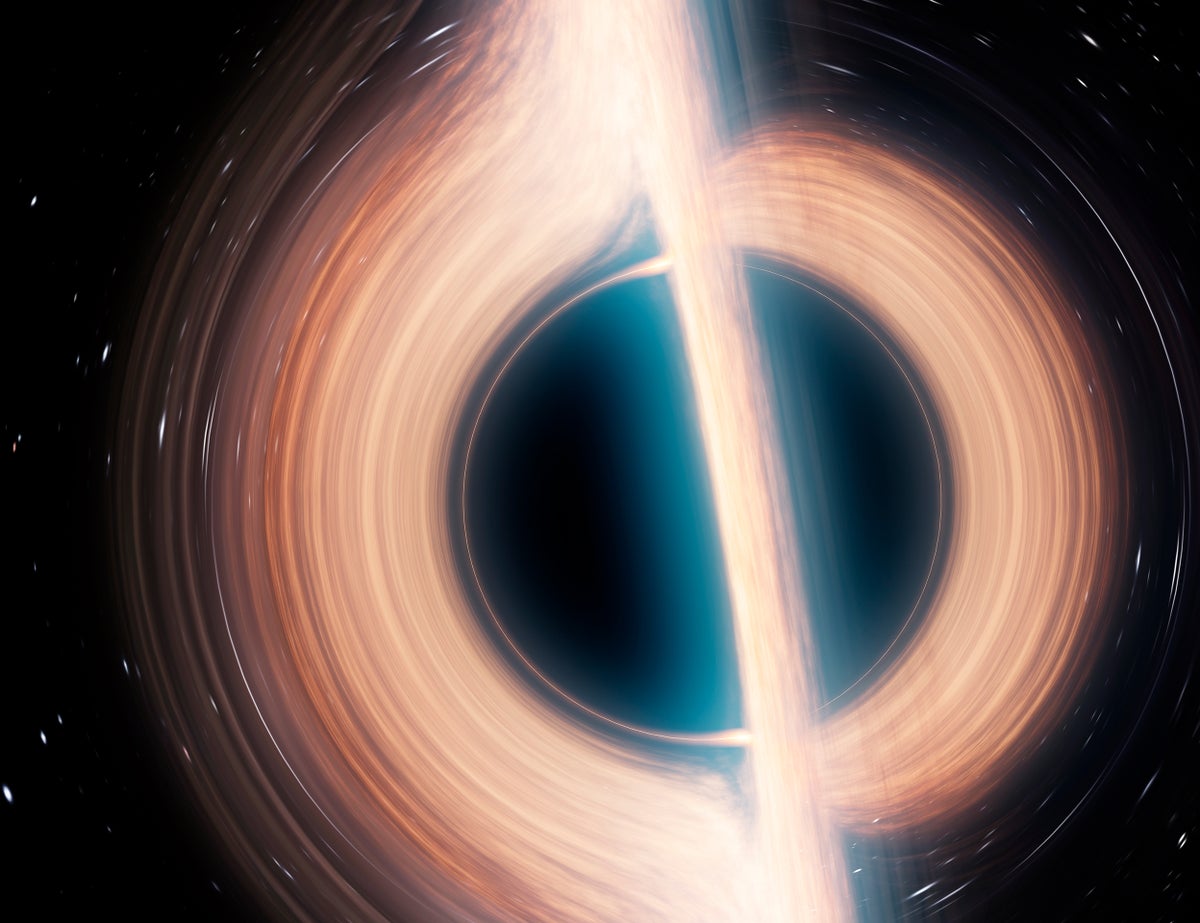
Clearly nature excels at making planets, even under extremely hostile conditions. Just how “hostile” those conditions can be, however, no one knows yet. Planets like those in our solar system form from whirling disks of gas and dust around baby stars, but disks are common around another kind of astrophysical object, too: black holes. Could planets be born there as well or at least emigrate from elsewhere and survive in their new neighborhood?
The answer, astonishingly, is “maybe,” though it depends on what kind of black hole we’re talking about.
On supporting science journalism
If you’re enjoying this article, consider supporting our award-winning journalism by subscribing. By purchasing a subscription you are helping to ensure the future of impactful stories about the discoveries and ideas shaping our world today.
For stellar-mass black holes—which, like pulsars, are forged in the collapsing core of an exploding massive star—there are some caveats. For example, when a massive star goes supernova, a majority of its matter is flung out into space. If enough matter is lost, the star’s gravity will be sufficiently weakened so that it can’t hold on to any extant planets, and they, too, will be lost to space. If any planets do survive the catastrophic explosion—or somehow form afterward from leftover debris—they can still be torn apart by tidal forces and gulped down by the black hole if they wander too close.
If material is falling into the black hole—perhaps siphoned off a companion star that orbits perilously close—the material forms an accretion disk: a flattened pancake of material whirling around the black hole. Friction heats the disk to ridiculously high temperatures that can fry planets from a substantial distance. Even worlds that are too far-off to broil could still suffer from having their atmospheres stripped away by the accretion disk’s copious emission of x-rays and other high-energy radiation.
With that in mind, planets orbiting stellar-mass black holes seem unlikely. But there also exist far, far larger beasts: supermassive black holes.
These lurk in the centers of all big galaxies and play a murky-but-critical role in galactic birth and growth. The one in the center of our Milky Way galaxy, called Sagittarius A* (Sgr A*), is four million solar masses, which actually makes it a relative lightweight; other supermassive black holes can contain billions of solar masses.
It’s conceivable that planets circle some of these supermassive black holes. We know many stars orbit Sgr A*, and we know from statistics that most stars host planets. In principle, a star on a sufficiently elongated orbit around a supermassive black hole could pass close enough for the black hole to gravitationally pilfer some of its planets.
Stranger still, it’s possible that planets could actually form around supermassive black holes. That’s the remarkable conclusion from a team of astronomers who investigated this idea; their results have been accepted for publication in the Astrophysical Journal, but you can read a preprint here.
A galaxy’s central supermassive black hole is often accompanied by a colossal accretion disk consisting of huge quantities of infalling material. Surrounding this disk is a doughnut-shaped cloud of dark, cold dust called a torus. Vast quantities of dust also exist in the disk’s cooler outer regions, which are hundreds of billions of kilometers away from the black hole. Dust can be raw material for planets, which can be built bit by bit via minuscule particles glomming together. Small grains aggregate into pebbles, then boulders, then upward and onward until planetary-mass objects emerge.
In their study, the astronomers found that a supermassive black hole’s outer disk and torus could foster this cumulative growth with remarkable efficiency. In fact, their work suggests this process can churn out a broad range of objects: anything from Earth-mass planets to hefty, full-fledged stars with 300 times our sun’s mass.
This is surprising, to say the least—in our suburban corner of the Milky Way, far from the bustling core, stars form from the top-down collapse of giant gas clouds, not the bottom-up agglomeration of smaller objects. Moreover, the scientists found that a typical disk and torus should contain so much material that tens of millions of planetary-mass objects could form there. If true, galactic cores with actively feeding black holes may, on average, be the most fecund places for planets in the universe!
But they would be very different than the planets we’re familiar with. The gas and dust in the outer disk are decoupled and noninteracting. Weirdly, planetary and even stellar objects would form fully from dust, with little or no gas in them at all. Even ones as beefy as Jupiter would, by definition, be “terrestrial”—completely made of rock.
The paper doesn’t cover whether such worlds could be habitable, but we can still speculate. Leaving aside any nastiness from the nearby black hole itself, if such planets were much bigger than Earth, they would probably make it difficult for life because of their cell-crushing, intensely powerful surface gravity.
It’s harder to gauge life’s prospects on approximately Earth-size worlds around a supermassive black hole. The probable lack of a gaseous atmosphere would be a huge hindrance to life as we know it. Aside from that, an accretion disk is a hostile place. Still, other studies have already shown how, under some circumstances, pulsar planets might be habitable—and if life could endure those hostile conditions, it could possibly find a way to exist in the vicinity of a giant black hole, too. Also, accretion disks don’t last forever but instead appear to come and go on a timescale of tens of millions to hundreds of millions of years. If any planets and stars happen to match up during that time, they might endure, making life’s emergence conceivable. That seems unlikely, admittedly, but not impossible.
This is all very speculative. But the universe itself is telling us this sort of thing seems to be possible, so stretching our minds is in order. Many, if not most, of the exoplanets we’ve discovered are very different from the worlds of our own solar system. It’s actually rather enchanting to think that far, far weirder ones may exist.