

Earth’s molten outer core is behaving in chaotic, unexpected ways
Scientists are working to solve a mystery of Earth’s molten outer core, which lies more than 2,000 kilometers beneath our feet
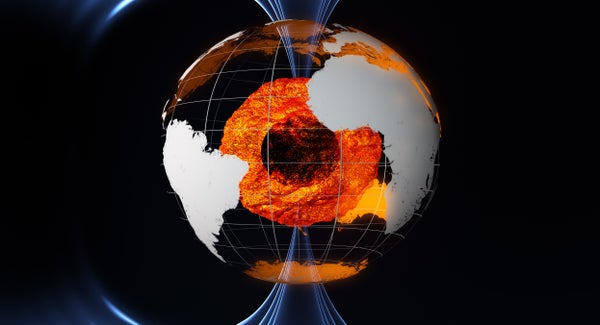
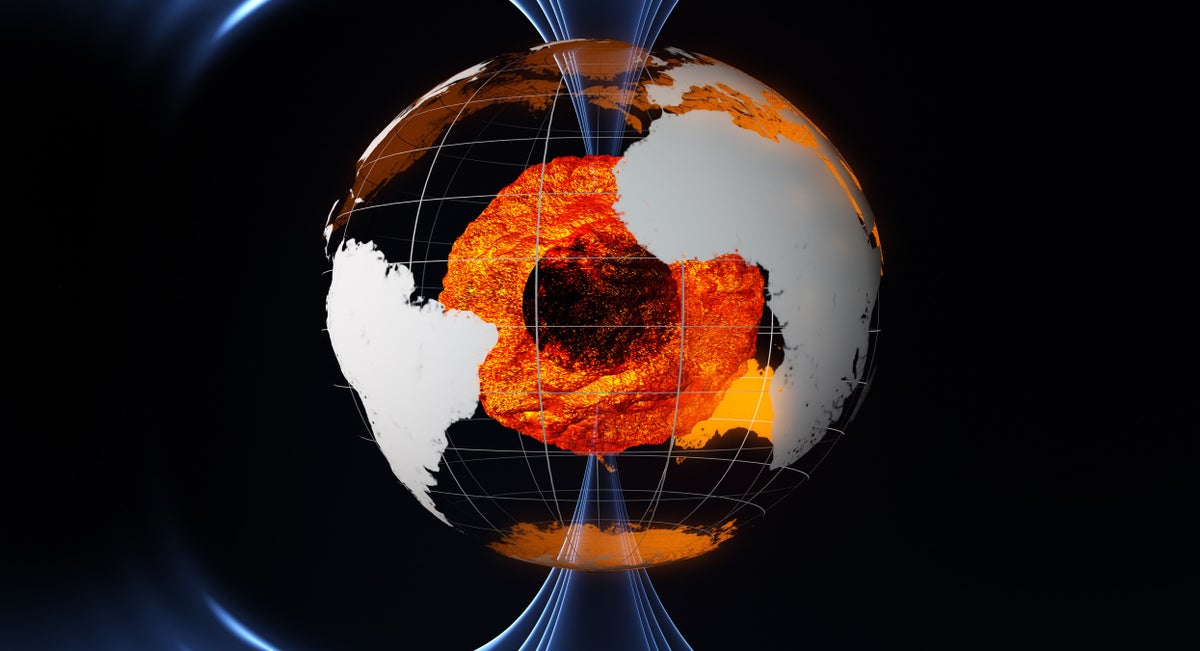
Earth’s molten outer core is critical to life on our planet. Churning some 2,900 kilometers beneath the surface, it’s a vast “sea” of liquid iron that swirls around the planet’s solid inner core. This movement generates Earth’s magnetic field, which shields our planet from harmful cosmic radiation.
Measurements show that the inner core rotates in an easterly direction, just like Earth itself, but the molten metal of the outer core tends to flow westward. Now, however, a new analysis of data from European Space Agency (ESA) satellites and other sources reveals something astonishing: Beginning in 2010, that flow abruptly changed direction to the east in a region of the outer core under the Pacific Ocean. Why exactly this occurred remains a mystery—but researchers are slowly gleaning clues.
Using archival observations gathered between 1997 and 2025 by sources such as ESA’s Swarm and CryoSat-2 missions, which study the Earth’s magnetic field and the polar ice caps, respectively, scientists pinpointed the anomalous flow of a glob of iron-rich liquid rock under the Pacific that changed direction, strongly flowing to the east instead of the west for about a decade before weakening again in 2020. The study, which recently appeared in the Journal of Studies of Earth’s Deep Interior, also incorporated data from Germany’s CHAMP mission and Denmark’s Ørsted mission, as well as from ground-based observatories.
On supporting science journalism
If you’re enjoying this article, consider supporting our award-winning journalism by subscribing. By purchasing a subscription you are helping to ensure the future of impactful stories about the discoveries and ideas shaping our world today.
The findings suggest that the large-scale motions of the outer core are far less stable than previously thought. They also indicate that the outer core may be influenced by hidden shifts happening within the inner core.
“The large-scale flow reversal beneath the Pacific raises new questions about the behaviour of Earth’s deep interior,” said Frederik Dahl Madsen, a Ph.D. student at the University of Edinburgh and lead author of the study, in a statement.
Other data suggest that something was indeed happening within the inner core that may have influenced the change in direction in the outer core, he said.
“Scientists now want to understand whether the reversal represents a short-lived fluctuation, part of a repeating oscillation, or a new stable equilibrium for core circulation,” he said. “Continued monitoring will be essential to determine how the flow evolves over the coming years.”
Understanding what happens so deep in Earth’s interior is crucial to knowing how our planet works, how it evolves over time and how those changes affect its protective magnetic field. Safeguarding our satellites and even Earth’s biosphere against radiation from outer space, it turns out, sometimes requires looking deeper within.
“This research raises intriguing questions about how Earth’s deepest layers are dynamically connected,” said ESA Swarm mission scientist Elisabetta Iorfida in the same statement.
“As the magnetic field continues to evolve,” she added, “satellite missions are providing an increasingly detailed view of the dynamic processes unfolding deep inside our planet, revealing that Earth’s core may be far more variable and complex than once believed.”
It’s Time to Stand Up for Science
If you enjoyed this article, I’d like to ask for your support. Scientific American has served as an advocate for science and industry for 180 years, and right now may be the most critical moment in that two-century history.
I’ve been a Scientific American subscriber since I was 12 years old, and it helped shape the way I look at the world. SciAm always educates and delights me, and inspires a sense of awe for our vast, beautiful universe. I hope it does that for you, too.
If you subscribe to Scientific American, you help ensure that our coverage is centered on meaningful research and discovery; that we have the resources to report on the decisions that threaten labs across the U.S.; and that we support both budding and working scientists at a time when the value of science itself too often goes unrecognized.
In return, you get essential news, captivating podcasts, brilliant infographics, can’t-miss newsletters, must-watch videos, challenging games, and the science world’s best writing and reporting. You can even gift someone a subscription.
There has never been a more important time for us to stand up and show why science matters. I hope you’ll support us in that mission.