

Feedback is New Scientist’s popular sideways look at the latest science and technology news. You can submit items you believe may amuse readers to Feedback by emailing feedback@newscientist.com
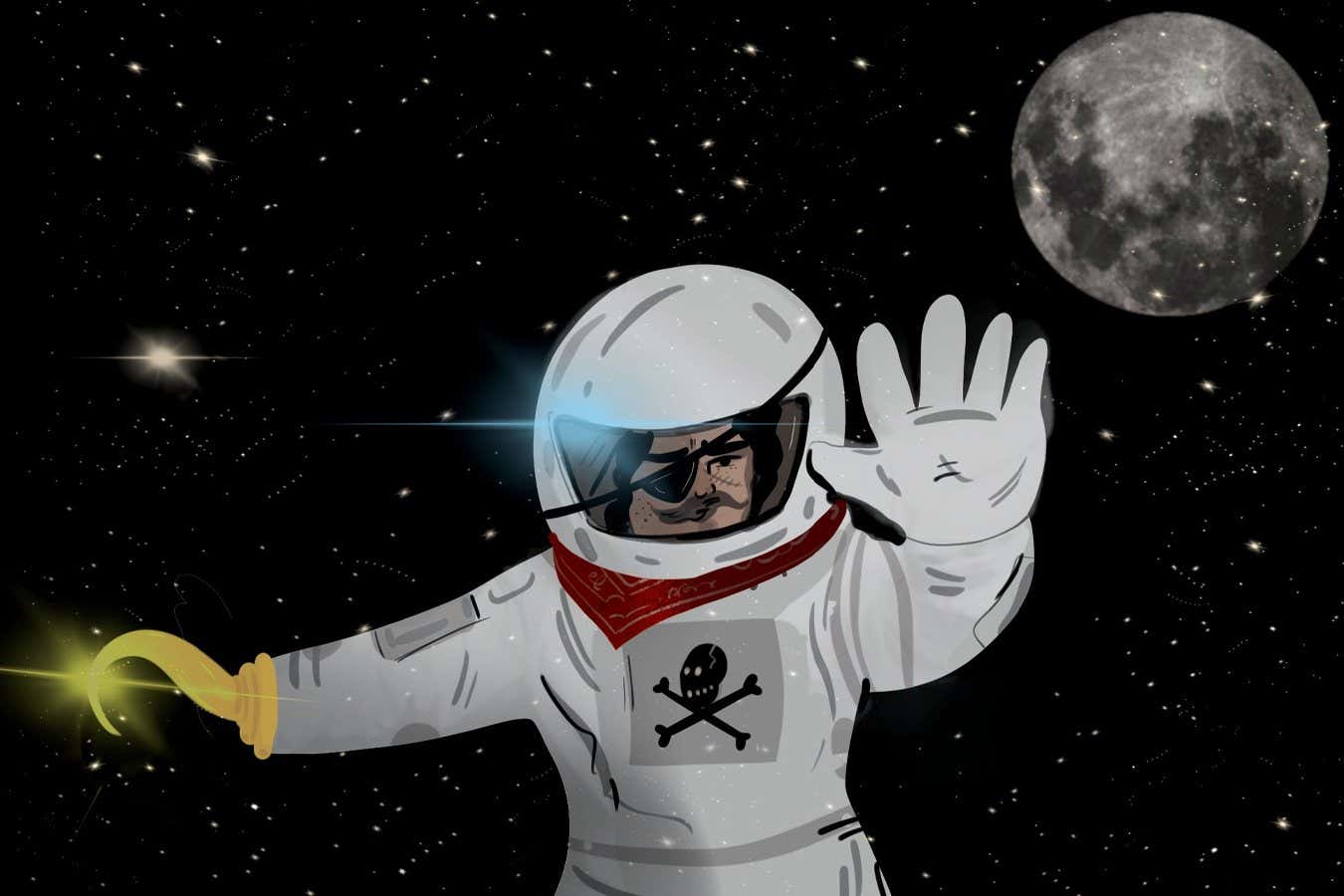
LunAAARRRR pirates
The moon looms large in the sky – and also, it seems, in the minds of future-oriented people. Right now, there is an awful lot of forward-thinking going on with regard to our natural satellite. One might almost imagine that people were trying to distract themselves.
For instance, in our 21 March missive, we discussed accounting firm PwC’s ongoing attempts to forecast the size of the future lunar economy: its future estimates were all measured in billions, which is a strong claim given that the current Gross Lunar Product is, to a close approximation, $0.00.
Now, via spacenews.com, we learn that some thinkers have taken it a step further. Readers may recall the existence of the US Space Force, the newest branch of the military. It seems the Space Force is establishing “a cislunar [near the moon] coordination office” to think through “the importance of the cislunar region for warfighting and national security”.
For instance, suppose the US builds a base on the moon. How might it defend this new installation and ensure that supply missions can safely reach it? It seems this requires the Space Force to establish some kind of operational control of cislunar space.
As Feedback rocketed down the moon warfare rabbit hole (and if that isn’t a mixed metaphor, we don’t know what is), we discovered a 2025 book called Space Piracy: Preparing for a criminal crisis in orbit by Marc Feldman and Hugh Taylor. The authors contend that acts of piracy in space could happen, perhaps perpetrated by existing criminal gangs who see profit in it or by rogue states. For instance, they suggest that some dastardly persons might hack a spacecraft’s software or blockade the moon, halting supplies to a lunar base.
So concerned are Feldman and Taylor that they have since founded the Center for the Study of Space Crime, Piracy, and Governance to talk about space piracy more.
Feedback wondered if we were being unduly sceptical about the march of technological progress. We are all too aware of the confident sceptics who said powered flight was impossible and that computers would never amount to anything much. It follows that, while the moon isn’t currently a centre of profit, piracy or armed conflict, it might be one day.
Hence we consulted an academic review of the space piracy book by Mark T. Peters II (now retired from the US Air Force). Peters concludes: “Despite some logical arguments, I cannot understand any scenario with viable space pirates… The book fails to demonstrate viable space piracy scenarios in any area other than cyber, which is already well known and understood.”
Feedback can’t quite decide if all this is admirably forward-thinking policy or an excuse to spend time workshopping how to turn the plot of The Expanse into reality. This may well be entirely useless, but it does sound like fun, so we would like to join.
Doesn’t add up
Feedback isn’t one to hide our mistakes: this entire item is a correction. When we said something was silly, we failed to understand just how silly it was.
The issue concerns some figures bandied around by the US health secretary, Robert F. Kennedy Jr. Discussing drug pricing, he said: “Well, if the drug was $100 and it raises to $600, that would be a 600 per cent rise… If it drops from $600 to $100, that’s a 600 per cent savings.”
In common, we suspect, with a fairly large percentage of the world, Feedback identified that the drop from $600 to $100 is not, in fact, 600 per cent (6 May). After all, a fall of 100 per cent would leave you with $0.00. But we missed that RFK Jr.’s first statement was also wrong.
With apologies to the many, many people who wrote in to point this out, we are going to cite the aptly named Chris Smart (please do not take that as an incentive to use nominatively deterministic pseudonyms when writing to Feedback). Chris says: “The premise… is that a rise from $100 to $600 is a 600 per cent increase. No it isn’t. The rise from $100 to $600 is $500 which is a 500 per cent increase. So both the premise and conclusion were incorrect, making it a vacuous truth.”
The confusion, which Tom Brock further clarifies, is between the percentage rise and the new value as a percentage of the original, which aren’t the same. Tom explains: “If the price was $100 and rises to $600, that is a rise of 500 per cent: the new value is 600 per cent of the old.”
Blunders like this, by the way, are why journalists are advised not to talk about percentage changes at all and to stick to natural numbers instead. It’s too easy to confuse both yourself and the audience (although based on the current state of our inbox, Feedback’s audience wasn’t confused at all).
This is all mildly embarrassing, but fortunately both Feedback and RFK Jr. have low-stakes jobs.
A bookish type
The recommendation algorithms are starting to know Feedback a little too well. It’s one thing to have websites identifying things that lie in the general vicinity of our core interests; it’s another to have them deliver story items on a platter. Yet somehow our podcast app realised that we would want to know about the podcast Off the Shelf, which is about books and publishing.
Off the Shelf‘s host has such an appropriate moniker that the podcast’s blurb includes the phrase “yes, that’s her actual last name”, because her name is, of course, Morgann Book.
Got a story for Feedback?
You can send stories to Feedback by email at feedback@newscientist.com. Please include your home address. This week’s and past Feedbacks can be seen on our website.