

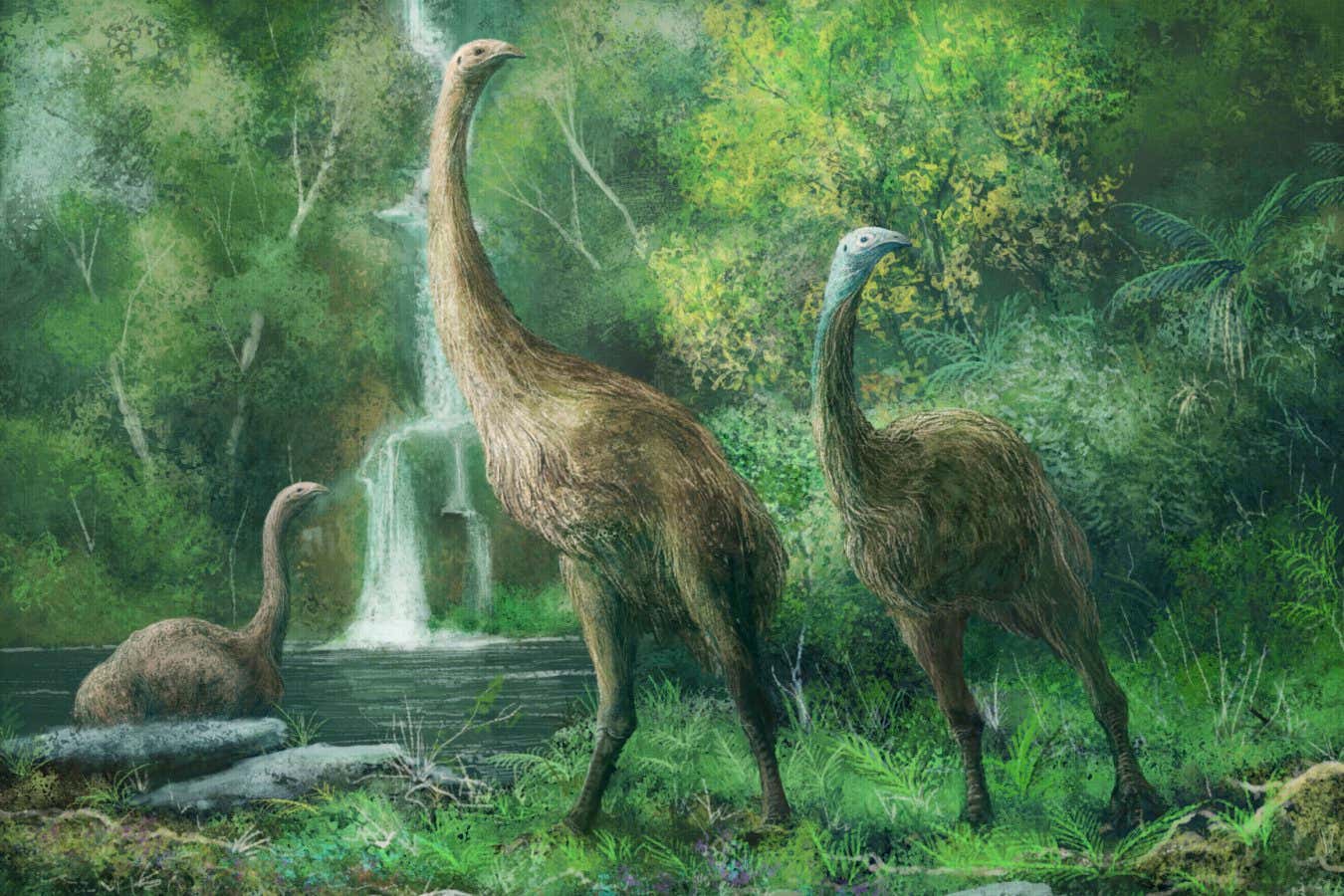
The moa, a large, extinct bird, was native to New Zealand
MARK P. WITTON/SCIENCE PHOTO LIBRARY
The extinct, flightless moas of New Zealand stood over 3 metres tall and weighed over 200 kilograms. Their eggs were larger than those of any living bird – a problem for Colossal Biosciences, which is aiming to bring them back to life. Now, the company claims to have developed an artificial eggshell consisting of a lattice supporting a transparent silicone membrane, which it says will enable it to create eggs as large as those of the moa.
Is this the first-ever artificial bird egg?
Colossal does use the term “artificial egg” in its press release, but it is really just an artificial eggshell. Either way, it isn’t a first – in fact, it’s possible to remove chicken eggs from their shells and hatch them from anything from plastic cups to cling film. However, the survival rate is usually low because, without an eggshell, the developing chicks may not get enough oxygen. A number of teams around the world have been working on more sophisticated so-called ex-ovo approaches.
How much better is it than cling film?
Colossal claims its silicone membrane is better than existing ex-ovo methods because it allows oxygen through at the same rate as a chicken eggshell and doesn’t require additional oxygen. However, it hasn’t released any experimental results to back this up. “I would love to see what the numbers are on efficiency,” says Ben Novak of non-profit wildlife conservation group Revive & Restore. “How many of these chicks hatch versus how many don’t?”
Does this mean we could create a giant artificial moa egg?
Even if Colossal’s approach does work well for chicken eggs, it won’t necessarily work for larger eggs. Larger eggs might need shells with different properties because of their lower surface-area-to-volume ratio, but this could probably be solved by tweaking the permeability of the membrane. Making a big egg also requires more than just a big eggshell. Moa eggs were up to 24 centimetres long and 18 cm wide, so they contained a lot more egg white and yolk than the eggs of living birds. Adding more egg white should be relatively straightforward. Chickens have been successfully hatched in the egg white from turkeys, says Novak, which suggests it won’t matter much what animal’s egg white is used.
What about the extra yolk required?
That’s more of a problem. Each egg yolk is a single cell, meaning ostrich yolks are the largest single cells found on the planet. To make a yolk larger would require penetrating the cell membrane and injecting more yolk, says Novak, which would likely cause the cell to burst. So it might be necessary to somehow enlarge the cell membrane so it can hold the extra yolk. Which is probably doable, given enough time, effort and money.
If all the problems with making really big eggs are solved, could we then bring back the moa?
Absolutely not. The big problem is that DNA breaks up into smaller and smaller pieces over time, and all nine species of moa went extinct around 600 years ago. It’s never going to be possible to get a complete, working copy of a moa genome and produce a living animal genetically identical to any of the extinct species. Even the human genome wasn’t completed until 2023.
But I thought Colossal had brought back the dire wolf?
No, it made a few gene edits to grey wolves and called them dire wolves. Colossal’s head scientist conceded as much in an interview with New Scientist last year, though the company itself still claims the gene-edited grey wolves are dire wolves. Independent researchers also flatly reject Colossal’s claim. “At least in the circles I’m in, there is unanimous agreement that these claims are unjustified,” Vincent Lynch at the University at Buffalo, New York, told New Scientist recently.
So is de-extinction impossible?
In the sense of creating living animals genetically identical to extinct ones, yes. But what could be done is creating a kind of hybrid between a living species and an extinct one. For instance, Revive & Restore aims to modify the band-tailed pigeon to create a bird resembling the extinct passenger pigeon – but Novak is very clear that this would be a hybrid and not a passenger pigeon.
Is this what Colossal aims to do with the moa?
Colossal hasn’t revealed its plans, but based on what it did with grey wolves and “woolly mice”, its aim will likely be to tweak a few genes in the emu to create something a bit like the moa in appearance, even if that means making genetic changes not present in the moa genome. Five of the 20 gene edits made to the grey wolves were changes not found in the dire wolf genome, for instance. Nic Rawlence at the University of Otago in New Zealand doesn’t think Colossal is close to achieving even this for the moa. “The development of a genetically engineered emu and calling it a moa for no good conservation or ecological reason, but rather an ecotourism venture, is still a long way off,” says Rawlence. Nor is the idea of bringing back the moa universally welcomed, he says. “There is widespread Māori and public opposition in Aotearoa New Zealand.”
This artificial eggshell isn’t a major breakthrough, then?
It doesn’t solve the biggest obstacles to de-extinction, but it could have many other uses if it works as well as Colossal claims. Rawlence describes it as “impressive and groundbreaking work all on its own”, with potential conservation uses such as for captive breeding of critically endangered species. It could also find many uses in research and poultry farming. The transparency of the artificial shell would allow researchers to tweak genes related to physical development and watch how this affects developing chicks over time – something that Novak suspects Colossal itself may be interested in doing.
Topics: