
Close Menu
    Trending
    • What You Can and Can’t Deduct in Your Side Hustle (Most People Get Tax Deductions Wrong)
    • What is love? Even a meeting on the subject can’t find the answer
    • Planatir To Control Britain’s Health Data
    • Jon Favreau Admits This ‘Star Wars’ Character Isn’t ‘Disney Cute’
    • US to screen for Ebola at airports, one American in DR Congo infected
    • Russia-China ties ‘stabilising’ force in world, Putin says before Xi talks | News
    • Cavaliers-Knicks Eastern Conference Finals preview
    • Why an Athlete’s Retirement Made Me Rethink My Exit After Building a $2.7B Company
    Benjamin Franklin Institute
    Tuesday, May 19
    • Home
    • Politics
    • Business
    • Science
    • Technology
    • Arts & Entertainment
    • International
    Benjamin Franklin Institute
    Home»Science»The rings of Uranus are even stranger than we thought
    Science

    The rings of Uranus are even stranger than we thought

    Team_Benjamin Franklin InstituteBy Team_Benjamin Franklin InstituteMay 18, 2026No Comments3 Mins Read
    Share Facebook Twitter Pinterest Copy Link LinkedIn Tumblr Email VKontakte Telegram
    Share
    Facebook Twitter Pinterest Email Copy Link


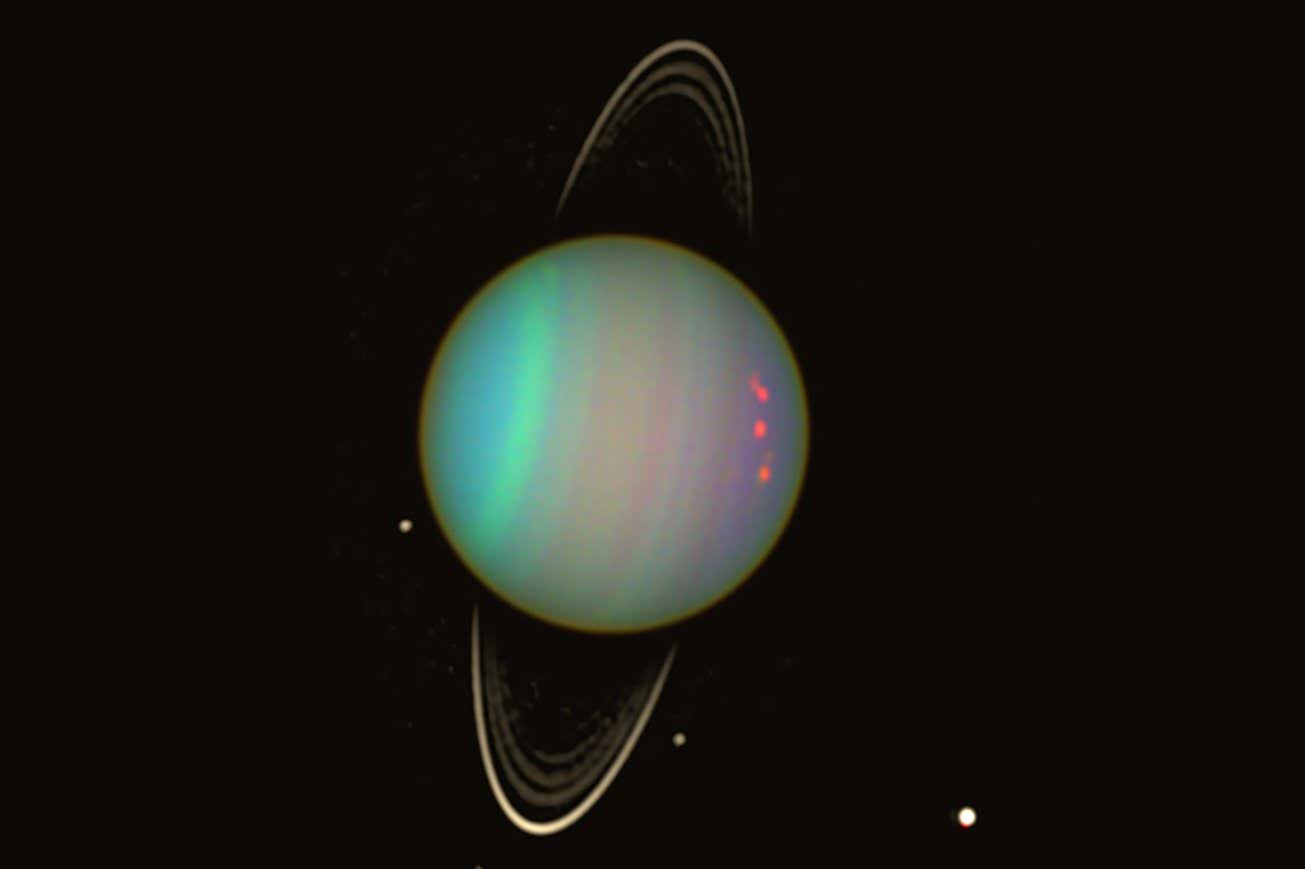
    A view of Uranus from the Hubble Space Telescope

    NASA and Erich Karkoschka, U. of Arizona

    The rings that encircle Uranus may look similar in images, but their compositions are surprisingly different. Understanding the rings could help us unravel the many mysteries of this strange, dynamic system.

    The outer rings of Uranus – the mu and nu rings – are so faint, and the whole system so distant, that it is difficult to observe them in any detail. Imke de Pater at the University of California, Berkeley and her colleagues combined nearly two decades of data from the Keck Telescope in Hawai’i, the Hubble space telescope, and the James Webb Space Telescope to get a better look.

    They found that the mu ring, which is the outermost one, looked very blue, and the light shining off it indicated that it is made of tiny grains of ice. The nu ring, on the other hand, appears red, and it is rich in dust and relatively complex organic molecules called tholins.

    The particles that make up the mu ring probably come from a small Uranian moon called Mab, so this indicates that Mab is icy, not rocky like the other moons that orbit near it. But it is unclear exactly how those tiny bits of ice got removed from Mab so that they could become a ring.

    In some ways, this situation is similar to Saturn’s E ring, which is supplied by the frozen moon Enceladus – but Enceladus spews water from its buried ocean in huge plumes, and that’s probably not happening on Mab, which is only about 12 kilometres across.

    “We don’t think that plumes would be possible on such a tiny moon like Mab, but still the parallels are exciting,” says Tracy Becker at the Southwest Research Institute in Texas, who was not involved with this work. Instead, it’s more likely that small rocks called micrometeoroids are hitting Mab’s surface and sending specks of ice flying.

    The nu ring being dusty is less of a surprise, but the rocky objects that must be supplying all that dust have not been discovered, which indicates that they must be relatively small. The researchers also found that the nu ring changes in brightness over time – its shine halved between 2003 and 2006 – which may indicate that there was a major collision in the rings before 2003 that caused it to temporarily brighten.

    The remaining question is not necessarily why the two rings are so different, but rather why the bodies that supply them with material are so different despite orbiting in similar areas around Uranus. “All the rocky bodies might have come from a moon that just fell apart or was slammed into pieces, but Mab is different,” says de Pater. “That really gets back to the origin of the whole system and what’s happened in the past.” Mab may be a shard of one of Uranus’s larger, more distant moons, which are icy, but then we don’t know what broke it off or why it migrated towards the planet.

    “This gives us two or three more really important puzzle pieces to start putting the Uranus system into perspective, and it is suggesting that there are actually quite a few more puzzle pieces than expected,” says Becker. “Maybe the puzzle’s a little bit bigger and harder than we thought, and we need a lot more pieces before we can fully understand that system.”

    Topics:


    Source link

    Share. Facebook Twitter Pinterest LinkedIn Tumblr Email Telegram Copy Link

    Related Posts

    Science

    What is love? Even a meeting on the subject can’t find the answer

    May 19, 2026
    Science

    Mystery of the ancient giant stone jars of Laos may have been solved

    May 19, 2026
    Science

    Floatation tanks deployed to combat PTSD after devastating wildfires

    May 18, 2026
    Science

    The Ebola emergency shines a light on the urgent need for new vaccines

    May 18, 2026
    Science

    The 3 things you need to know about protein, according to an expert

    May 18, 2026
    Science

    Human heads have changed shape a lot in the past 100 years

    May 18, 2026
    Editors Picks

    Why most AI rollouts fail

    February 12, 2026

    Many new UK drone users must take theory test for outdoor use

    December 29, 2025

    Let these nine romantic animals inspire you on Valentine’s Day

    February 15, 2026

    Playboy just named its first openly gay editor-in-chief. He wants to change the brand’s pornographic reputation amid a ‘sex recession’

    March 11, 2026

    Sudan Accuses U.A.E. of Being Complicit in Genocide

    March 6, 2025
    About Us
    About Us

    Welcome to Benjamin Franklin Institute, your premier destination for insightful, engaging, and diverse Political News and Opinions.

    The Benjamin Franklin Institute supports free speech, the U.S. Constitution and political candidates and organizations that promote and protect both of these important features of the American Experiment.

    We are passionate about delivering high-quality, accurate, and engaging content that resonates with our readers. Sign up for our text alerts and email newsletter to stay informed.

    Latest Posts

    What You Can and Can’t Deduct in Your Side Hustle (Most People Get Tax Deductions Wrong)

    May 19, 2026

    What is love? Even a meeting on the subject can’t find the answer

    May 19, 2026

    Planatir To Control Britain’s Health Data

    May 19, 2026

    Subscribe for Updates

    Stay informed by signing up for our free news alerts.

    Paid for by the Benjamin Franklin Institute. Not authorized by any candidate or candidate’s committee.
    • Privacy Policy
    • About us
    • Contact us

    Type above and press Enter to search. Press Esc to cancel.