

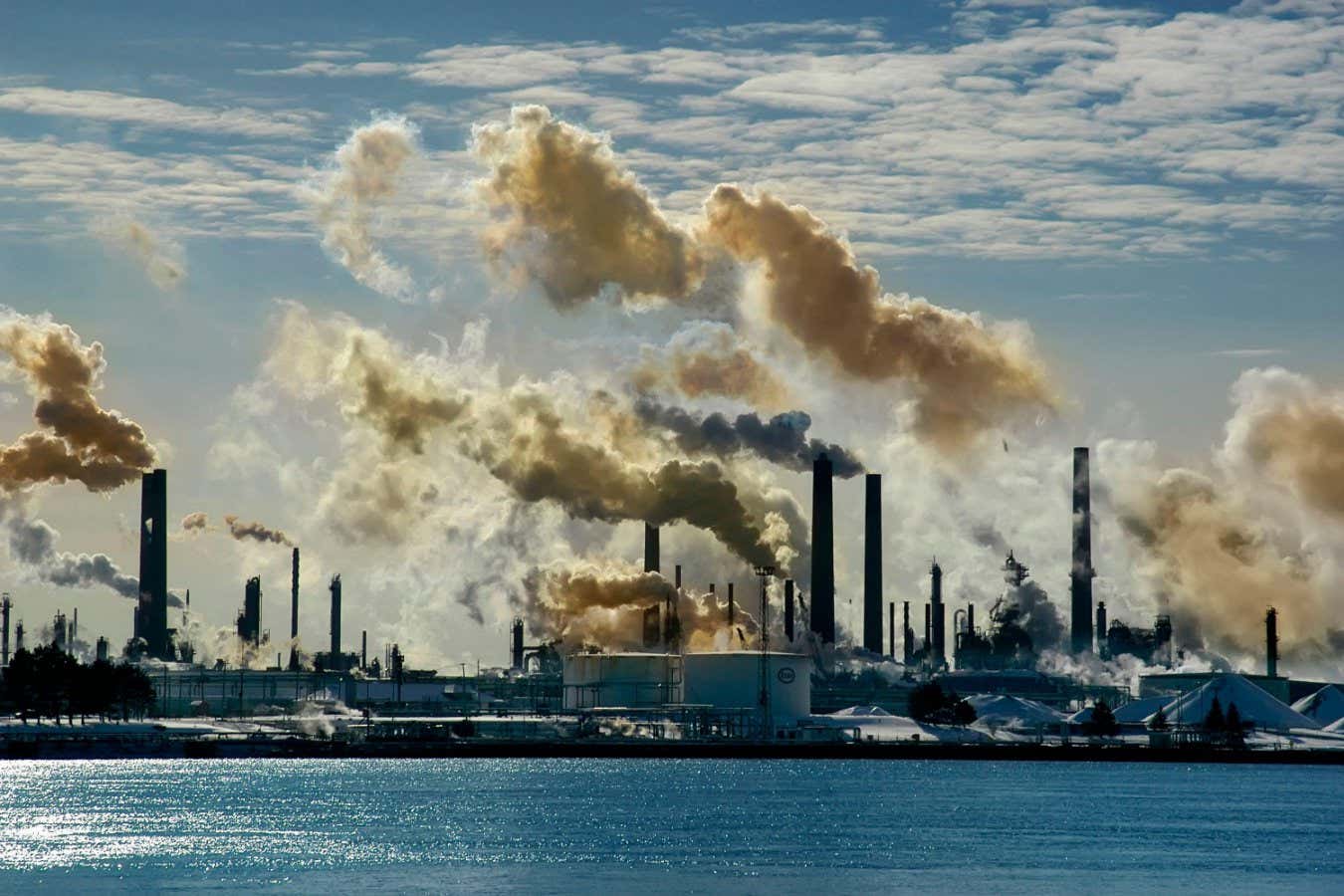
Smog contains particles that reflect the sun’s rays and cool Earth’s surface
Dennis MacDonald/Alamy
Cleaning up air pollution in Europe and North America could result in more weakening of the Atlantic Meridional Overturning Circulation (AMOC), an ocean current that is critical for Europe’s climate.
The smog and soot dirtying the air around the world claim some 7 million lives every year and induce illnesses that affect many others. Yet aerosols – small particles of substances like sulphur dioxide that make up most ground-level pollution – tend to reflect sunlight and brighten clouds, which wards away some of the sun’s heat.
In recent years, research has revealed how cutting air pollution from sources such as shipping has caused global temperatures to rise even faster. “As we reduce aerosols, they’re going to unmask warming,” says Michael Diamond at Florida State University.
To date, scientists’ understanding of how aerosols impact the climate has been limited to running the same kind of global simulations that are used to study the greenhouse effect. These global models have shown “if there’s an increase in aerosol, that cools the surface in the North Atlantic, which strengthens the AMOC,” says Robert Allen at University of California, Riverside, “but if you reduce global aerosol emissions, that warms the surface and weakens the AMOC.”
Yet, those global simulations can’t capture the regional nature of air pollution. Unlike greenhouse gases, which endure in the atmosphere for decades or centuries and end up evenly mixed throughout the atmosphere, most aerosols last less than a week. So the pollution’s impact on weather and climate is felt close to the source, and the same goes for the unintended consequences of eliminating it.
To get a better idea of the effects of clean-air policies, Allen and his colleagues used eight different climate models to understand how regional aerosol emission changes impact the climate locally and remotely. The models calculated the strength of the AMOC under a high-emissions scenario defined by the Intergovernmental Panel on Climate Change, then assessed how the strength changed when the model was run under the same greenhouse gas conditions but with more stringent air-quality controls.
When those clean-air conditions were factored in, the researchers found that by mid-century – if greenhouse gas emissions continue to rise but aerosol pollutants fall – the magnitude of the AMOC weakening would be a third larger than if skylines stayed gritty.
Though Allen and his colleagues didn’t assess the ramifications this weakening would have on regional weather patterns, previous studies have shown that a collapse of the AMOC could worsen drought throughout Europe, worsen sea-level rise in the north-east of North America, disrupt monsoons around the globe and cause temperatures in northern Europe to plummet.
Looking at aerosol emissions on a region-by-region basis, Allen’s team found that the impact on the AMOC was, unsurprisingly, greatest when aerosols were eliminated from Europe and North America. Allen was, however, surprised to discover that pollution clean-up campaigns as far away as East Asia – where aggressive clean-air measures have already impacted planetary temperatures – can weaken the AMOC as well because, as short-lived as aerosols are, they still manage to drift long distances and mask warming wherever they reach.
“If we want to clean up the air and improve air quality, there’s a climate penalty associated with that,” says Allen. “So if we want to clean up the air but minimise that climate penalty, we have to simultaneously reduce other warming agents, such as CO2 and methane.”
Diamond echoes this view. “It’s really important when we’re thinking about these clean-air policies to be thinking about decarbonisation policies at the same time,” he says.
Topics: