

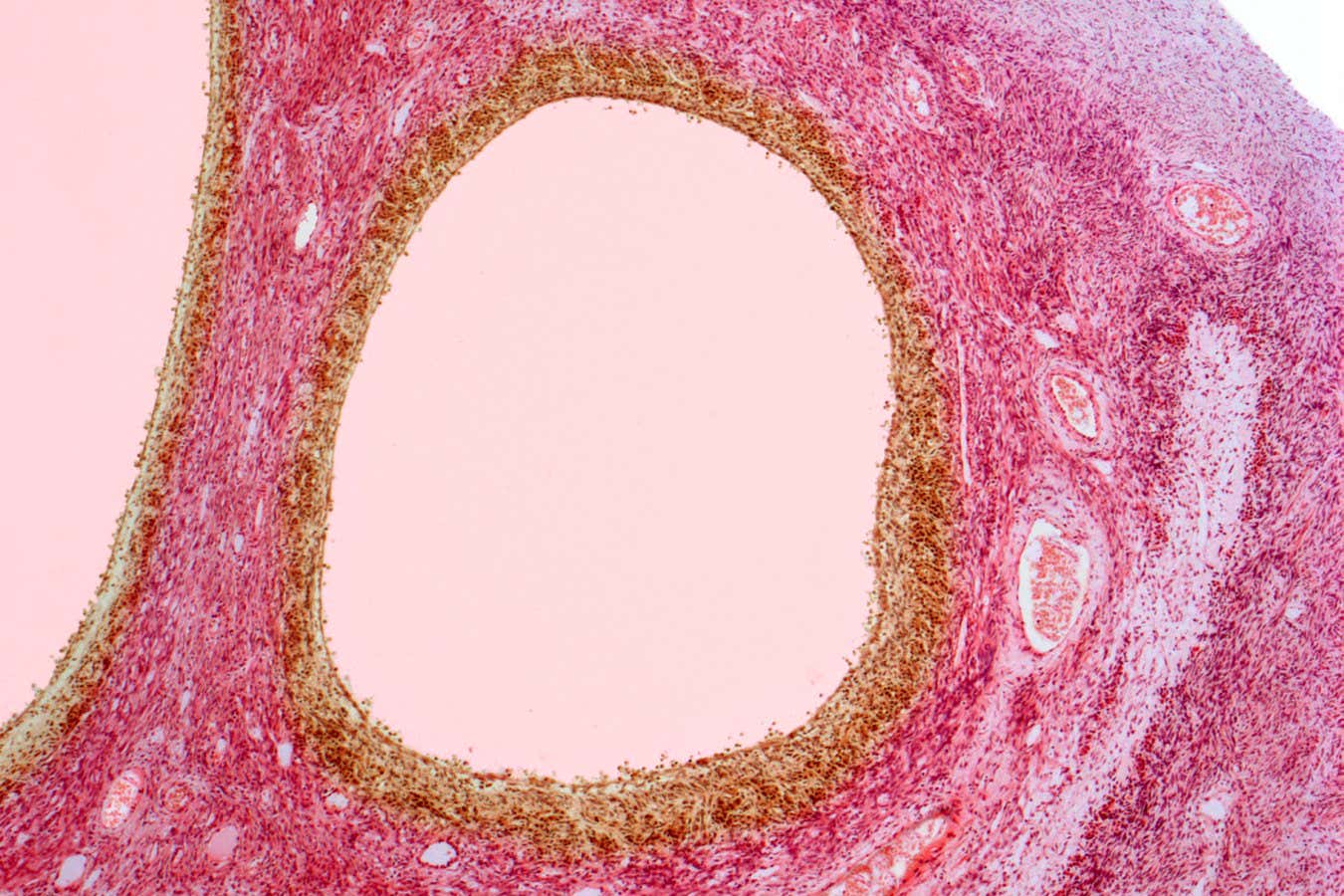
The “cysts” (light pink) seen in polycystic ovary syndrome aren’t really cysts at all
STEVE GSCHMEISSNER/SCIENCE PHOTO LIBRARY
Polycystic ovary syndrome (PCOS) has finally got a new name. Today at the European Congress of Endocrinology in Prague, Czech Republic, endocrinologist Helena Teede announced it will now be known as polyendocrine metabolic ovarian syndrome (PMOS).
This might not sound like much of a change, but it is a boon for those of us with the condition. For one, it addresses a huge misconception about how the ovaries are affected. It also draws much-needed attention to the metabolic and hormonal dimensions of the condition that have nothing to do with our ovaries.
Things have changed enormously since I was diagnosed with PCOS more than two decades ago, in my late teens. I had terrible acne and irregular periods, two common symptoms, and was sent for an ultrasound to investigate. I was appalled to see my ovaries covered in dark spots, so-called “cysts”. I was told I might not be able to have children, and that there was a risk the cysts would burst and require emergency surgery. I was bewildered and devastated.
It was only when I started looking into emerging PCOS/PMOS research for New Scientist that I realised how mischaracterised it had been. I first wrote about the condition in 2018 and it was the most-read article I have ever produced, which told me I wasn’t alone in wanting to understand it better.
The biggest myth that has been busted is the “polycystic ovary” part of PCOS. It turns out those dark spots aren’t cysts at all, nor are they at risk of bursting. Instead, they are eggs that have been unable to mature fully and be released via ovulation. The reason they get stuck at a midway point in their development seems to be because those affected have an overabundance of eggs in their ovaries, making it difficult for each one to grow and squeeze its way out of the crowd. I find this a much nicer way to think about my ovaries – that they are brimming with eggs, rather than riddled with cysts.
Because this crowding disrupts egg development and ovulation, it can cause irregular or absent periods. It can also take longer to become pregnant, because eggs are released less often for potential fertilisation. However, research shows that women with the condition are just as likely to ultimately have their desired family size as those without it, and 80 per cent conceive without medication or IVF. After years worrying that I wouldn’t be able to have a family, I had the three children I wanted, although I did have five miscarriages along the way, which may have been related to my hormonal imbalances.
Another important development is the understanding that the condition affects the whole body, not just the ovaries. It is characterised by high levels of male sex hormones like testosterone, which can cause acne, excess hair on the face and body, and thinning hair on the head. Insulin resistance is also common and can lead to weight gain, type 2 diabetes, high blood pressure and heart disease. Anxiety and depression may emerge too.
On the other hand, there may be some benefits after the age of 40. A recent study found that the higher egg reserve in those with the condition can delay perimenopause and menopause, which is good news, because later menopause is associated with living longer. It may also allow pregnancies at older ages.
Terhi Piltonen at Oulu University Hospital in Finland, who is president of the International Androgen Excess and Polycystic Ovary Syndrome Society, told me that the reason why the condition is so common – occurring in about 1 in 8 women – may be that it had evolutionary benefits for our ancestors. When food resources were scarcer and childbirth more dangerous, there may have been advantages to being able to store energy as extra weight, have longer gaps between pregnancies and continue reproducing at older ages.
Now that we have an oversupply of energy-dense foods and childbirth is safer, the condition tends to come with more problems than benefits. But we also have tools for managing most of the symptoms, which is why it is important that they are accessed. For a long time, the primary focus on the ovaries has meant that help is often sought only for fertility challenges, but the renaming of the condition will hopefully widen this out.
Teede – who works at Monash University in Melbourne, Australia – has spent 14 years leading the campaign for a new name and has worked with 56 patient and professional organisations to come up with one that is scientifically accurate and easy to implement. If it lessens some of the confusion and worry that has often accompanied diagnoses in the past, all the hard work will have been worth it.
Topics: