

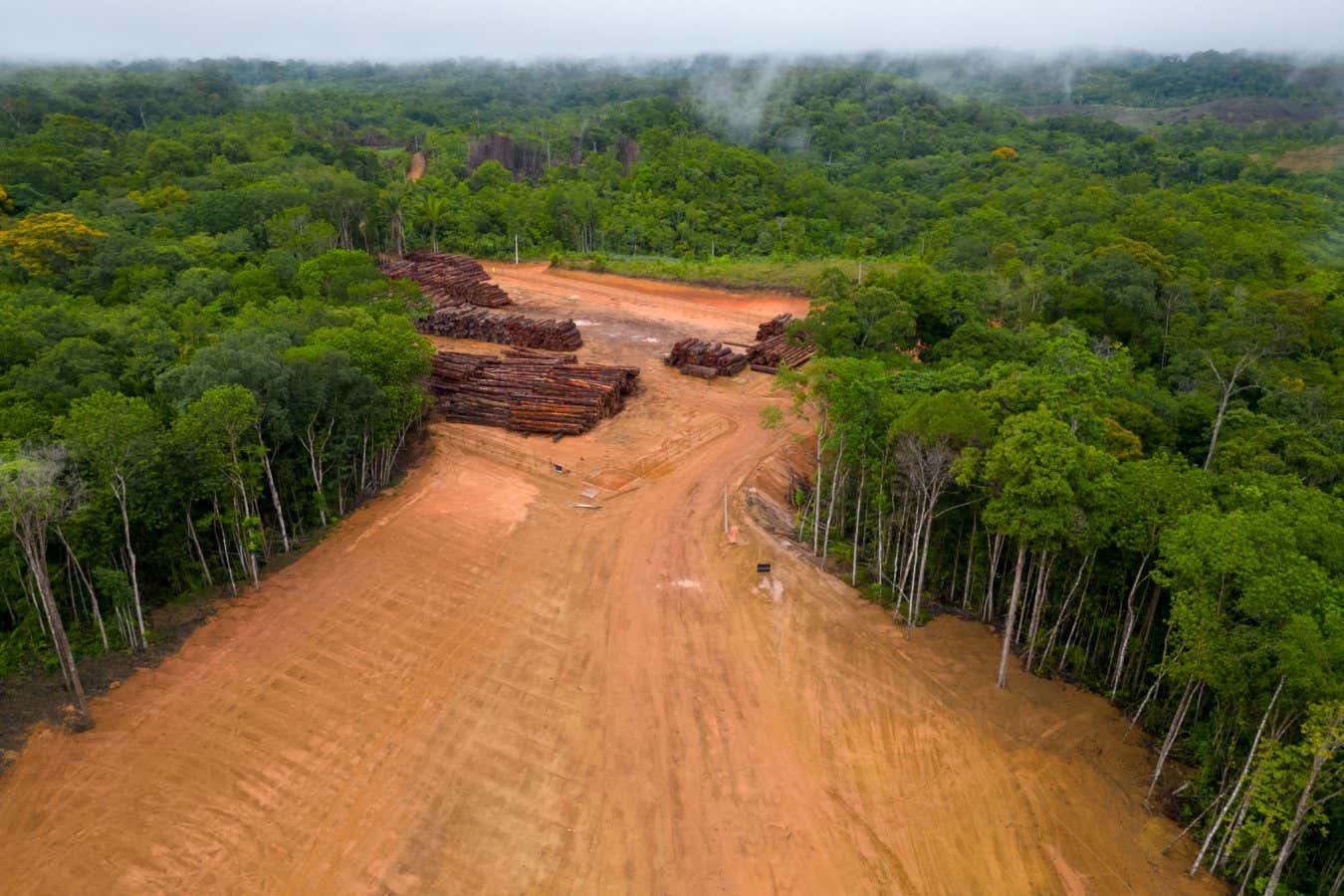
A logging yard in the Amazon rainforest
Tarcisio Schnaider/Getty Images
In 1986, an energy CEO heard a briefing about climate change and felt guilty that his company was building a coal-fired power plant in Connecticut. The company eventually paid to plant trees for timber in Guatemala so farmers would stop cutting down intact forest, in theory compensating for the coal plant’s carbon emissions.
The idea would develop into markets that allow companies to offset their emissions by buying “voluntary” carbon credits that help avoid deforestation, among other measures. Advocates say land users should be paid to leave a forest standing. Critics say maybe the land users weren’t going to cut down the forest anyway.
So who’s right? Both, according to a growing body of research. Last month, one of the most rigorous studies yet found that most early projects did successfully reduce deforestation. But they sold credits for almost 11 times more forest on average than they actually saved.
Historically, forests have absorbed about half of humanity’s fossil fuel emissions, and tropical forests are particularly important, holding back global warming by about 1°C. But they are mainly in lower-income countries that are rapidly clearing trees to expand agriculture like cattle ranching and palm oil plantations.
“Forests are seriously under threat, and they do need financial mechanisms that can pay for them,” says Tom Swinfield at the University of Cambridge, who led the study. “Carbon finance is one of the best of a bad set of options for protecting forests.”
Although tropical forest loss slowed in 2025, more than 40,000 square kilometres of trees were still cut or burned. A gap of $216 billion per year of additional financing must be filled to achieve a global goal of halting deforestation by 2030.
Before the COP30 climate summit last November, Brazil launched the Tropical Forests Forever Facility, an investment fund that will pay its returns to countries for each hectare of forest they leave standing. But only $6.6 billion has been donated towards its $125 billion goal.
Carbon credits have been failing to live up to their promise as an answer to the shortfall in government funding. A 2023 investigation by The Guardian, Die Zeit and SourceMaterial found that 90 per cent of rainforest credits issued by the largest credit certifier were largely worthless. As a result of that and other research, the market value of voluntary credits collapsed by 60 per cent that year and, for the most part, never recovered.
In response, Swinfield and his colleagues analysed 44 projects started after United Nations guidelines for reducing emissions from deforestation and forest degradation (REDD+) were developed in the 2010s. Thirty-six of them resulted in at least slightly less deforestation than would have been expected if the project didn’t exist, and only one resulted in significantly more deforestation.
At the same time, only about 1/11th of the credits were justified. But that average was inflated by the eight projects that didn’t reduce deforestation, which also issued the largest number of credits. Excluding the nine top credit sellers, about one-quarter of credits were legitimate.
The over-crediting was largely caused by two main errors, which may have been unintentional, says Swinfield. To estimate how much forest in a project area would have been cut down if it hadn’t been protected, credit developers looked at how much had already been chopped down in a similar, unprotected “reference area”. They then modelled how much more deforestation might occur in the future on top of this.
But developers selected reference areas that were more exposed to deforestation because they were closer to a road or on gentler terrain. And they tended to pick the worst-case scenario for future deforestation, rather than a more likely middle-of-the-road one.
The study cited a project in the Amazon rainforest in Peru designed to create an alternative income source to slash-and-burn agriculture for 18 local communities. The French company that developed it selected a patch of rainforest around the project area as the reference area. But this reference area was on average lower, less steep, less heavily forested and about half as far from the nearest road, meaning it was likely to suffer greater deforestation than the project area in any case.
“Many of these projects may have been good, but the methods used to work out how much credit should have been generated were often bad,” says Swinfield.
If developers, credit certifiers and ratings agencies hold projects to the more accurate methodology outlined in the research, it would cut down on over-crediting. But it would also increase the price of carbon credits, since there would be fewer credits, and development costs would be higher. So companies should also pay more for carbon credits if they want to claim to have net-zero emissions, says Swinfield’s collaborator Julia Jones at Bangor University, UK.
“The era of companies being able to offset their carbon emissions by buying really cheap emissions [credits] that claim to slow deforestation in poor countries, I think that is over,” she says. “You can’t deliver equitable and effective forest conservation for a low price.”
An avoided deforestation credit, which is supposed to represent 1 tonne of avoided CO2 emissions, can still be purchased for as little as a few dollars. From high-quality projects, it can cost tens of dollars.
Meanwhile, a different type of credit for actively removing carbon from the atmosphere, either through tree planting or novel techniques like direct air capture machines, costs hundreds of dollars at least.
“There needs to be a market for high-quality carbon credits that genuinely do what they say on the tin in terms of avoided deforestation,” says Jones.
While avoided deforestation credits do prevent some emissions, as the study shows, they are incompatible with the Paris Agreement goal of reaching net-zero emissions, says Danny Cullenward at the University of Pennsylvania. That’s because companies are buying them to offset rather than actually reduce their emissions.
If they truly wanted to help forests and the climate, they would buy high-quality credits and not “retire” them against their emissions budget, says Cullenward. Or they would simply donate funds to forest conservation. Either way, it is important to quantify deforestation risk more accurately.
“We need to protect tropical forests, and if we know how to measure impact, we can pay for and quantify those benefits without making an offsetting claim,” he says. “We can do so with or without carbon credits.”
Topics: