

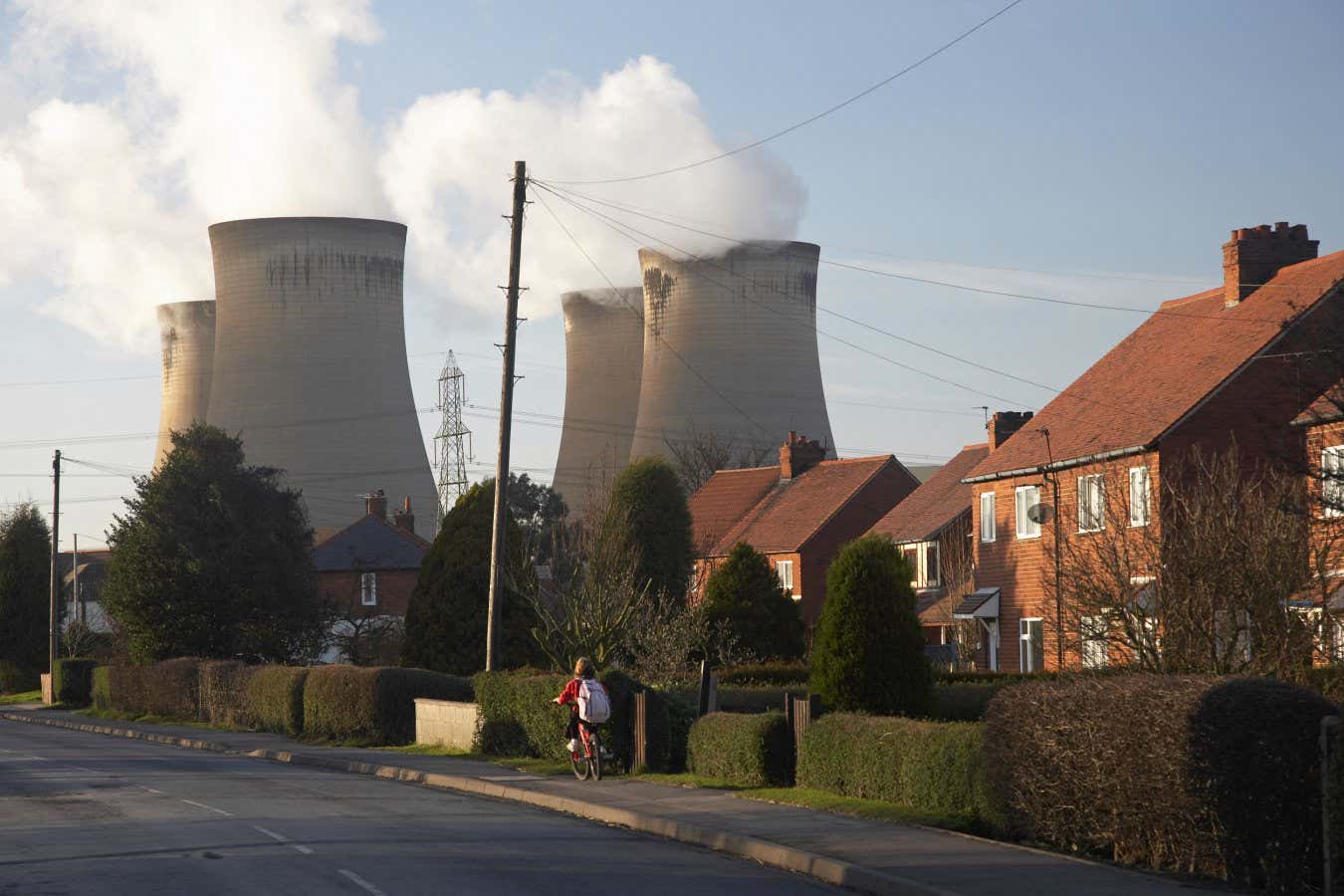
The Drax Power Station in the north of England
Ian Lamond/Alamy
You’ve probably seen those nice graphs showing carbon dioxide levels and temperatures falling towards the end of the century. How is this miracle meant to be achieved? The idea is that we harvest plants, burn them for energy and then capture and store the CO2. Voila, problem solved!
Except bioenergy with carbon capture and storage, or BECCS, as this idea is known, is turning out to be an unmitigated disaster. It isn’t being rolled out on anything like the scale required, in part because it’s ridiculously expensive, would be catastrophic for biodiversity if it was done on this scale and, last but far from least, it doesn’t even work. It actually increases CO2 emissions rather than reducing them on the timescales that matter.
As Leo Hickman at CarbonBrief has documented, BECCS was first proposed in 2001 by researchers in Sweden thinking about how paper mills there might be able to earn carbon credits. In 2005, a few climate modellers seized on this entirely theoretical idea as a way to justify scenarios in which global temperatures come back down after overshooting 1.5°C. In 2014, climate models that assumed vast amounts of carbon could be removed with BECCS were highlighted in the fifth report of the Intergovernmental Panel on Climate Change (IPCC). A nonexistent technology had somehow become the “official solution” that was going to save the world.
For a time, it looked as if it might become a reality. In 2015, the Drax energy company in the UK announced that a huge coal power plant would be converted to run on wood pellets, and the CO2 captured and stored.
A decade later, the Drax plant is burning wood pellets but isn’t capturing any carbon. In fact, as Politico reported earlier this month, the company has now shelved its plans to do so. So the world’s flagship project for bioenergy with carbon capture and storage is now dead – or at least in intensive care. “We still see BECCS as a potential option for the site, but it’s much more longer-term than we initially planned,” says a spokesperson for Drax.
There are a few other, smaller projects planned around the world but it’s clear that BECCS is not taking off in the way envisaged a decade or so ago. And there’s a reason for that – governments are baulking at the massive subsidies required. “It’s phenomenally expensive,” says Tim Searchinger at Princeton University.
It might seem to be a bad thing that we’re not rolling out the technology meant to save us, but it is, in fact, a good thing, because it doesn’t work – at least not on the timescale we need it to. “There are probably unrealistic scenarios where you can get some negative emissions. But they’re not that big, and you’re not getting any benefit for decades,” says Searchinger.
To help convince policy-makers, he and his colleagues are releasing a computer model of the carbon flows involved, so people can play with the numbers themselves. This model suggests it could take 150 years for BECCS to remove any CO2 from the atmosphere, and that for the first few decades it’s worse than burning natural gas without any carbon capture. Oh, and it will triple electricity costs.
Why? Essentially, BECCS turns CO2 already stored in forests into CO2 that can be stored in other ways – perhaps in geological structures below ground – but with lots of that CO2 being lost during the process, and ending up in the atmosphere.
For starters, a lot of forest carbon never reaches power plants – roots get left behind to rot, other vegetation is destroyed during harvesting and so on. This carbon all ends up in the atmosphere.
Burning wood also produces twice as much carbon per unit of energy as burning gas, while lower temperatures mean less of that energy can be turned into electricity. What’s more, capturing carbon is energy-intensive. So power plants would need to burn a lot of extra wood just to power the carbon-capture process – which is likely to capture only around 85 per cent of the CO2 released.
There’s yet another, more subtle problem. Some argue that it’s fine to use wood for purposes such as BECCS as long as carbon is not removed any faster than a forest takes it up. But climate projections assume that many forests are going to take up extra carbon due to the CO2 fertilisation effects – or, in the jargon, that land sinks will continue to grow. So what some see as sustainable harvesting is actually destroying a climate solution we’re already banking on.
These arguments apply to slow-growing trees, and many BECCS scenarios envisaged using fast-growing energy crops like grasses. This could deliver modest benefits if we had lots of spare farmland sitting around doing nothing, but the global picture is that we are still razing rainforests to clear more land for farms to grow food. Clearing a lot more land would be even more catastrophic for biodiversity.
Without BECCS it might be unclear how we get CO2 levels back down, but for now the focus should be on stopping them getting even higher. “We should be accelerating our move toward wind and solar as much as possible,” says Searchinger.
Topics: