
Close Menu
    Trending
    • Pentagon Requests $54 Billion For AI War
    • Clavicular Hit With New YouTube Crackdown
    • Beijing’s new supply chain rules deepen concerns for US firms in China
    • India denounces ‘hellhole’ remark shared by Trump | Donald Trump News
    • New photos of Mike Vrabel and Dianna Russini emerge
    • AI search demands a new audience playbook
    • How do earthquakes end? A seismic ‘stop sign’ could help predict earthquake risk
    • Trump Announces Cease-Fire Between Israel and Lebanon
    Benjamin Franklin Institute
    Friday, April 24
    • Home
    • Politics
    • Business
    • Science
    • Technology
    • Arts & Entertainment
    • International
    Benjamin Franklin Institute
    Home»Latest News»NASA’s Artemis II astronauts splash down on Earth after lunar mission | Science and Technology News
    Latest News

    NASA’s Artemis II astronauts splash down on Earth after lunar mission | Science and Technology News

    Team_Benjamin Franklin InstituteBy Team_Benjamin Franklin InstituteApril 11, 2026No Comments3 Mins Read
    Share Facebook Twitter Pinterest Copy Link LinkedIn Tumblr Email VKontakte Telegram
    Share
    Facebook Twitter Pinterest Email Copy Link


    Published On 11 Apr 202611 Apr 2026

    |

    Updated: 5 minutes agoUpdated: 5 minutes ago

    NASA’s Artemis II astronauts have returned safely to Earth, completing the first crewed mission to travel around the Moon in more than 50 years.

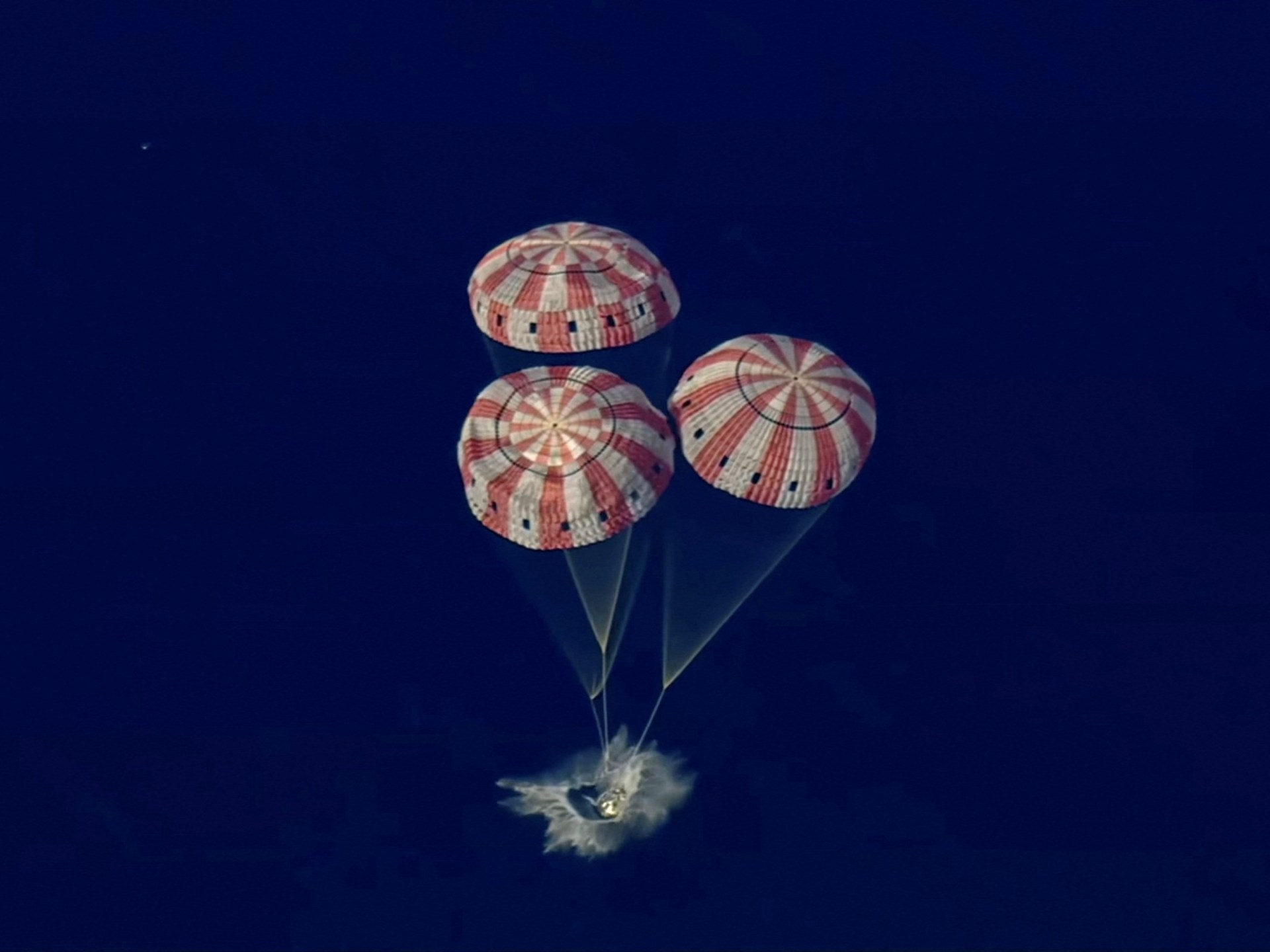
    The Orion spacecraft splashed down in the Pacific Ocean off the coast of California at 5:07pm local time (00:07 GMT) on Friday, following a high-speed re-entry through Earth’s atmosphere.

    Recommended Stories

    list of 3 itemsend of list

    Recovery teams were already in position, moving quickly to secure the capsule and bring the crew aboard.

    On board were NASA astronauts Reid Wiseman, Victor Glover and Christina Koch, along with Canadian astronaut Jeremy Hansen.

    Minutes before re-entry, Wiseman, the mission commander, radioed mission control: “We got a great view of the Moon out window 2 – looks a little smaller than yesterday.”

    “Guess we’ll have to go back,” came the reply from Houston.

    The return marked a crucial test for the Orion spacecraft, built by Lockheed Martin, demonstrating it can safely withstand the intense conditions of a lunar re-entry.

    The capsule endured a dramatic 13-minute descent, slamming into the atmosphere at extreme speed. Temperatures on its exterior climbed to about 2,760 degrees Celsius (5,000 degrees Fahrenheit), hot enough to generate a plasma layer that briefly cut off communications with the crew.

    Contact was restored as parachutes deployed, slowing Orion’s descent before it gently hit the ocean.

    Recovery crews later opened the hatch and began extracting the astronauts, who reported minor communication issues but were otherwise in good condition.

    “We are back in the business of sending astronauts to the moon, bringing them back safely and [are] set up for a series more,” said NASA chief Jared Isaacman from a US Navy recovery ship.

    The four astronauts launched just over a week ago from Kennedy Space Center in Florida, embarking on a 10-day journey that took them farther from Earth than any humans since the Apollo era.

    They travelled around the far side of the Moon, testing systems designed for future missions, before heading back to Earth.

    A new perspective on Earth

    Artemis II is widely seen as a critical test flight for future Moon missions, particularly Artemis IV, which aims to land astronauts on the lunar surface for the first time since the Apollo era.

    Engineers will now analyse key data from the mission, including the performance of the Orion capsule’s heat shield as well as navigation systems and life-support technology, all essential for safely carrying humans deeper into space.

    The return also included one of the most challenging phases of the journey: a brief communication blackout during re-entry, caused by intense heat building up around the spacecraft.

    But on top of its record-setting distance, the mission also marked other historic firsts. Glover became the first person of colour to travel around the moon, Koch the first woman, and Hansen the first non-American.

    During their journey, the crew reported in vivid detail features of the lunar surface and later witnessed a solar eclipse as well as meteorite impacts.

    Mission commander Wiseman reflected that “what we really hoped in our soul is that we could, for just a moment, have the world pause – and remember that this is a beautiful planet in a very special place in our universe”.

    “We should all cherish what we have been gifted.”

    Every morning since the astronauts’ departure, NASA has sent a song to Artemis II to start the day.

    On Friday, the astronauts awoke to the tune of Live’s song Run to the Water and the country hit Free, by Zac Brown Band.

    A handout picture made available by the National Aeronautics and Space Administration (NASA)
    Artemis II Commander Reid Wiseman shares a picture of Earth taken from the Orion spacecraft’s window on April 2, 2026 [EPA/NASA]


    Source link

    Share. Facebook Twitter Pinterest LinkedIn Tumblr Email Telegram Copy Link

    Related Posts

    Latest News

    India denounces ‘hellhole’ remark shared by Trump | Donald Trump News

    April 24, 2026
    Latest News

    China’s DeepSeek unveils latest models a year after upending global tech | Technology News

    April 24, 2026
    Latest News

    US professors sue university over arrest during pro-Palestine protest | Israel-Palestine conflict News

    April 24, 2026
    Latest News

    Meta lines up layoffs while Microsoft offers buyouts | Business and Economy News

    April 23, 2026
    Latest News

    US Senate passes ICE funding resolution after ‘vote-a-rama’: What’s next? | Donald Trump News

    April 23, 2026
    Latest News

    Turkiye MPs pass bill to restrict social media use for children under 15 | News

    April 23, 2026
    Editors Picks

    How to See the First Fiery Meteor Shower of 2026

    January 4, 2026

    ‘You cannot annex another country’: Denmark PM to US on Greenland | Donald Trump News

    April 4, 2025

    Indeed CEO says this—not AI—is the biggest threat to the workforce

    April 18, 2026

    Falcons’ Kirk Cousins move will make divorce a lot easier

    January 8, 2026

    Qatar says Iran’s attacks on neighbours crossed ‘many red lines’ | US-Israel war on Iran News

    March 31, 2026
    About Us
    About Us

    Welcome to Benjamin Franklin Institute, your premier destination for insightful, engaging, and diverse Political News and Opinions.

    The Benjamin Franklin Institute supports free speech, the U.S. Constitution and political candidates and organizations that promote and protect both of these important features of the American Experiment.

    We are passionate about delivering high-quality, accurate, and engaging content that resonates with our readers. Sign up for our text alerts and email newsletter to stay informed.

    Latest Posts

    Pentagon Requests $54 Billion For AI War

    April 24, 2026

    Clavicular Hit With New YouTube Crackdown

    April 24, 2026

    Beijing’s new supply chain rules deepen concerns for US firms in China

    April 24, 2026

    Subscribe for Updates

    Stay informed by signing up for our free news alerts.

    Paid for by the Benjamin Franklin Institute. Not authorized by any candidate or candidate’s committee.
    • Privacy Policy
    • About us
    • Contact us

    Type above and press Enter to search. Press Esc to cancel.