
Close Menu
    Trending
    • When is London Marathon 2026? Start time and how to watch race for FREE
    • Pentagon Requests $54 Billion For AI War
    • Clavicular Hit With New YouTube Crackdown
    • Beijing’s new supply chain rules deepen concerns for US firms in China
    • India denounces ‘hellhole’ remark shared by Trump | Donald Trump News
    • New photos of Mike Vrabel and Dianna Russini emerge
    • AI search demands a new audience playbook
    • How do earthquakes end? A seismic ‘stop sign’ could help predict earthquake risk
    Benjamin Franklin Institute
    Friday, April 24
    • Home
    • Politics
    • Business
    • Science
    • Technology
    • Arts & Entertainment
    • International
    Benjamin Franklin Institute
    Home»Science»Bumblebees surprise scientists by showing a sense of rhythm
    Science

    Bumblebees surprise scientists by showing a sense of rhythm

    Team_Benjamin Franklin InstituteBy Team_Benjamin Franklin InstituteApril 3, 2026No Comments3 Mins Read
    Share Facebook Twitter Pinterest Copy Link LinkedIn Tumblr Email VKontakte Telegram
    Share
    Facebook Twitter Pinterest Email Copy Link


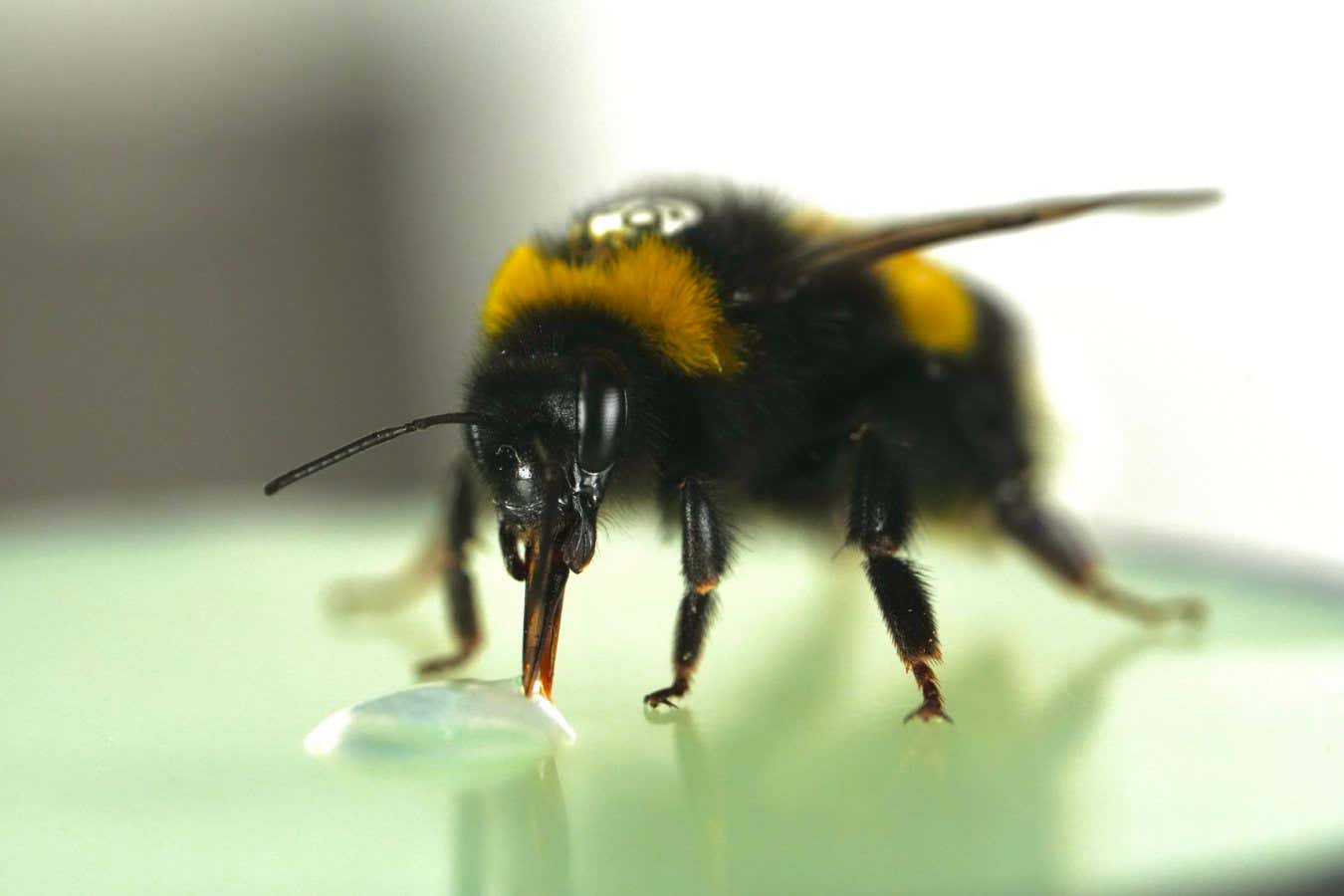
    A buff-tailed bumblebee on an artificial flower

    Bee lab at Southern Medical University

    Bumblebees have learned to recognise Morse code-like sequences of flashing lights and vibrations, demonstrating a sense of rhythm that has never been seen in such a small-brained animal.

    The ability to recognise flexible, abstract rhythms – when, for example, the same pattern or melody is played at a different tempo in different ways – has only been demonstrated in a few birds and mammals, including parrots, songbirds and primates like chimpanzees.

    Andrew Barron at Macquarie University in Sydney, Australia, and his colleagues ran a series of experiments to try to determine whether buff-tailed bumblebees (Bombus terrestris), which have far less complex brains, could also recognise a range of different rhythms.

    In the first experiment, bumblebees learned to choose between two artificial flowers consisting of flashing LED lights. One flower produced long flashes and the other short pulses, like dashes and dots in Morse code. One flower contained a reward – sucrose – and the other unpalatable quinine.

    Once the bees had learned to distinguish between the flashing flowers offering reward and punishment, they were tested with flowers filled only with water. Almost all the bees still chose the flower producing the type of flash that previously contained sucrose.

    Next, the scientists increased the complexity of the light stimuli, with each flower emanating a different flash pattern – either dash dash dot dot or dot dash dot dash. The bees could still distinguish between them.

    But then came the truly “remarkable” result, says Barron. The artificial flowers were replaced with a maze, and at the junction between two branches, there was a vibrating floor.

    “If it was vibrating dot dash dot dash, it meant turn right to get sugar,” says Barron. “So, one rhythm indicated to turn left, one rhythm indicated turn right, and we trained them like that. We showed they could learn that.”

    Finally, with no more training of the bees, the scientists replaced the vibrating floor with LED lights flashing in the same pattern as this floor. “Not all of them got it, but the population overall showed that they were able to transfer the task from vibration into light pulses,” says Barron.

    In other words, the bees could recognise a pattern independently of how it was presented. Whether it was light flashes or vibration pulses, they recognised the rhythms.

    Until now, abstract rhythmic recognition was thought to require a big brain, says Barron. Understanding how bees do this with tiny brains could revolutionise the way that miniature drones and other small, autonomous devices interpret the world, he says.

    “I think what this work is showing is there’s got to be a simpler trick,” says Barron. “That an organism like a bee, with a bee-type brain, is able to abstract a rhythm is remarkable.”

    Topics:


    Source link

    Share. Facebook Twitter Pinterest LinkedIn Tumblr Email Telegram Copy Link

    Related Posts

    Science

    How do earthquakes end? A seismic ‘stop sign’ could help predict earthquake risk

    April 24, 2026
    Science

    ‘Kraken’ fossils show enormous, intelligent octopuses were top predators in Cretaceous seas

    April 24, 2026
    Science

    Largest ever octopus was great white shark of invertebrate predators

    April 24, 2026
    Science

    Do you need to worry about Mythos, Anthropic’s computer-hacking AI?

    April 23, 2026
    Science

    How many dachshunds would it take to get to the moon?

    April 23, 2026
    Science

    The Age Code review: Can you slow ageing with your diet? A new book gives it a go

    April 23, 2026
    Editors Picks

    Sports merch that’s cute? It exists

    April 20, 2026

    CNA Explains: How the Iran war might reshape Asia’s energy playbook

    April 3, 2026

    Common type of inflammatory bowel disease linked to toxic bacteria

    November 21, 2025

    Epstein sought help of ex-Russian official linked to FSB, files show | Business and Economy News

    February 12, 2026

    Opinion | The Empty Propaganda of ‘Melania’

    February 6, 2026
    About Us
    About Us

    Welcome to Benjamin Franklin Institute, your premier destination for insightful, engaging, and diverse Political News and Opinions.

    The Benjamin Franklin Institute supports free speech, the U.S. Constitution and political candidates and organizations that promote and protect both of these important features of the American Experiment.

    We are passionate about delivering high-quality, accurate, and engaging content that resonates with our readers. Sign up for our text alerts and email newsletter to stay informed.

    Latest Posts

    When is London Marathon 2026? Start time and how to watch race for FREE

    April 24, 2026

    Pentagon Requests $54 Billion For AI War

    April 24, 2026

    Clavicular Hit With New YouTube Crackdown

    April 24, 2026

    Subscribe for Updates

    Stay informed by signing up for our free news alerts.

    Paid for by the Benjamin Franklin Institute. Not authorized by any candidate or candidate’s committee.
    • Privacy Policy
    • About us
    • Contact us

    Type above and press Enter to search. Press Esc to cancel.