
Close Menu
    Trending
    • Negotiations that enable Israel’s land-grabs | Israel-Palestine conflict
    • True-or-false for Round 1 of 2026 NFL Draft: Will Cowboys regret their trade?
    • Opinion | Stewart Brand, Silicon Valley’s Favorite Prophet, on Life’s Most Important Principle
    • Struggling to scale your company? Here are five things that could be holding you back
    • What happens if you’re hit by a primordial black hole?
    • When is London Marathon 2026? Start time and how to watch race for FREE
    • Pentagon Requests $54 Billion For AI War
    • Clavicular Hit With New YouTube Crackdown
    Benjamin Franklin Institute
    Friday, April 24
    • Home
    • Politics
    • Business
    • Science
    • Technology
    • Arts & Entertainment
    • International
    Benjamin Franklin Institute
    Home»Science»Historic Artemis II launch sends astronauts bound for the moon
    Science

    Historic Artemis II launch sends astronauts bound for the moon

    Team_Benjamin Franklin InstituteBy Team_Benjamin Franklin InstituteApril 2, 2026No Comments3 Mins Read
    Share Facebook Twitter Pinterest Copy Link LinkedIn Tumblr Email VKontakte Telegram
    Share
    Facebook Twitter Pinterest Email Copy Link


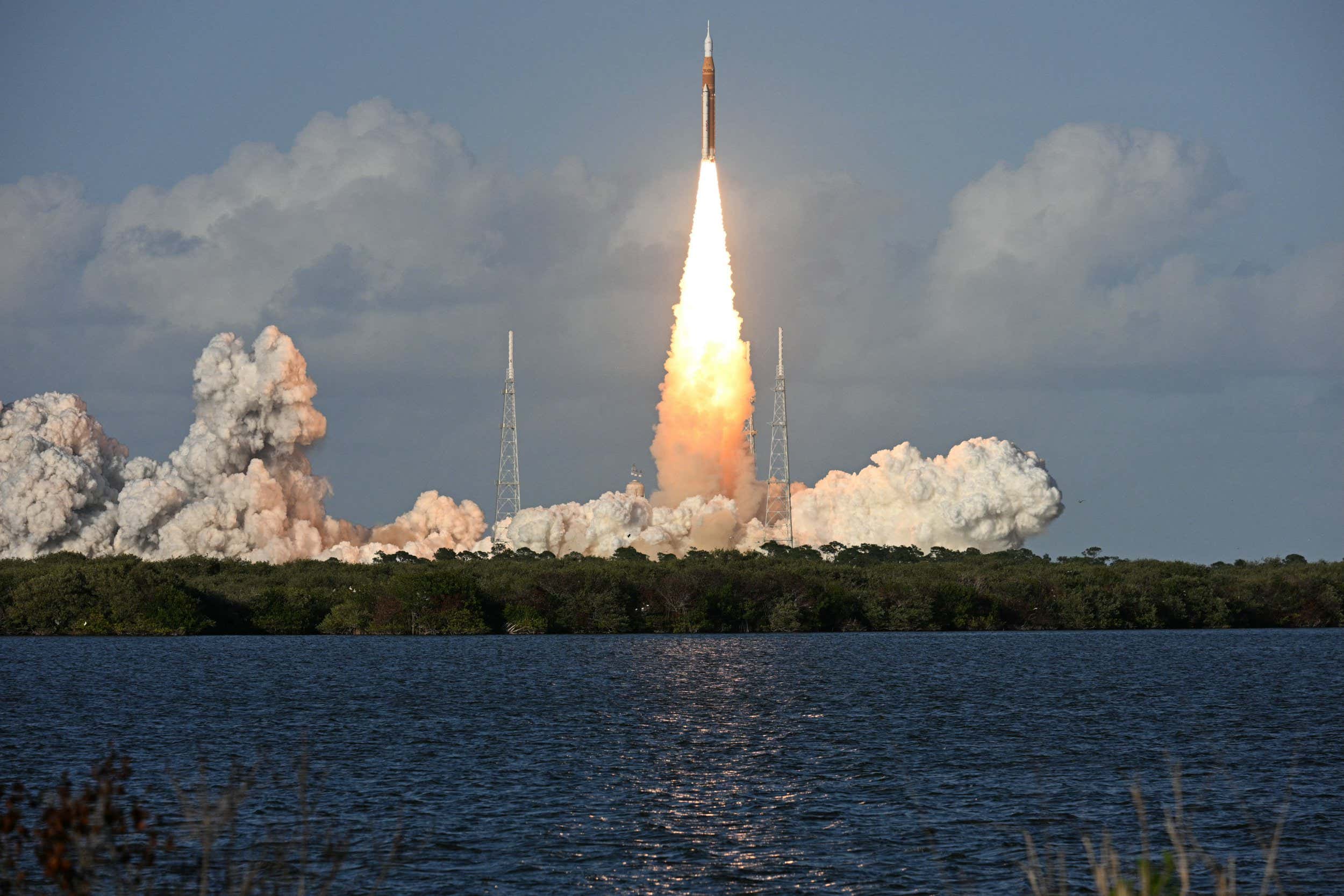
    The Artemis II mission launched from Kennedy Space Center in Cape Canaveral, Florida

    AFP via Getty Images

    The first crewed mission to the moon since the Apollo programme ended in 1972 is on its way. The Artemis II mission launched from Cape Canaveral, Florida on 1 April, and if all goes well, the four astronauts aboard will soon fly further than any humans have ever been from Earth.

    This marks only the second flight for NASA’s Space Launch System rocket and its Orion crew capsule, and its first crewed flight. The previous launch in 2022 was for the uncrewed Artemis I mission, which took a loop around the moon similar to the trajectory that is planned for Artemis II.

    Now that the rocket is launched, the NASA crew members Reid Wiseman, Victor Glover and Christina Koch, and Canadian astronaut Jeremy Hansen, will spend the first two days of their mission orbiting Earth and performing tests on the spacecraft itself. The most involved of these tests will be piloting Orion to dock with an older craft in orbit. For most of the flight and future flights, the capsule will steer itself autonomously, but for the docking procedure, the astronauts will be in control.

    “You’re not always going to manually dock, but you may need to manually stop a docking that’s not going well,” Glover said in a 29 March press conference. “Even if we don’t do the operation by hand [in the future], we need to be able to stop it.”

    After that, Orion will travel in a loop around the moon. At its most distant, it will be about 402,000 kilometres from Earth, beating the record set by the Apollo 13 astronauts in 1970. It will get as close as 6513 kilometres from the lunar surface, allowing the astronauts to see parts of the moon that have never been seen by human eyes before because of the light conditions during the Apollo flights.

    The mission will last about 10 days in total before the Orion capsule returns to Earth. If everything goes smoothly, the next mission, Artemis III, will be in 2027. Until recently, that was intended to be a lunar landing, but it will now remain in orbit around Earth to test the docking system with the lunar lander or landers that will finally carry astronauts to the moon’s surface. This is now planned to happen in the Artemis IV mission in 2028.

    “Our motto from day one has been ‘Help Artemis III succeed’,” said Wiseman in the press conference. All of these missions together are in preparation for a permanent moon base, which NASA officials hope will enable a sustained human presence on the moon for decades to come.

    “It is our strong hope that this mission is the start of an era where everyone, every person on Earth, can look at the moon and see it also as a destination [rather than some distant rock in the sky],” said Koch.

    Topics:


    Source link

    Share. Facebook Twitter Pinterest LinkedIn Tumblr Email Telegram Copy Link

    Related Posts

    Science

    What happens if you’re hit by a primordial black hole?

    April 24, 2026
    Science

    How do earthquakes end? A seismic ‘stop sign’ could help predict earthquake risk

    April 24, 2026
    Science

    ‘Kraken’ fossils show enormous, intelligent octopuses were top predators in Cretaceous seas

    April 24, 2026
    Science

    Largest ever octopus was great white shark of invertebrate predators

    April 24, 2026
    Science

    Do you need to worry about Mythos, Anthropic’s computer-hacking AI?

    April 23, 2026
    Science

    How many dachshunds would it take to get to the moon?

    April 23, 2026
    Editors Picks

    Raising Cane’s CEO reveals he excludes this menu item from his order

    April 4, 2026

    Two teams that make sense for Tyreek Hill

    April 3, 2026

    France and Other World Leaders Recognize Palestinian Statehood

    September 23, 2025

    Indonesia searches for missing plane with at least 10 on board | Transport News

    January 17, 2026

    Roki Sasaki makes unusual request of his MLB suitors

    December 31, 2024
    About Us
    About Us

    Welcome to Benjamin Franklin Institute, your premier destination for insightful, engaging, and diverse Political News and Opinions.

    The Benjamin Franklin Institute supports free speech, the U.S. Constitution and political candidates and organizations that promote and protect both of these important features of the American Experiment.

    We are passionate about delivering high-quality, accurate, and engaging content that resonates with our readers. Sign up for our text alerts and email newsletter to stay informed.

    Latest Posts

    Negotiations that enable Israel’s land-grabs | Israel-Palestine conflict

    April 24, 2026

    True-or-false for Round 1 of 2026 NFL Draft: Will Cowboys regret their trade?

    April 24, 2026

    Opinion | Stewart Brand, Silicon Valley’s Favorite Prophet, on Life’s Most Important Principle

    April 24, 2026

    Subscribe for Updates

    Stay informed by signing up for our free news alerts.

    Paid for by the Benjamin Franklin Institute. Not authorized by any candidate or candidate’s committee.
    • Privacy Policy
    • About us
    • Contact us

    Type above and press Enter to search. Press Esc to cancel.