
Close Menu
    Trending
    • May 2026 Live Webinar Series
    • Damson Idris Says Messi Made Him Quit Soccer
    • Netanyahu says he was successfully treated for prostate cancer
    • Negotiations that enable Israel’s land-grabs | Israel-Palestine conflict
    • True-or-false for Round 1 of 2026 NFL Draft: Will Cowboys regret their trade?
    • Opinion | Stewart Brand, Silicon Valley’s Favorite Prophet, on Life’s Most Important Principle
    • Struggling to scale your company? Here are five things that could be holding you back
    • What happens if you’re hit by a primordial black hole?
    Benjamin Franklin Institute
    Friday, April 24
    • Home
    • Politics
    • Business
    • Science
    • Technology
    • Arts & Entertainment
    • International
    Benjamin Franklin Institute
    Home»Science»Temperature gets a new definition using a quantum device
    Science

    Temperature gets a new definition using a quantum device

    Team_Benjamin Franklin InstituteBy Team_Benjamin Franklin InstituteMarch 27, 2026No Comments3 Mins Read
    Share Facebook Twitter Pinterest Copy Link LinkedIn Tumblr Email VKontakte Telegram
    Share
    Facebook Twitter Pinterest Email Copy Link


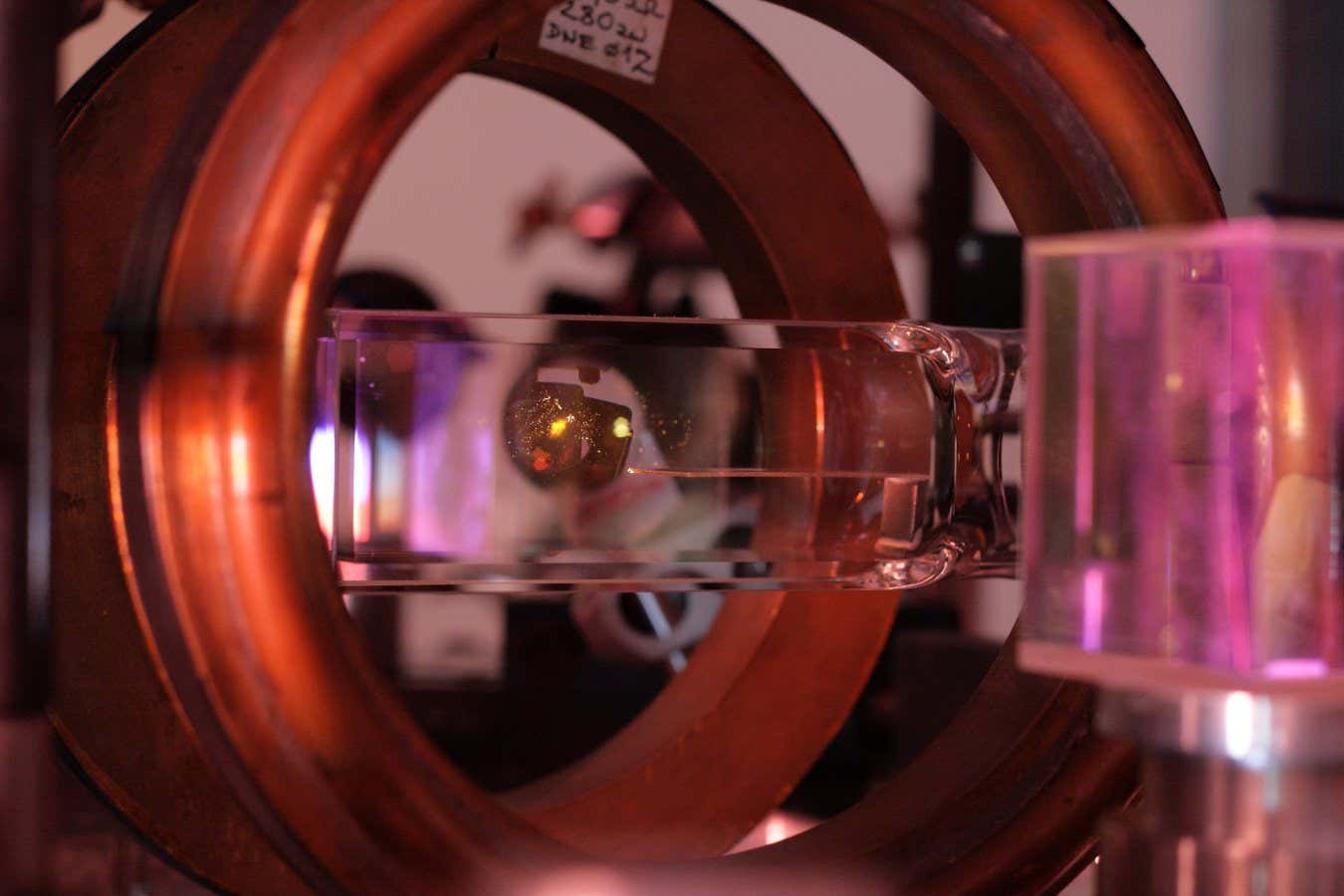
    The main part of the new set-up for cooling and trapping rubidium atoms

    Tomasz Kawalec CC BY-SA 4.0

    A better, more reliable definition of temperature could come from a quantum device full of giant atoms.

    While some countries measure temperatures in Celsius and others use Fahrenheit, physicists everywhere use a unit called kelvin. Zero kelvin denotes the absolute coldest temperature allowed by the known laws of physics, so kelvin is said to measure “absolute temperature”. In practice, however, making sure that when you measure a single kelvin, it really is a single kelvin is a laborious process.

    “If you want to make an absolute temperature measurement, you buy a commercial temperature sensor, which was calibrated by another commercial temperature sensor, which was calibrated by another commercial temperature sensor, and so on. And one of those sensors was, at some point, sent to the National Institute of Standards [and Technology],” says Noah Schlossberger at NIST in Colorado.

    He and his colleagues have now built a device that uses quantum effects to measure kelvin, which researchers could use instead of having to get someone else to calibrate their sensors.

    The device is a small box made from metal and glass containing trapped rubidium atoms. The researchers push these atoms to an extreme size, using lasers to move the outermost electrons unusually far from the nucleus, and to an extreme temperature by using both lasers and electromagnetic fields to grab onto and chill the atoms to about half a millikelvin, a temperature roughly a 600,00th that of room temperature.

    As a result, the outermost electrons in the rubidium atoms become extremely sensitive to even a small increase in temperature and “jump” into a different quantum state when exposed to one. These jumps are what makes the device a great temperature sensor, because there are well-established mathematical models that can determine the temperature differences needed to make them – effectively allowing for a redefinition of kelvin in these terms.

    The International Bureau of Weights and Measures defines the kelvin in a similar way – as a product of several quantum constants – but, in practice, even institutions like NIST use non-quantum devices for calibration. The hope is that the new device gives a quantum definition of kelvin where calibration wouldn’t be needed.

    “Every rubidium atom in the world is exactly the same, and they will behave in exactly the same way in the same environment. I can rebuild the device on the other side of the world, and it will be exactly the same,” says Schlossberger. He says this is especially important for keeping high-precision devices functioning correctly, such as atomic clocks, which can only work at very low-kelvin temperatures.

    But the new device is still a prototype and so it still has imperfections in how quantum states are detected, for example. It is also too bulky to leave the lab and took more than six months to build. The researchers are now working on optimising its design to make it more practical and to increase its accuracy.

    Schlossberger presented the work on 16 March at the American Physical Society Global Physics Summit in Colorado.

    Topics:


    Source link

    Share. Facebook Twitter Pinterest LinkedIn Tumblr Email Telegram Copy Link

    Related Posts

    Science

    What happens if you’re hit by a primordial black hole?

    April 24, 2026
    Science

    How do earthquakes end? A seismic ‘stop sign’ could help predict earthquake risk

    April 24, 2026
    Science

    ‘Kraken’ fossils show enormous, intelligent octopuses were top predators in Cretaceous seas

    April 24, 2026
    Science

    Largest ever octopus was great white shark of invertebrate predators

    April 24, 2026
    Science

    Do you need to worry about Mythos, Anthropic’s computer-hacking AI?

    April 23, 2026
    Science

    How many dachshunds would it take to get to the moon?

    April 23, 2026
    Editors Picks

    Can diplomacy end the conflict between Thailand and Cambodia? | Conflict News

    December 22, 2025

    Spurs’ Stephon Castle makes franchise, NBA history

    February 8, 2026

    Opinion | The Growing Scandal of $TRUMP

    May 28, 2025

    Third day of Ukraine settlement talks to begin in Miami

    December 21, 2025

    Uber brings forward trialling driverless taxis in UK

    June 10, 2025
    About Us
    About Us

    Welcome to Benjamin Franklin Institute, your premier destination for insightful, engaging, and diverse Political News and Opinions.

    The Benjamin Franklin Institute supports free speech, the U.S. Constitution and political candidates and organizations that promote and protect both of these important features of the American Experiment.

    We are passionate about delivering high-quality, accurate, and engaging content that resonates with our readers. Sign up for our text alerts and email newsletter to stay informed.

    Latest Posts

    May 2026 Live Webinar Series

    April 24, 2026

    Damson Idris Says Messi Made Him Quit Soccer

    April 24, 2026

    Netanyahu says he was successfully treated for prostate cancer

    April 24, 2026

    Subscribe for Updates

    Stay informed by signing up for our free news alerts.

    Paid for by the Benjamin Franklin Institute. Not authorized by any candidate or candidate’s committee.
    • Privacy Policy
    • About us
    • Contact us

    Type above and press Enter to search. Press Esc to cancel.