

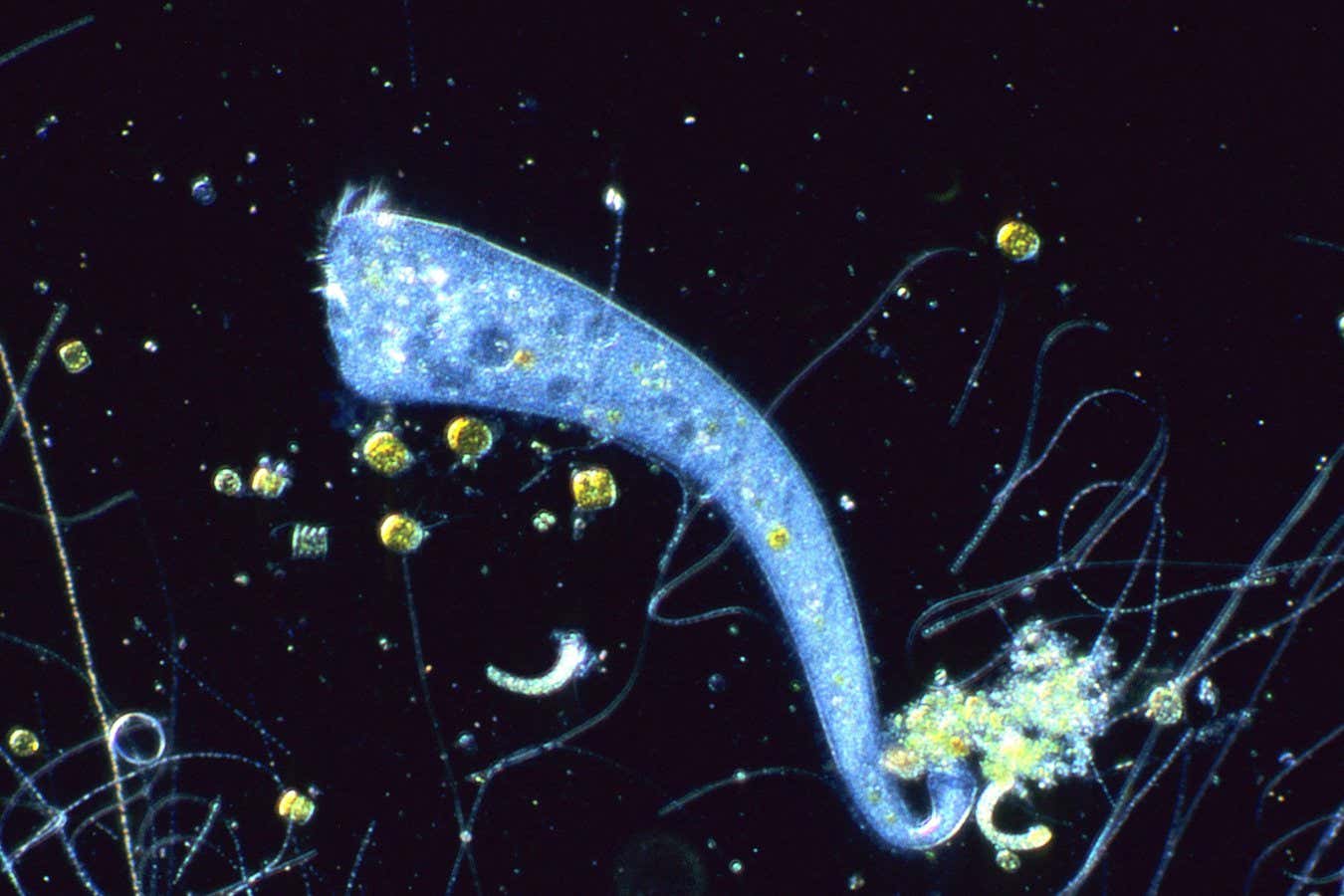
Stentor coeruleus is a single-celled organism with unexpected abilities
MELBA PHOTO AGENCY / Alamy
A simple unicellular organism with no brain or neurons seems capable of an advanced form of learning.
The simplest form of learning, known as habituation, is gradually reducing how much you respond to a repeated, harmless stimulus, like a smell or noise. This is common across all animals and has even been seen in plants. It has also been demonstrated in some protists, which have complex eukaryotic cells like animals, land plants and fungi, but are generally single-celled organisms, including the trumpet-shaped Stentor coeruleus and the slime mould Physarum polycephalum.
Much more difficult is learning to connect different types of stimuli or events, and predicting that one is linked to another. Such associative learning was most famously demonstrated when Ivan Pavlov paired the sound of a bell with giving dogs food, resulting in the animals salivating when they heard the bell ring.
Now, Sam Gershman at Harvard University and his colleagues have used similar conditioning experiments to show that Stentor seems capable of associative learning, too.
These surprising organisms live in ponds and swim using lines of hair-like cilia running down their sides. At up to 2 millimetres long, they are giants among single-celled life. At one end, they have an anchor called the holdfast to attach to a surface, while at the other is their trumpet-like feeding apparatus.
“When they’re attached, they just filter feed. If they are bothered, they’ll quickly contract into a sphere. During that time, they can’t feed, so it’s ecologically advantageous to not respond like that very often unless they have to,” says Gershman.
He and his colleagues used this behaviour to investigate how much Stentor can learn. First, they tapped strongly on the bottom of Petri dishes containing cultures of a few dozen Stentor cells. In response, most of the organisms contracted fast at first, but as the taps continued every 45 seconds, for a total of 60 thuds, fewer and fewer of the Stentor contracted, showing that they had habituated to the signal.
Next, the Stentor cultures felt a weak tap – in response to which fewer of the organisms generally contract – 1 second before a strong tap. The pairs of taps repeated every 45 seconds, which is about how long it takes Stentor to unfurl again.
Over 10 trials of this process, the chance of the organisms contracting immediately after the weak tap first increased and then decreased. “We saw this bump in the graph where the contraction rate initially goes up before going down. If you just present the weak tap by itself, you don’t see this,” says Gershman.
The researchers say this means Stentor has associated the weak tap with the bigger tap, making it the first protist known to be able to master associative learning. “It raises the question of whether apparently simple organisms are capable of aspects of cognition that we generally associate with much more complex, multicellular organisms with brains,” says Gershman.
It also suggests an ancient evolutionary origin of associative learning hundreds of millions of years before the emergence of multicellular nervous systems, he says. Other traces of this may still be seen in the way our neurons seem able to learn from their inputs in a way that isn’t dependent on modifying the synapses or connections between neurons – which is how most learning is thought to work, he says.
“It’s fascinating that a single cell can do such complex things that we thought required a brain, that required neurons, that required behavioural learning,” says Shashank Shekhar at Emory University in Atlanta, Georgia, who has shown that Stentor can aggregate into short-lived groups to feed more efficiently.
He thinks other unicellular organisms may also be capable of associative learning. “My gut feeling is if it’s there once, it’s going to be there more,” he says.
If an organism is learning, that means it must somehow be storing a memory. How this happens in Stentor isn’t yet known, but Gershman suspects it involves receptors that respond to touch by letting calcium flow into the cell, changing the voltage inside and leading Stentor to contract. He suggests that after repeated stimuli, some receptors are being modified somehow, acting as a molecular switch to stop contraction.
Topics: