

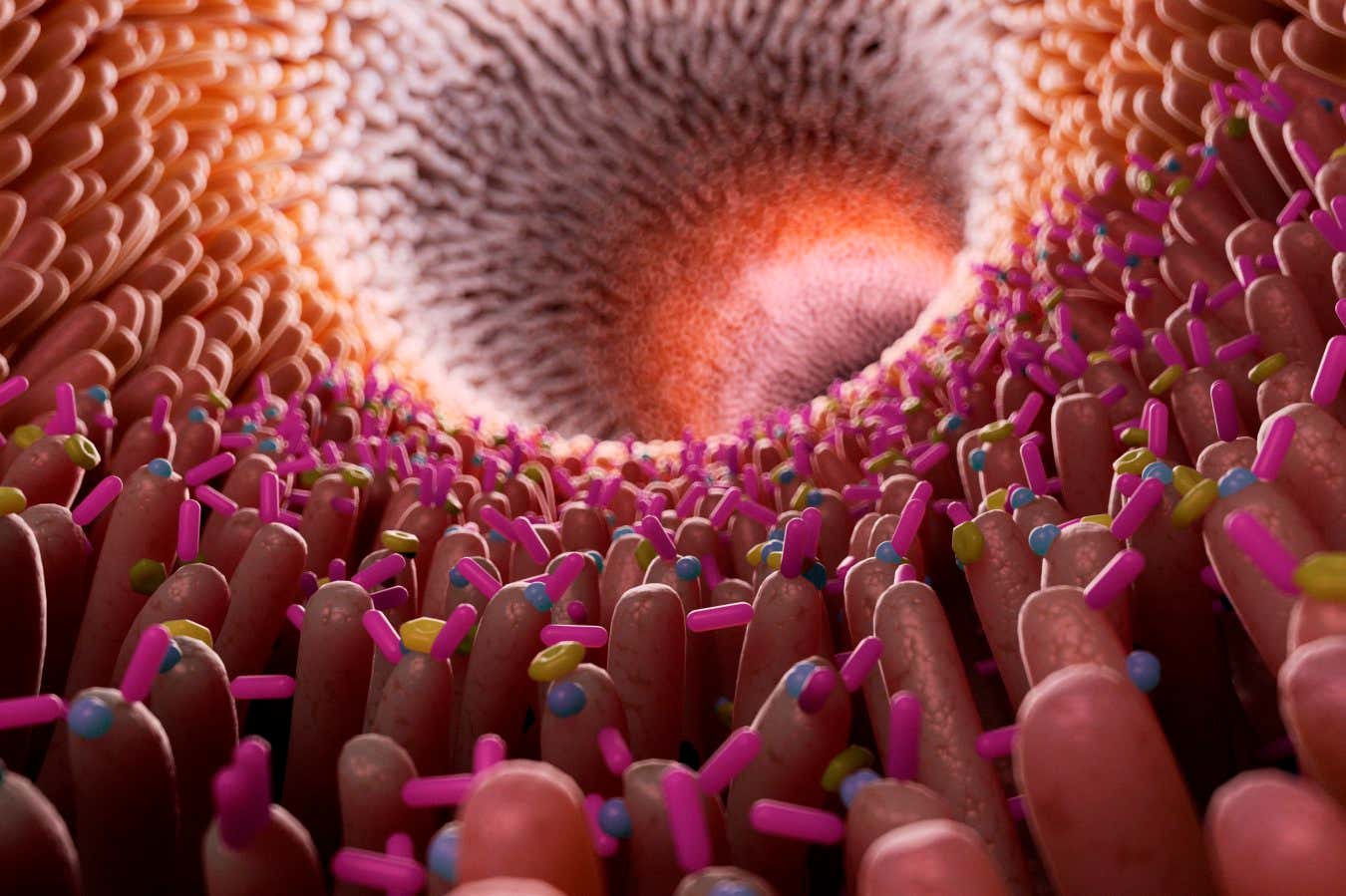
Gut bacteria that we barely know anything about may be essential for good health
3DMEDISPHERE/SCIENCE PHOTO LIBRARY
A mysterious group of bacteria seems to thrive in the gut microbiomes of people without illness, hinting that they may be crucial to good health.
More than 4600 species of bacteria are estimated to reside in our gut, interacting with each other and our bodies to influence everything from our immune system to our sleep, rate of ageing and risk of mental health conditions.
Yet about two-thirds of these species are part of the “hidden microbiome”, most of which we haven’t managed to grow in a lab or even name. We only know they exist after spotting their genomes in the gut. “A burning question still remains: are these species just bystanders or relevant to human health?” says Alexandre Almeida at the University of Cambridge.
To get an idea, Almeida and his colleagues searched for the genetic fingerprints of bacteria in the array of genomes found in gut microbiome samples. These were taken from studies that involved more than 11,000 people from 39 countries, primarily in Europe, North America and Asia.
About half of these people had no known medical condition, while the other half had been diagnosed with one of 13 conditions, including inflammatory bowel disease, obesity and chronic fatigue syndrome.
The researchers linked 715 bacterial species to at least one of these conditions, of which 342 species were found in higher numbers when people had a condition and 373 were more numerous when people had a clean bill of health.
Among these candidates, a genus called CAG-170 emerged with the strongest link. “Consistently across different conditions, we found that CAG-170 seem to be markedly increased in health compared to disease,” says Almeida.
In another part of the study, Almeida and his colleagues investigated which bacterial species were most associated with a healthy mix of gut microbes or an unbalanced one, known as dysbiosis.
“We found that, again, CAG-170 seem to be having a pronounced effect,” says Almeida. “There was a clear correlation where, essentially, higher abundance of CAG-170 was associated with lower dysbiosis and a healthier gut microbiome.”
To investigate why this might be, the team then looked into CAG-170 genomes, discovering genes for metabolic pathways that can produce high levels of vitamin B12, and for enzymes that break down a range of carbohydrates and fibres.
There was no sign that CAG-170 bacteria use vitamin B12 themselves, but other species usually found alongside them often have the capacity to utilise it, says Almeida. “It seems like CAG-170 are taking more of an altruistic approach and providing metabolic support to the rest of the microbiome.”
This is an important step towards better understanding which features of our gut microbiome are associated with health or illness, says Nicola Segata at the University of Trento in Italy, whose work recently revealed what a healthy gut microbiome may look like, but didn’t specifically outline the mechanisms by which such bacteria may bring about these benefits.
Whether high numbers of CAG-170 cause good health or are a consequence of it isn’t easy to answer, says Almeida. Working that out will require studies that investigate whether introducing CAG-170 reduces the risk of certain conditions.
“The human microbiome and the human body are so tightly connected that they should be regarded as a single, extremely complex system,” says Segata. “Rather than discussing the causal role of the first with respect to the second, we should investigate how the overall system is linked to healthy or unhealthy states and to healthy and unhealthy diets.”
Segata says it is important to follow up this research with nutritional clinical trials to assess which changes in diet affect which parts of the microbiome-human system.
Almeida sees the potential of CAG-170 in two ways. The first is that these bacteria could be used as an indicator of gut microbiome health. The second is by opening the door to a new generation of probiotics designed to support overall health.
CAG-170 could be a good candidate for probiotics, says Segata, but it is very challenging to grow these bacteria in the lab, let alone develop methods to deliver them alive into the gut and then actually colonise it. “Finding the best food or the best prebiotic supplement able to increase the amounts of CAG-170 is likely something more at hand than the development of those species as a probiotic product,” he says.
But the genomic data offers a clue about what might help, says Almeida. CAG-170 bacteria seem unable to produce the amino acid arginine, so providing more of that may help culture the bacteria, or one day boost their presence in the gut.
Topics: