
Close Menu
    Trending
    • Mamdani, Who Said Israel ‘Not a Place,’ Gets Roasted for Wishing Jewish NYCers ‘Peaceful’ Holiday That’s Definitely About Israel Being a Place
    • ‘The Ultimatum’ Star Blake Robertson Shares Relationship Update
    • US missiles hit Iran as path towards de-escalation uncertain
    • UN rights chief Turk wins second term despite US and Israeli opposition | United Nations News
    • LeBron’s decision might force Jalen Brunson to do the unthinkable
    • 8 Unique Side Hustle Ideas for Summer 2026 and Beyond
    • NHTSA considers new car door safety rules after fatal Tesla crashes
    • PlayStation Network outage resolved after thousands of gamers unable to play
    Benjamin Franklin Institute
    Saturday, July 25
    • Home
    • Politics
    • Business
    • Science
    • Technology
    • Arts & Entertainment
    • International
    Benjamin Franklin Institute
    Home»Science»The best map of dark matter has revealed never-before-seen structures
    Science

    The best map of dark matter has revealed never-before-seen structures

    Team_Benjamin Franklin InstituteBy Team_Benjamin Franklin InstituteJanuary 26, 2026No Comments3 Mins Read
    Share Facebook Twitter Pinterest Copy Link LinkedIn Tumblr Email VKontakte Telegram
    Share
    Facebook Twitter Pinterest Email Copy Link


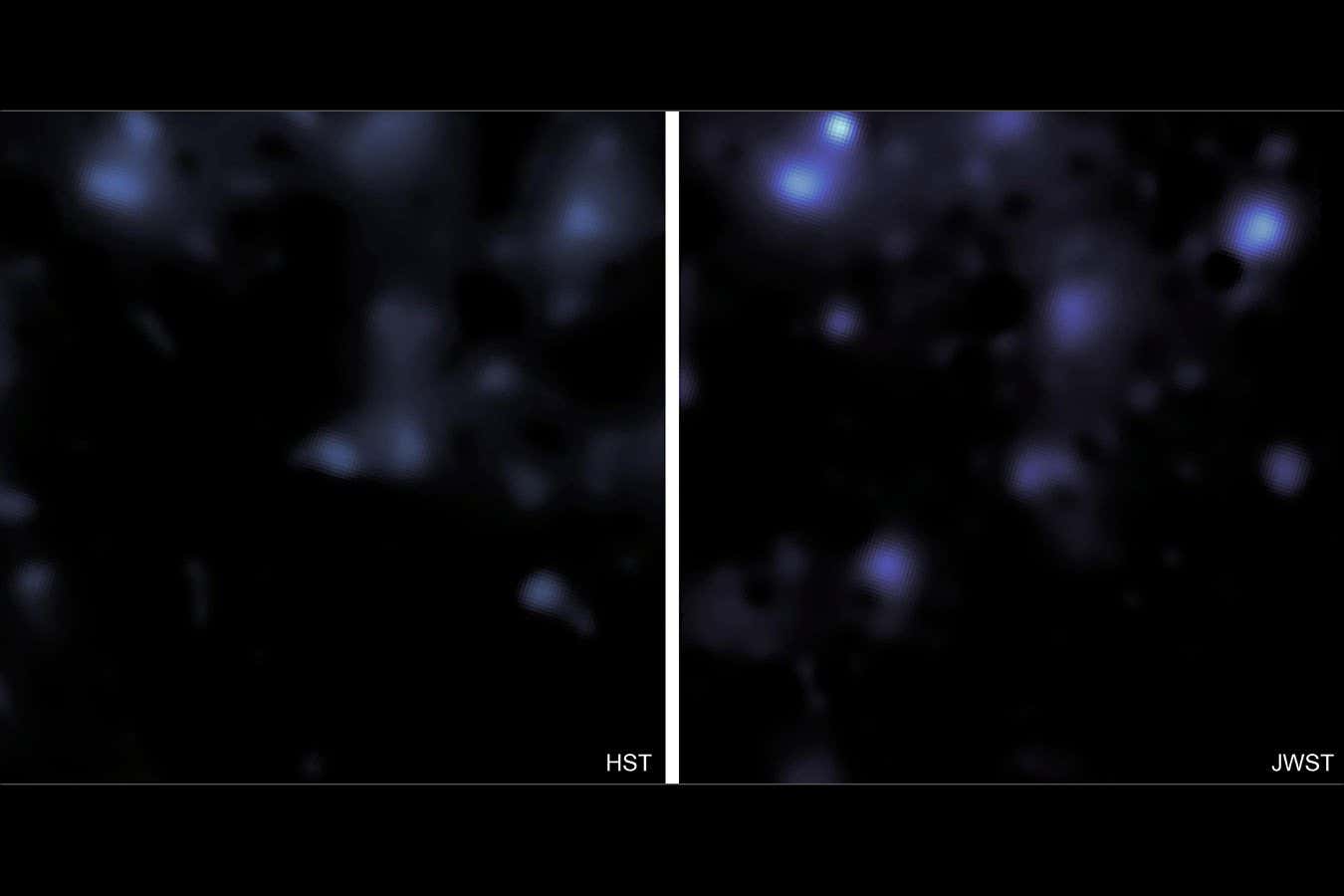
    The dark matter distribution observed by the Hubble Space Telescope (left) and by the James Webb Space Telescope (right)

    Dr Gavin Leroy/Professor Richard Massey/COSMOS-Webb collaboration

    Scientists have created the best ever map of dark matter using subtle distortions in the shape of about 250,000 galaxies. It could help us understand some of the biggest mysteries in the cosmos.

    Dark matter is extraordinarily hard to map because, true to its name, it doesn’t emit any light that we can detect. It only interacts with regular matter through its gravitational pull, so that is what researchers use to figure out where it is. Jacqueline McCleary at Northeastern University in Massachusetts and her colleagues used the James Webb Space Telescope (JWST) to do so, examining an area of sky slightly bigger than the full moon.

    “It is a very high-resolution picture of the scaffolding of this little corner of the universe,” says McCleary. The resolution of the map is about twice as high as previous ones made with the Hubble Space Telescope, and it includes structures much further from Earth.

    To make this map, the researchers examined the shapes of about 250,000 galaxies – but it isn’t their intrinsic shape that is interesting. “Those galaxies are basically the cosmic wallpaper,” says Liliya Williams at the University of Minnesota, who wasn’t involved in the analysis. Instead, what’s important is how the gravity of dark matter between the telescope and the “wallpaper” warps the light of the galaxies, in a process called gravitational lensing: the further the average shape of the distant galaxies is from circular, the more dark matter lies between them and us.

    By analysing these differences in shape, the researchers mapped out huge clusters of galaxies, along with the filaments of the cosmic web that connects them. Some of these structures didn’t match up with anything we had previously seen while observing regular, or luminous, matter, indicating that they must be dominated by dark matter. “To identify many of these structures over a wide field, gravitational lensing is one of very, very few techniques, and definitely the best,” says Williams.

    This is important because dark matter makes up about 85 per cent of the total matter in the universe, so it is crucial to the evolution of not only galaxies and galaxy clusters, but also the cosmos as a whole. Building a map of its distribution could help us nail down how it behaves and what exactly it is made of, says Williams.

    “Not only is it an observational coup, but in turn it’s going to enable a lot of other analysis – cosmological parameter constraints, the connection between galaxies and their dark matter haloes and how they grow and evolve over time,” says McCleary. These cosmological parameters include the strength of dark energy, the mysterious force causing the universe to expand at an accelerating rate.

    For now, it appears that the JWST map matches our current standard model of the universe, known as lambda-CDM, but there are many in-depth investigations of the data yet to be done that are certain to provide new insights, says McCleary. “Although at a glance it’s a match for lambda-CDM, I’m not giving up yet – I’m withholding judgment until our analysis is finished.”

    Topics:


    Source link

    Share. Facebook Twitter Pinterest LinkedIn Tumblr Email Telegram Copy Link

    Related Posts

    Science

    NHTSA considers new car door safety rules after fatal Tesla crashes

    July 24, 2026
    Science

    Fungus made fashion—researchers turn living organisms into textiles

    July 24, 2026
    Science

    How a 99-year-old mathematician unraveled a century-old braid mystery

    July 24, 2026
    Science

    Is it possible to regain a sense of smell? These scientists are working on it

    July 24, 2026
    Science

    Why don’t insects live in the ocean?

    July 24, 2026
    Science

    Why environmental groups are suing over SpaceX’s land swap deal

    July 24, 2026
    Editors Picks

    Why the Words You Choose as a Leader Can Build (or Break) Team Performance

    May 20, 2026

    Keir Starmer Apologizes to Epstein’s Victims For Appointing Mandelson

    February 5, 2026

    How to make the most of a hallway chat

    June 14, 2026

    A key week for Nato and defence deals

    June 22, 2025

    Indiana scores special teams TD vs. Miami in CFP title game

    January 20, 2026
    About Us
    About Us

    Welcome to Benjamin Franklin Institute, your premier destination for insightful, engaging, and diverse Political News and Opinions.

    The Benjamin Franklin Institute supports free speech, the U.S. Constitution and political candidates and organizations that promote and protect both of these important features of the American Experiment.

    We are passionate about delivering high-quality, accurate, and engaging content that resonates with our readers. Sign up for our text alerts and email newsletter to stay informed.

    Latest Posts

    Mamdani, Who Said Israel ‘Not a Place,’ Gets Roasted for Wishing Jewish NYCers ‘Peaceful’ Holiday That’s Definitely About Israel Being a Place

    July 25, 2026

    ‘The Ultimatum’ Star Blake Robertson Shares Relationship Update

    July 25, 2026

    US missiles hit Iran as path towards de-escalation uncertain

    July 25, 2026

    Subscribe for Updates

    Stay informed by signing up for our free news alerts.

    Paid for by the Benjamin Franklin Institute. Not authorized by any candidate or candidate’s committee.
    • Privacy Policy
    • About us
    • Contact us

    Type above and press Enter to search. Press Esc to cancel.