
Close Menu
    Trending
    • Negotiations that enable Israel’s land-grabs | Israel-Palestine conflict
    • True-or-false for Round 1 of 2026 NFL Draft: Will Cowboys regret their trade?
    • Opinion | Stewart Brand, Silicon Valley’s Favorite Prophet, on Life’s Most Important Principle
    • Struggling to scale your company? Here are five things that could be holding you back
    • What happens if you’re hit by a primordial black hole?
    • When is London Marathon 2026? Start time and how to watch race for FREE
    • Pentagon Requests $54 Billion For AI War
    • Clavicular Hit With New YouTube Crackdown
    Benjamin Franklin Institute
    Friday, April 24
    • Home
    • Politics
    • Business
    • Science
    • Technology
    • Arts & Entertainment
    • International
    Benjamin Franklin Institute
    Home»Science»Super-low density worlds reveal how common planetary systems form
    Science

    Super-low density worlds reveal how common planetary systems form

    Team_Benjamin Franklin InstituteBy Team_Benjamin Franklin InstituteJanuary 8, 2026No Comments3 Mins Read
    Share Facebook Twitter Pinterest Copy Link LinkedIn Tumblr Email VKontakte Telegram
    Share
    Facebook Twitter Pinterest Email Copy Link


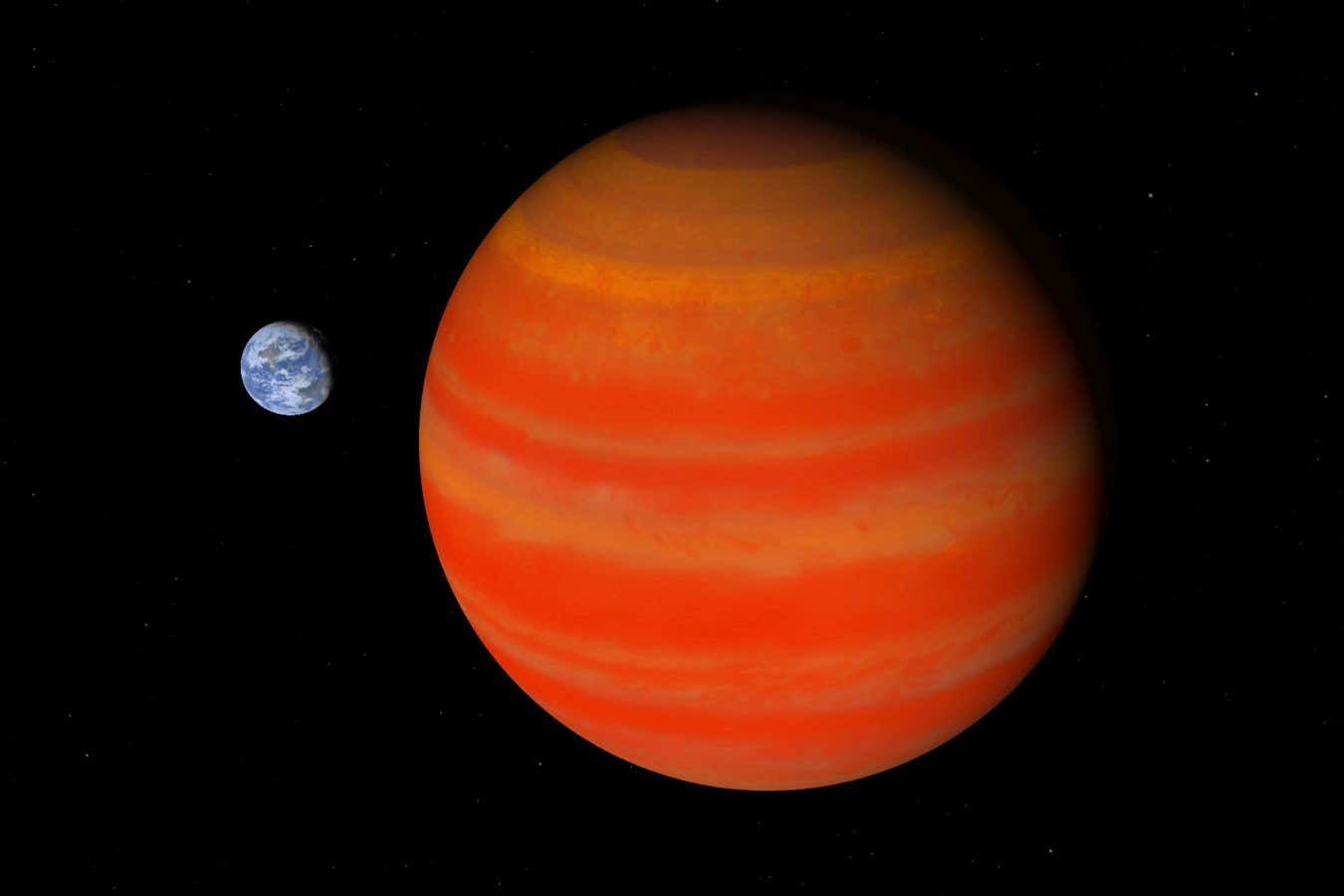
    One of the low-density planets compared with Earth

    NASA

    Four planets orbiting a newly born star in our galaxy are so light that they have the density of polystyrene, and could provide a key missing link in helping us understand how the most common planetary systems form.

    This solar system is unusual when compared with most other planetary systems in the Milky Way, which typically contain planets larger than Earth but smaller than Neptune. Astronomers have found hundreds of planetary systems like these, but almost all of them are formed around stars that are billions of years old, making it difficult to explain how they take shape.

    Now, a team led by John Livingston at the Astrobiology Center in Tokyo, Japan and Erik Petigura at the University of California, Los Angeles has identified four tightly clustered planets that appear to have formed recently, given that they orbit a young, 20-million-year-old star called V1298 Tau.

    “We are seeing a young version of a type of planetary system we see all over the galaxy,” says Petigura.

    V1298 Tau and its four planets were first discovered in 2017, but little was known about the planets themselves. The researchers used telescopes in space and on Earth to observe them for five years, looking for subtle variations in the time it took for each planet to complete an orbit and pass in front of the star due to the gravitational forces of attraction among the four worlds. By measuring these small differences, they could more accurately calculate each planet’s radius and mass.

    However, for this method to work, they needed to know beforehand how long each of the four planets should take to orbit the star in the absence of these gravitational forces. They didn’t have this information for the outermost planet, so had to use educated guesswork – and if their guess was wrong, then all of their calculations would have failed.

    “I thought that this, frankly, was kind of a fool’s errand,” says Petigura. “There were so many ways in which we could have gotten this wrong… the first time we recovered [the outermost planet’s] transit, I almost fell out of my chair; it was like somebody getting a hole in one in golf.”

    Once they had accurately measured all the planets’ orbital periods and calculated their radii and masses, they could then estimate the density of each planet. They found these were among the lowest of any known exoplanet, with radii between five to 10 times Earth’s, but masses only a few times as great.

    “These planets have the density of Styrofoam; they’re extremely low-density,” says Petigura.

    This is because the planets are in the process of contracting due to gravitational forces to form planets that are around only one to three times Earth’s radius, so-called super-Earths or sub-Neptunes. The researchers simulated how the planets would evolve and found that they would eventually end up as these kinds of planets.

    V1298 Tau’s planets are configured in what’s called orbital resonance, which means the planets’ orbital times are multiples of each other. This fits with the picture that astronomers have of how most planetary systems form, including our solar system, says Sean Raymond at the University of Bordeaux in France. They begin as crowded systems with neat orbital resonances but then become unstable, in terms of the ratio of their periods.

    “This discovered system of close-in, lower-mass planets orbiting a very young star represents a potential precursor to a typical sub-Neptune system,” says Raymond. “This discovery is amazing, in that it is very hard to characterise such young systems.”

    Topics:


    Source link

    Share. Facebook Twitter Pinterest LinkedIn Tumblr Email Telegram Copy Link

    Related Posts

    Science

    What happens if you’re hit by a primordial black hole?

    April 24, 2026
    Science

    How do earthquakes end? A seismic ‘stop sign’ could help predict earthquake risk

    April 24, 2026
    Science

    ‘Kraken’ fossils show enormous, intelligent octopuses were top predators in Cretaceous seas

    April 24, 2026
    Science

    Largest ever octopus was great white shark of invertebrate predators

    April 24, 2026
    Science

    Do you need to worry about Mythos, Anthropic’s computer-hacking AI?

    April 23, 2026
    Science

    How many dachshunds would it take to get to the moon?

    April 23, 2026
    Editors Picks

    Singapore responds to US probe, says it does not condone forced labour in supply chains

    April 15, 2026

    Iran’s Supreme Leader Khamenei is dead, says Trump

    March 1, 2026

    Gwyneth Paltrow Compares Exes In Resurfaced Clip

    April 19, 2026

    Tylor Chase Reportedly Wrecked Motel Room Hours After Getting Shelter

    December 26, 2025

    Top US news anchor pleads with kidnappers for mother’s life

    February 5, 2026
    About Us
    About Us

    Welcome to Benjamin Franklin Institute, your premier destination for insightful, engaging, and diverse Political News and Opinions.

    The Benjamin Franklin Institute supports free speech, the U.S. Constitution and political candidates and organizations that promote and protect both of these important features of the American Experiment.

    We are passionate about delivering high-quality, accurate, and engaging content that resonates with our readers. Sign up for our text alerts and email newsletter to stay informed.

    Latest Posts

    Negotiations that enable Israel’s land-grabs | Israel-Palestine conflict

    April 24, 2026

    True-or-false for Round 1 of 2026 NFL Draft: Will Cowboys regret their trade?

    April 24, 2026

    Opinion | Stewart Brand, Silicon Valley’s Favorite Prophet, on Life’s Most Important Principle

    April 24, 2026

    Subscribe for Updates

    Stay informed by signing up for our free news alerts.

    Paid for by the Benjamin Franklin Institute. Not authorized by any candidate or candidate’s committee.
    • Privacy Policy
    • About us
    • Contact us

    Type above and press Enter to search. Press Esc to cancel.