
Close Menu
    Trending
    • 2022 IEEE President K.J. Ray Liu Honored for Leadership
    • ‘They Left Failed States, But Want To Reenact The Disaster They Fled From’ (VIDEO) * The Gateway Pundit * by Mike LaChance
    • Insider Claims Blake Lively ‘Knows Everything’ About Taylor Swift
    • ICC prosecutor Karim Khan removed over ‘serious misconduct’
    • ‘The show must go on’: Trump returns to rescheduled White House press gala | Donald Trump News
    • Layne Riggs dominates NASCAR Truck Series race at IRP
    • Why Wall Street Trusts Some CEOs and Doubts Others With the Same Balance Sheet
    • SpaceX launches Starship on successful test flight
    Benjamin Franklin Institute
    Saturday, July 25
    • Home
    • Politics
    • Business
    • Science
    • Technology
    • Arts & Entertainment
    • International
    Benjamin Franklin Institute
    Home»Science»Cheers! NASA Rings in the New Year with Sparkling ‘Champagne Cluster’ Image
    Science

    Cheers! NASA Rings in the New Year with Sparkling ‘Champagne Cluster’ Image

    Team_Benjamin Franklin InstituteBy Team_Benjamin Franklin InstituteJanuary 4, 2026No Comments3 Mins Read
    Share Facebook Twitter Pinterest Copy Link LinkedIn Tumblr Email VKontakte Telegram
    Share
    Facebook Twitter Pinterest Email Copy Link


    December 31, 2025

    2 min read

    Add Us On GoogleAdd SciAm

    Cheers! Ring in the New Year with Glittering ‘Champagne Cluster’ Image

    A galaxy cluster discovered on New Year’s Eve in 2020 shines in a new image from NASA’s Chandra X-Ray Observatory
    By Meghan Bartels edited by Claire Cameron

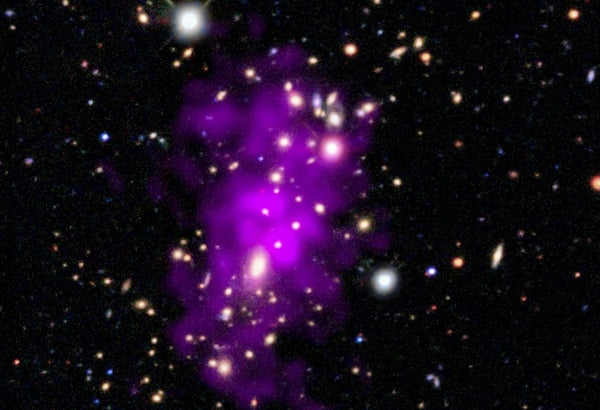
    The cluster appears here as a large collection of brilliant white lights, each a distinct galaxy. A neon purple cloud stretches across the cluster’s crowded core. Many of the hundred-plus galaxies in the cluster are in two clumps of galaxies towards the top and bottom of center. Some are encircled by a faint glowing haze, while a few foreground stars gleam with diffraction spikes. Some of the smaller galaxies are tinted blue, orange, or red, and some appear more oblong than round, suggesting spiral shapes viewed edge-on. The neon purple cloud sits at the heart of the image, surrounding the most densely-packed part of the cluster. This cloud, which spreads vertically across the cluster, is multimillion-degree gas observed by Chandra. The two clumps of observable galaxies, and the spread of superheated gas, reveal that the Champagne Cluster is in fact two clusters in the process of colliding.

    X-ray: NASA/CXC/UCDavis/F. Bouhrik et al.; Optical: Legacy Survey/DECaLS/BASS/MzLS; Image processing: NASA/CXC/SAO/P. Edmonds and L. Frattare

    Raise a toast to another orbit around the sun with a new NASA image of sparkling galaxy clusters fittingly dubbed the “Champagne Cluster.”

    The object was first discovered on December 31, 2020. But the new image combines data from NASA’s Chandra X-ray Observatory—which sees the superheated gas of the merging clusters as purple bubbles—and a collection of ground-based optical telescopes that contribute the starry background.

    When the Champagne Cluster was first observed, astronomers thought the celestial object—formally named RM J130558.9+263048.4—was a single galaxy cluster, but subsequent observations have revealed that it is in fact two clusters interacting. All told, the merger involves more than 100 galaxies—plus enough multimillion-degree gas to outweigh them all.


    On supporting science journalism

    If you’re enjoying this article, consider supporting our award-winning journalism by subscribing. By purchasing a subscription you are helping to ensure the future of impactful stories about the discoveries and ideas shaping our world today.


    Scientists have two theories to explain the Champagne Cluster’s distinct appearance. Both of them were outlined in research published earlier this year in the Astrophysical Journal.

    The first hypothesis is that the two clusters first collided more than two billion years ago, blowing past each other before being trapped in a gravitational dance that will eventually see them smash together again. According to the second theory, the clusters’ collision happened just 400 million years ago, and the two objects are now zipping away from each other. Either way, the researchers say, the clusters crashed into each other practically head-on.

    The Champagne Cluster is a particularly interesting object for astronomers looking to understand dark matter, which is invisible to all telescopes but exerts a gravitational tug on everything around it. Scientists believe this enigmatic stuff is unlikely to interact with itself—and massive collisions between galaxy clusters such as the Champagne Cluster or a similar object dubbed the Bullet Cluster could be just the place to spot its strange behavior.

    It’s Time to Stand Up for Science

    If you enjoyed this article, I’d like to ask for your support. Scientific American has served as an advocate for science and industry for 180 years, and right now may be the most critical moment in that two-century history.

    I’ve been a Scientific American subscriber since I was 12 years old, and it helped shape the way I look at the world. SciAm always educates and delights me, and inspires a sense of awe for our vast, beautiful universe. I hope it does that for you, too.

    If you subscribe to Scientific American, you help ensure that our coverage is centered on meaningful research and discovery; that we have the resources to report on the decisions that threaten labs across the U.S.; and that we support both budding and working scientists at a time when the value of science itself too often goes unrecognized.

    In return, you get essential news, captivating podcasts, brilliant infographics, can’t-miss newsletters, must-watch videos, challenging games, and the science world’s best writing and reporting. You can even gift someone a subscription.

    There has never been a more important time for us to stand up and show why science matters. I hope you’ll support us in that mission.


    Source link

    Share. Facebook Twitter Pinterest LinkedIn Tumblr Email Telegram Copy Link

    Related Posts

    Science

    SpaceX launches Starship on successful test flight

    July 25, 2026
    Science

    NHTSA considers new car door safety rules after fatal Tesla crashes

    July 24, 2026
    Science

    Fungus made fashion—researchers turn living organisms into textiles

    July 24, 2026
    Science

    How a 99-year-old mathematician unraveled a century-old braid mystery

    July 24, 2026
    Science

    Is it possible to regain a sense of smell? These scientists are working on it

    July 24, 2026
    Science

    Why don’t insects live in the ocean?

    July 24, 2026
    Editors Picks

    Israel announces new West Bank settlements despite sanctions threat

    May 29, 2025

    Man whose gut made its own alcohol gets relief from faecal transplant

    January 10, 2026

    The real reasons birth rates are declining worldwide

    March 3, 2026

    Why So Many States Want to Ban China From Owning Farmland

    August 25, 2025

    AREA15’s Oddyssey Signals A New Era Of Vegas Nightlife

    March 8, 2026
    About Us
    About Us

    Welcome to Benjamin Franklin Institute, your premier destination for insightful, engaging, and diverse Political News and Opinions.

    The Benjamin Franklin Institute supports free speech, the U.S. Constitution and political candidates and organizations that promote and protect both of these important features of the American Experiment.

    We are passionate about delivering high-quality, accurate, and engaging content that resonates with our readers. Sign up for our text alerts and email newsletter to stay informed.

    Latest Posts

    2022 IEEE President K.J. Ray Liu Honored for Leadership

    July 25, 2026

    ‘They Left Failed States, But Want To Reenact The Disaster They Fled From’ (VIDEO) * The Gateway Pundit * by Mike LaChance

    July 25, 2026

    Insider Claims Blake Lively ‘Knows Everything’ About Taylor Swift

    July 25, 2026

    Subscribe for Updates

    Stay informed by signing up for our free news alerts.

    Paid for by the Benjamin Franklin Institute. Not authorized by any candidate or candidate’s committee.
    • Privacy Policy
    • About us
    • Contact us

    Type above and press Enter to search. Press Esc to cancel.