

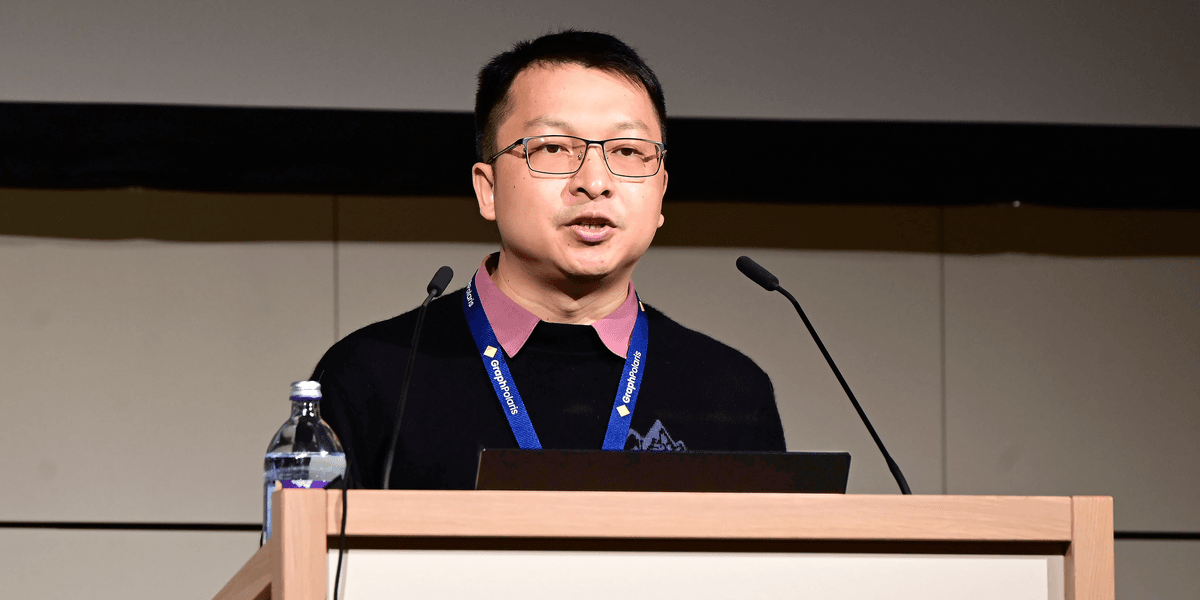
When Yong Wang recently received one of the highest honors for early-career data visualization researchers, it marked a milestone in an extraordinary journey that began far from the world’s technology hubs.
Wang was born in a small farming village in southwestern China to parents with little formal education and few electronic devices. Today the IEEE member and associate editor of IEEE Transactions on Visualization and Computer Graphics is an assistant professor of computing and data science at Nanyang Technological University, in Singapore. He studies how people can employ data visualization techniques to get more out of artificial intelligence tools.
YONG WANG
EMPLOYER
Nanyang Technological University, in Singapore
POSITION
Assistant professor of computing and data science
IEEE MEMBER GRADE
Member
ALMA MATERS
Harbin Institute of Technology in China; Huazhong University of Science and Technology in Wuhan, China; Hong Kong University of Science and Technology
“Visualization helps people understand complex ideas,” Wang says. “If we design these tools well, they can make advanced technologies accessible to everyone.”
For his work in the field, the IEEE Computer Society visualization and graphics technical committee presented him with its 2025 Significant New Researcher Award. The recognition highlights his growing influence in fields including human-computer interaction and human-AI collaboration—areas becoming more important as the world generates more data than humans can easily interpret.
Growing up in rural Hunan
Wang was born in southwestern Hunan Province. China’s economy was still developing, and life in his village was modest. Most families in Hunan grew rice, vegetables, and fruit to support themselves.
Wang’s parents worked in agriculture too, and his father often traveled to cities to earn money working in a factory or on construction jobs. The extra income helped support the family and made it possible for Wang to attend college.
“I’m very grateful to my parents,” Wang says. “They never attended university, but they strongly supported my education.”
“If we build tools that help people understand information, then more people can participate in science and innovation. That’s the real power of visualization.”
Technology was scarce in the village, he says. Computers were almost nonexistent, and televisions were considered precious, expensive household possessions.
One childhood memory still makes him laugh: During a summer vacation, he and his brother spent so many hours playing video games on a simple console connected to the family’s television that the TV screen eventually burned out.
“My mother was very angry,” he recalls. “At that time, a TV was a very valuable thing.”
He says that despite never having used a laptop or experimenting with electronic equipment, he was fascinated by the technologies he saw on TV shows.
Discovering robotics and engineering
His parents encouraged a practical career such as medicine or civil engineering, but he felt drawn to robotics and computing, he says.
“I didn’t really understand what computer science involved,” he says. “But from what I saw on TV, it looked exciting and advanced.”
He enrolled at Harbin Institute of Technology, in northeastern China. The esteemed university is known for its engineering programs. His major—automation— combined elements of electrical engineering, robotics, and control systems.
One of the defining experiences of his undergraduate years, he says, was a university robotics competition. Wang and his teammates designed a robot capable of autonomously navigating around obstacles.
The design was simple compared with professional systems, he acknowledges. But, he says, the experience was exhilarating. His team placed second, and Wang began to see engineering as both creative and collaborative.
He graduated with a bachelor’s degree in 2011 and briefly worked as an assistant at the Research Institute of Intelligent Control and Systems at Harbin.
In 2014 he took a position as a research intern working at Da Jiang Innovation in Shenzhen, China.
That experience helped him clarify his future, he says: “I realized I didn’t enjoy doing repetitive work or simply following instructions. I wanted to explore ideas that interested me, and I wanted to conduct research.” The realization pushed him toward graduate school, he says.
Building tools that help humans work with AI
Wang received a master’s degree in pattern recognition and image processing from the Huazhong University of Science and Technology, in Wuhan, China, in 2016.
He then enrolled in the computer science Ph.D. program at the Hong Kong University of Science and Technology and earned the degree in 2018. He remained there as a postdoctoral researcher until 2020, when he moved to Singapore to join Singapore Management University as an assistant professor of computing and information systems. He moved over to Nanyang Technological University as an assistant professor in 2024.
His research focuses on a challenge facing nearly every business: how to make sense of the enormous amounts of data being generated.
“We live in an era of information explosions,” Wang says. “Huge amounts of data are generated, and it’s difficult for people to interpret all of it to make better business decisions.”
Data visualization offers a solution by turning complex information into images, patterns, and diagrams that people can more readily understand.
But many visualizations still must be designed manually by experts, Wang notes. It’s a time-consuming process that creates a bottleneck, he says.
His solution is to use large language models and multimodal systems that can generate text, images, video, and sensor data simultaneously and automate parts of the process.
One system developed by his research group lets users design complex infographics through natural-language instructions combined with simple interactions such as drawing on a touchscreen with a finger. It allows nontechnical people to generate visualizations instead of hiring professional designers.
Another focus of Wang’s research is human-AI collaboration. AI systems can analyze data at enormous scale, but people still need to be the final decision-makers, he says.
Visualization helps bridge the gap between human intention and AI’s complex calculations by making the process an AI system uses to reach a result more transparent and understandable.
“If people understand how the AI system works,” Wang says, “they can collaborate with it more effectively.”
He recently explored how visualization techniques could help researchers understand quantum computing, a field where core concepts—such as superposition, where a bit can be in more than one state at a time—are abstract. In classical computing, the bit state is binary: It’s either 1 or 0. A quantum bit, or qubit, can be 1, 0, or both. The differences get more dizzying from there.
Visualization tools could help scientists monitor quantum systems and interpret quantum machine-learning models, he says.
The importance of IEEE communities
Teaching and mentoring students remain among the most meaningful parts of Wang’s career, he says.
Professional communities such as the IEEE Computer Society, he says, play a major role in helping him transform early-stage graduate students unsure of which lines of inquiry they will pursue into independent researchers with a solid technical focus. Through conferences, publications, and technical committees, IEEE connects Wang with other researchers working in visualization, AI, and human-computer interactions, he says.
Those connections have helped him share ideas, collaborate, and stay up to date on innovations in the research community.
Receiving the Significant New Researcher award motivates him to continue pushing the field forward, he says.
Looking back, he says, the distance between his rural village in Hunan and an international research career still feels remarkable. But, he says, the journey reflects something larger about his chosen field: “If we build tools that help people understand information, then more people can participate in science and innovation.
“That’s the real power of visualization.”
From Your Site Articles
Related Articles Around the Web