

 Reuters
Just as India showed flickers of progress toward its long-held dream of becoming the world’s factory, Washington and Beijing announced a trade “reset” that could derail Delhi’s ambitions to replace China as the global manufacturing hub.
Last week, Trump’s tariffs on China dropped overnight – from 145% to 30%, vs 27% for India – as the two sides thrashed out an agreement in Switzerland.
As a result, there’s a chance manufacturing investment that was moving from China to India could either “stall” or “head back”, feels Ajay Srivastava of the Delhi-based think tank, Global Trade Research Institute (GTRI).
“India’s low-cost assembly lines may survive, but value-added growth is in danger.”
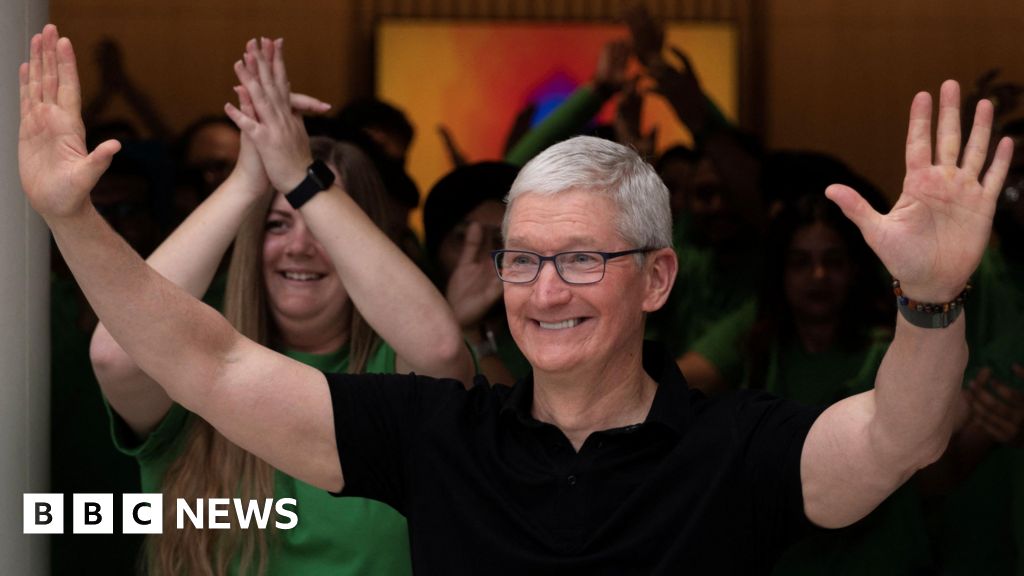
The change in sentiment stands in sharp relief to the exuberance in Delhi last month when Apple indicated that it was shifting most of its production of iPhones headed to the US from China to India.
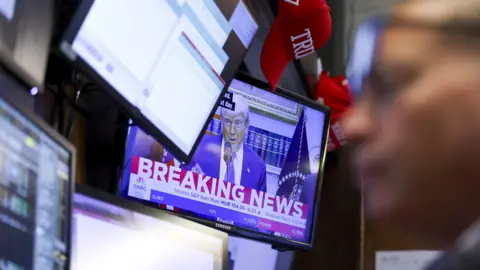
That may well still happen, even though US President Donald Trump revealed that he had told Apple CEO Tim Cook not to build in India because it was “one of the highest tariff nations in the world”.
“India is well positioned to be an alternative to China as a supplier of goods to the US in the immediate term,” Shilan Shah, an economist with Capital Economics, wrote in an investor note before the deal was announced. He pointed out that 40% of India’s exports to the US were “similar to those exported by China”.
There were early signs that Indian exporters were already stepping in to fill the gap left by Chinese producers. New export orders surged to a 14-year high, according to a recent survey of Indian manufacturers.
Nomura, a Japanese broking house, also pointed to growing “anecdotal evidence” of India emerging as a winner from “trade diversion and supply-chain shift in low and mid-tech manufacturing” particularly in sectors like electronics, textiles and toys.

 EPA
EPASome analysts do believe that despite the so-called trade “reset” between Beijing and Washington, a larger strategic decoupling between China and the US will continue to benefit India in the long run.
For one, there’s greater willingness by Narendra Modi’s government to open its doors to foreign companies after years of protectionist policies, which could provide tailwind.
India and the US are also negotiating a trade deal that could put Asia’s third-largest economy in a sweet spot to benefit from the so-called “China exodus” – as global firms shift operations to diversify supply chains.
India has just signed a trade pact with the UK, sharply cutting duties in protected sectors like whiskey and automobiles. It offers a glimpse of the concessions Delhi might offer Trump in the ongoing India-US trade talks.
But all of this optimism needs to be tempered for more reasons than one.
Apart from the fact that China is now back in the running, companies are also “not entirely writing off other Asian competitors, with countries like Vietnam still on their radars”, economists Sonal Verma and Aurodeep Nandi from Nomura said in a note earlier this month.
“Hence, for India to capitalise on this opportunity, it needs to complement any tariff arbitrage with serious ease-of-doing-business reforms.”
A tough business climate has long frustrated foreign investors and stalled India’s manufacturing growth, with its share of Gross Domestic Product (GDP) stuck at around 15% for two decades.
The Modi government’s efforts, such as the Production Linked Incentive (PLI) scheme, have delivered only limited success in boosting this figure.
The government’s think tank, Niti Aayog, has acknowledged India’s “limited success” in attracting investment shifting from China. It noted that factors like cheaper labour, simpler tax laws, lower tariffs, and proactive Free Trade Agreements helped countries like Vietnam, Thailand, Cambodia, and Malaysia expand exports – while India lagged behind.
 Reuters
Another major concern, says Nomura, is India’s ongoing reliance on China for raw materials and components used in electronics like iPhones, limiting Delhi’s ability to fully capitalise on supply chain shifts.
“India’s earnings from making iPhones will only rise if more of the phone is made locally,” Mr Srivastava told the BBC.
According to him, right now Apple earns over $450 per iPhone sold in the US while India keeps less than $25 – even though the full $1,000 is counted as an Indian export.
“Just assembling more iPhones in India won’t help much unless Apple and its suppliers also start making components and doing high-value work here. Without that, India’s share stays small, and the export numbers go up only on paper -possibly triggering more scrutiny from the US without real economic gain for India,” Mr Srivastava said.
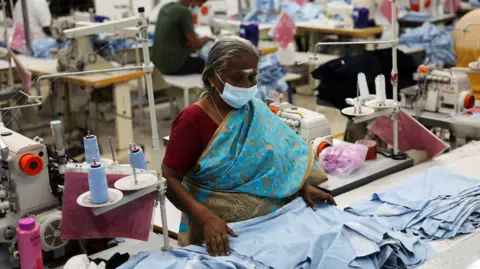
The jobs created by such assembly lines aren’t very high quality either, says GTRI.
Quite unlike companies like Nokia which set up a factory in the southern city of Chennai in 2007 where suppliers moved in together, “today’s smartphone makers mostly import parts and push for lower tariffs instead of building supply chains in India”, explained Mr Srivastava. He noted that, in certain instances, the investment made could be lower than the subsidies received under India’s PLI scheme.
Finally there are concerns that Chinese exporters could try to use India to reroute products to the US.
India doesn’t seem averse to this idea despite the pitfalls. The country’s top economic adviser said last year that the country should attract more Chinese businesses to set-up export oriented factories and boost its manufacturing industry – a tacit admission that its own industrial policy hadn’t delivered.
But experts caution, this could further curtail India’s ability to build local know-how and grow its own industrial base.
All of this shows that beyond the headline-grabbing announcements by the likes of Apple, India is still a long way from realising its factory ambitions.
“Slash production costs, fix logistics, and build regulatory certainty,” Mr Srivastava urged policymakers in a social media post.
“Let’s be clear. This US-China reset is damage control, not a long-term solution. India must play the long game, or risk getting side-lined.”
Follow BBC News India on Instagram, YouTube, Twitter and Facebook