

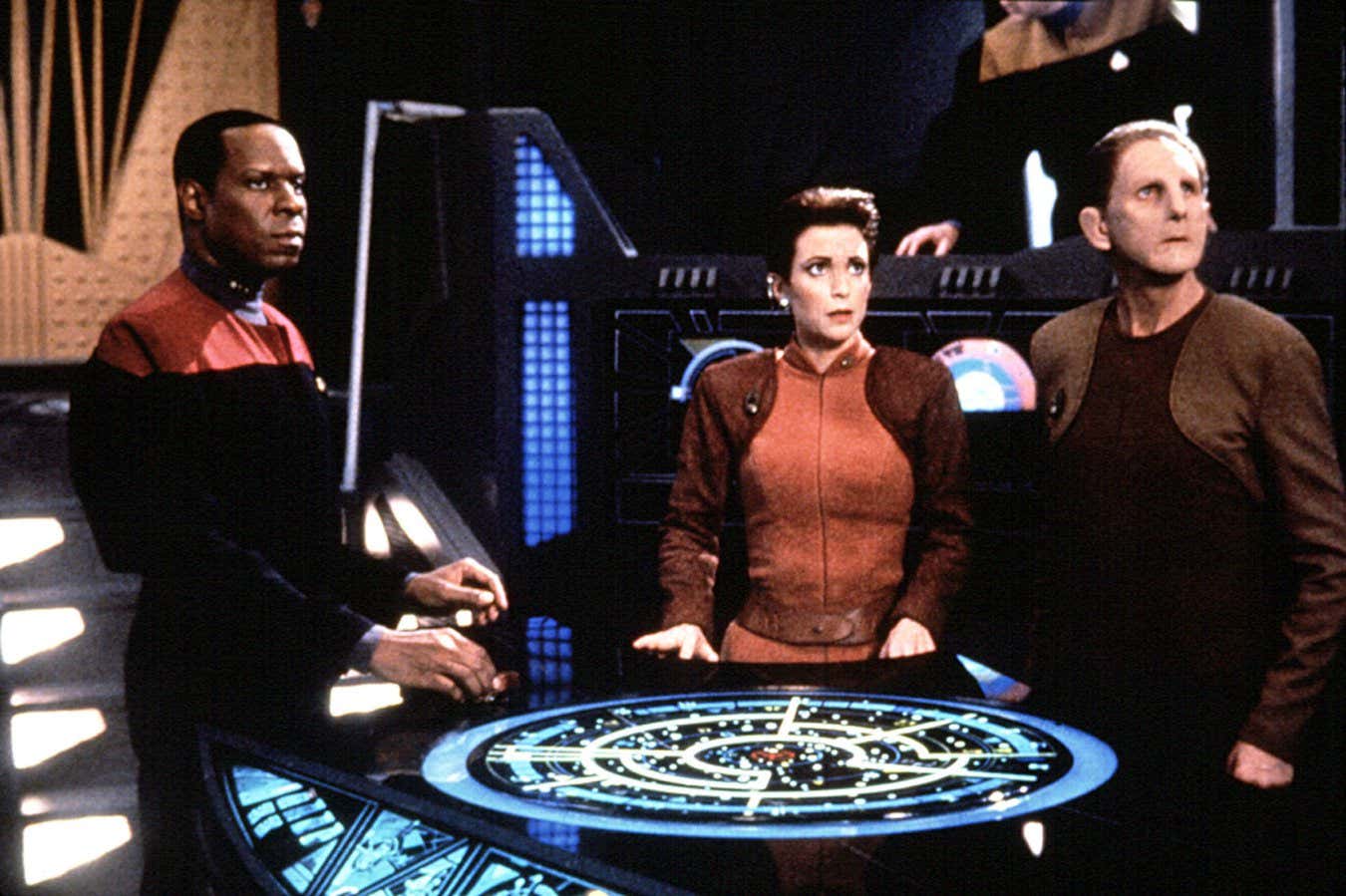
“Space travel is the setting but not the heart of the Star Trek franchise” … A scene from Star Trek: Deep Space Nine
Everett Collection Inc/Alamy
To live in the US at this moment is to live through a series of strange juxtapositions. I prepare myself for how to respond if the construction workers at my house get stopped by government agents; I need to think about what I would like to eat for dinner. I tell my spouse to pick up some veggies from the grocer; I worry he will be stopped by US Immigration and Customs Enforcement on the way home. I am supposed to do science, to write about how the universe is exciting; I spend part of my day reading about children being held in detention camps. NASA’s funding survived an attempted cut; NASA decimated its workforce in 2025, and they are probably not coming back.
The week this column publishes, NASA may launch an astronaut on a journey around the moon – humanity’s first in decades. This is a stage of the Artemis mission, which will eventually land people on the moon. In the long term, Artemis is widely understood to be a stepping stone on the journey to placing humans on Mars. At a SpaceX event with Pete Hegseth, head of the US Department of Defense (which the administration wishes you would call the Department of War), Elon Musk pitched sending humans to other planets as an important part of getting us to the Star Trek universe. We are supposed to be excited and to think that all of these missions are bringing us a step closer to spacefaring utopia.
What a delightful idea. If only it were true. As a Trek convention-attending fan, I can tell you that not only do these men not understand the franchise, but they have never really seen it. Otherwise, they would know that, in the Trek universe, the 2020s were a terrible era in human history. The Bell Riots, which take place in a fictional 2024, involve an uprising of poor and discarded people against an authoritarian government that runs a society of extreme wealth inequality. In Trek, the world must survive another world war in which soldiers are given a drug to enable their participation in atrocities.
The similarities between fact and 30-year-old fiction are striking. In the Trek scenario, the men telling us about their militarised, corporate plans for space are the baddies, not the ones who will get us to utopia. Not only do those citing Trek today misunderstand their place in the narrative, but they also don’t understand what Trek is really about. Space travel is the setting, but that isn’t the heart of the franchise’s story, which is about humanity bettering itself through cooperating with each other, reckoning with hard philosophical questions and imagining a socialist-inspired socioeconomic system – where everyone’s needs are taken care of.
“
In the StarTrek scenario, the men telling us of their militarised, corporate plans are the baddies
“
Will going to Mars do that for us? There is an alternate timeline where maybe going to Mars is part of our journey toward appreciating “infinite diversity in infinite combinations”, which is the basis for the alien Vulcan species’ world view. Already, we have successfully sent multiple uncrewed missions to Mars and learned so many amazing things – that Mars once had the conditions for the formation of life, and liquid water may still be somewhere on the planet, and that Mars has terribly unpredictable weather, due in part to its rather thin atmosphere.
Another lesson our remote explorations of Mars have taught us is that it’s cold, dry and, by human standards, an awful place to live. So, even in the scenario where sending a crewed mission to Mars emerged from a united and peaceful humanity, we would still have to reckon with the reality that Mars is trying to kill us. We can’t breathe there, and, even if we could change the chemical make-up of the atmosphere, the dirt would still be dangerous. If you are like me, when you are in a dusty room, you have a bit of an allergic reaction, full of sneezing. That’s a cakewalk compared with what Mars dirt would do to the human body. It has got just enough silica in it to do serious damage to human lungs, causing an illness similar to the black lung disease that miners often have.
You might be thinking, “Well, it’s not like we plan to inhale the dirt!” But Mars has enormous dust storms that kick up dirt all the time. Any astronaut on the surface can expect to get it all over their suit, all the time. It will be hard to keep the dust out of habitats. The resources required to make building a settlement on Mars survivable are enormous. It would, literally, be a heavy lift to launch them off Earth’s surface and out of our planet’s gravitational pull.
I think trying to settle Mars is probably a terrible idea. And that’s OK, because we have got a pretty awesome planet already: Earth. We aren’t taking very good care of it, but that could change. For me, that’s what Star Trek is all about. Not the promise of a high-tech future where we escape our world, but rather one where we learn to respect the incredible spaceship that is our home planet.
What I’m reading
I loved Fara Dabhoiwala’s What is Free Speech? The history of a dangerous idea.
What I’m watching
I’m loving Gina Yashere and Kerrice Brooks in Star Trek: Starfleet Academy.
What I’m working on
Figuring out how to get through the day while the US government attacks its own population.
Chanda Prescod-Weinstein is an associate professor of physics and astronomy at the University of New Hampshire. She is the author of The Disordered Cosmos and the forthcoming book The Edge of Space-Time: Particles, poetry, and the cosmic dream boogie
Topics: