
Close Menu
    Trending
    • Trump invokes Defense Production Act to keep U.S. coal plants running
    • Map: 3.8-Magnitude Earthquake Shakes Las Vegas
    • Market Talk – June 4, 2026
    • Prince Harry Enjoyed Solo Night Ahead Of Lilibet’s Birthday
    • Oil drops, stocks mostly higher despite AI concerns
    • US defence secretary compares Bolivia protests to government ‘overthrow’ | Donald Trump News
    • Dylan Larkin trade request shows how far Red Wings have fallen
    • Mamdani taps into Knicks fever to do what Mamdani does best
    Benjamin Franklin Institute
    Thursday, June 4
    • Home
    • Politics
    • Business
    • Science
    • Technology
    • Arts & Entertainment
    • International
    Benjamin Franklin Institute
    Home»International»What will the storm names be for 2026 as Storm Goretti strikes?
    International

    What will the storm names be for 2026 as Storm Goretti strikes?

    Team_Benjamin Franklin InstituteBy Team_Benjamin Franklin InstituteJanuary 8, 2026No Comments4 Mins Read
    Share Facebook Twitter Pinterest Copy Link LinkedIn Tumblr Email VKontakte Telegram
    Share
    Facebook Twitter Pinterest Email Copy Link


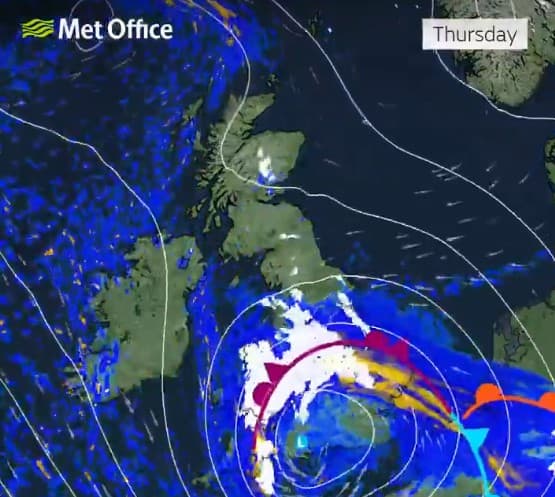
    Storm Goretti is sweeping across the UK, bringing a combination of powerful gusts, torrential rain and periods of snowfall.

    The Met Office has put a range of amber and yellow weather warnings in place nationwide, with forecasts suggesting that some areas could see up to a foot of snow alongside winds reaching speeds of 70mph.

    Weather experts in the UK, Ireland and the Netherlands previously announced the new list of names for the 2025/26 ‘storm season’, which runs until 31 August 2026.

    Of the list of 21 names, each of the national partners contributed seven, with some names chosen from pubic submissions. The Met Office takes suggestions through an online form.

    So what are this season’s storm names? How are these names chosen? And why are storms named in the first place?

    Here’s what you need to know.

    What are the storm names for 2026?

    The 2025/26 storm names

    Met Office

    The 2025/26 storm naming season began in September 2025, although the first named system did not arrive until October, when Storm Amy affected the UK.

    Storm Benjamin came next, but it largely impacted France, meaning the name was assigned by Météo-France rather than the Met Office.

    In November 2025, Storm Claudia followed, with the name selected by Spain’s national weather agency, AEMET.

    The Met Office then returned to its own list in December, naming the next storm Bram.

    Storm Goretti, which is currently impacting the UK, was named by Météo-France, the French national meteorological service, because the worst impacts were expected to be felt in France and the surrounding region before it moved towards the UK.

    The name itself doesn’t have a specific meteorological meaning, it is derived from a personal name (most famously associated with the Italian Saint Maria Goretti) and was part of the list used by Météo-France for the 2025–26 storm season.

    The next UK based storm will be called Chandra.

    Why are there no storms named with the letters Q, U, X, Y, and Z?

    Only 21 letters in the alphabet are included in the list of storm names as it is challenging to come up with six appropriate names (one for each of the six rotating lists), beginning with Q, U, X, Y, and Z.

    You will never see your name on the list of storms if your name starts with these letters.

    How are storm names chosen?

    A collaboration between the Met Office, Met Éireann (the Irish meteorological service), and KNMI (the Dutch meteorological service) names storms in the UK. This naming process is designed to make the public more aware of severe weather events and to ensure that people take necessary precautions when such storms are forecasted.

    Each service has chosen seven names on the alphabetical list (excluding the letters q, u, x, y and z).

    Each year, the UK Met Office, in collaboration with Met Éireann and KNMI, releases a list of names for the upcoming storm season. The names are selected alphabetically, alternating between male and female names.

    A storm is named when it is expected to have a significant impact, particularly if it is forecasted to bring strong winds, heavy rain, or snow that could cause substantial damage or pose a risk to life.

    The decision to name a storm is based on the potential for an amber or red warning (high or very high impact) to be issued.

    The Met Office and Met Éireann launched their first “Name our Storms” campaign in 2015. The tradition of naming storms began in the US in 1950 to help people “engage with weather forecasts”.

    Met Éireann in April 2024 named Storm Kathleen after two Irish scientists, Kathleen McNulty and Kathleen Lonsdale.

    You can learn more about the storm naming process here.

    Experts say storms are named to enhance communication and public safety. A specific name makes it easier for people to remember and discuss a storm, reducing confusion, especially when multiple storms are active simultaneously.

    This clarity helps consistently disseminate warnings and ensures that media, government agencies, and the public all refer to the same event.

    Additionally, naming storms increases public awareness and urgency, prompting people to take necessary precautions. A named storm tends to receive more media coverage, helping to spread important safety information. Overall, the practice simplifies communication, improves preparedness, and aids in the effective coordination of emergency responses.

    Rebekah Hicks, Chief Meteorologist at the UK Met Office said: “Naming storms isn’t just about giving them a label, it’s about making sure people take notice. When a storm has a name, it becomes easier for the media and public to talk about it, share information, and prepare.

    “It’s a simple step that can make a big difference in helping communities stay safe, protect their homes, and make informed decisions ahead of severe weather.”


    Source link

    Share. Facebook Twitter Pinterest LinkedIn Tumblr Email Telegram Copy Link

    Related Posts

    International

    Map: 3.8-Magnitude Earthquake Shakes Las Vegas

    June 4, 2026
    International

    Mistrust Spreads With the Ebola Virus in Congo

    June 4, 2026
    International

    Israel and Lebanon Agree to Renew Cease-Fire

    June 4, 2026
    International

    Protests Over Murder Case in Britain Turn Violent

    June 3, 2026
    International

    Where Is Iran’s Highly Enriched Uranium?

    June 3, 2026
    International

    Battling a Deadly Ebola Outbreak in Eastern Congo

    June 2, 2026
    Editors Picks

    The ‘internet of beings’ is the next fronteir that could change humanity and healthcare

    December 27, 2025

    Iranian missiles intercepted over Saudi, UAE, drones launched at Qatar | Israel-Iran conflict News

    March 7, 2026

    North Korea’s Kim Jong Un re-elected as chief of Workers’ Party | Kim Jong Un News

    February 23, 2026

    Trump’s ‘America First’ agenda will hit global growth, economists tell FT polls

    January 2, 2025

    The ‘Active 100-RBI MLB season leaders’ quiz

    February 17, 2026
    About Us
    About Us

    Welcome to Benjamin Franklin Institute, your premier destination for insightful, engaging, and diverse Political News and Opinions.

    The Benjamin Franklin Institute supports free speech, the U.S. Constitution and political candidates and organizations that promote and protect both of these important features of the American Experiment.

    We are passionate about delivering high-quality, accurate, and engaging content that resonates with our readers. Sign up for our text alerts and email newsletter to stay informed.

    Latest Posts

    Trump invokes Defense Production Act to keep U.S. coal plants running

    June 4, 2026

    Map: 3.8-Magnitude Earthquake Shakes Las Vegas

    June 4, 2026

    Market Talk – June 4, 2026

    June 4, 2026

    Subscribe for Updates

    Stay informed by signing up for our free news alerts.

    Paid for by the Benjamin Franklin Institute. Not authorized by any candidate or candidate’s committee.
    • Privacy Policy
    • About us
    • Contact us

    Type above and press Enter to search. Press Esc to cancel.