

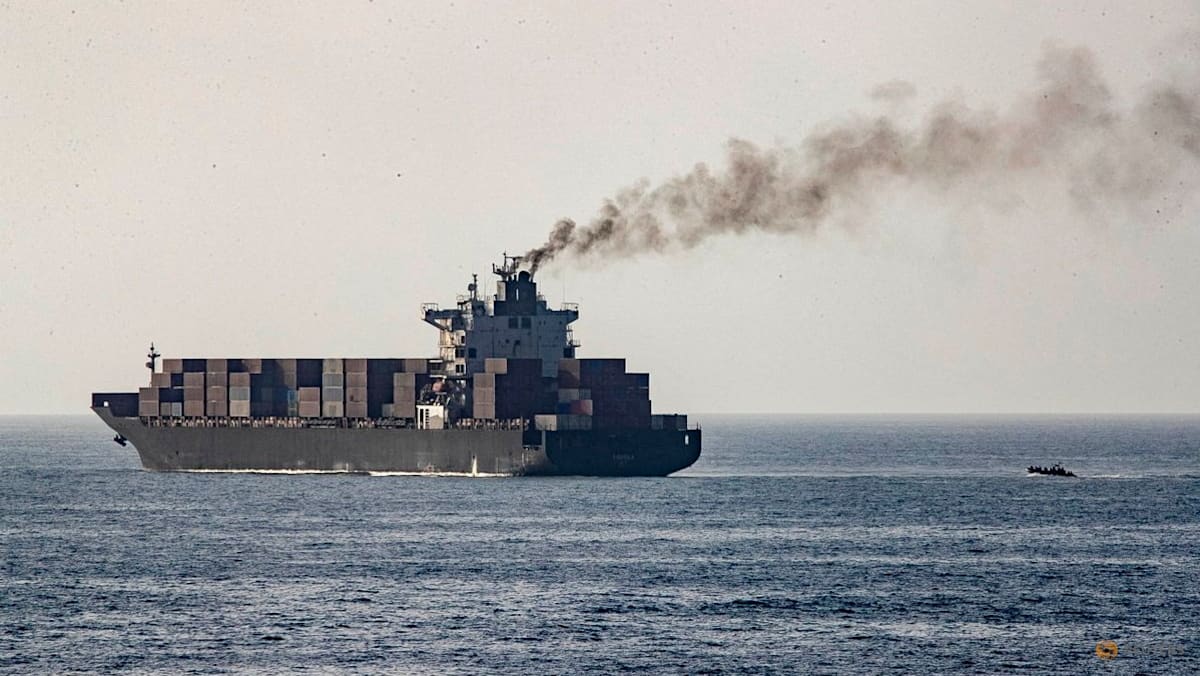
As a US-Iran ceasefire nears its expiry, Washington’s blockade of Iranian ports – and its seizure of a cargo ship – is adding to uncertainty.
Rather than forcing Tehran back to the negotiating table, the move has drawn fresh threats.
Iran has condemned the seizure as unlawful and a violation of international law, demanding the immediate release of the ship, its crew and their families.
What is the Touska?
The Touska is an Iranian-flagged container ship operated by the Islamic Republic of Iran Shipping Lines (IRISL), a company under US sanctions since 2019.
Washington has accused IRISL of acting as a logistics arm for Iran’s proliferation networks, including transporting materials linked to its ballistic missile programme.
The Touska’s crew includes an Iranian captain and Iranian sailors, although it is not clear if the entire crew are Iranian nationals, a maritime security source told Reuters.
Some IRISL ships are known to employ Pakistani seafarers.
According to satellite tracking, the Touska recently travelled from China, calling at Taicang port north of Shanghai and Gaolan port in southern Guangdong province.
It then stopped near Malaysia’s Port Klang to load additional cargo on Apr 11 and 12.
The vessel was carrying containers when it reached the Gulf of Oman on Apr 19, before it was boarded by the US Navy off the coast of Iran’s Chabahar port.
What was it carrying?
US officials say the Touska may have been transporting so-called “dual-use” goods – items that can serve both industrial and military purposes.
Maritime security sources told Reuters that the vessel had previously transported such cargo, and initial assessments suggests the same for its latest voyage from Asia.
US Central Command (CENTCOM) has identified materials like metals, pipes and electronic components as examples of goods that are potential dual-use items, although the exact contents of the Touska remain unclear.
US President Donald Trump said on Apr 19 that the Touska was under US sanctions due to its “prior history of illegal activity”, adding that US forces were “seeing what’s on board”.