

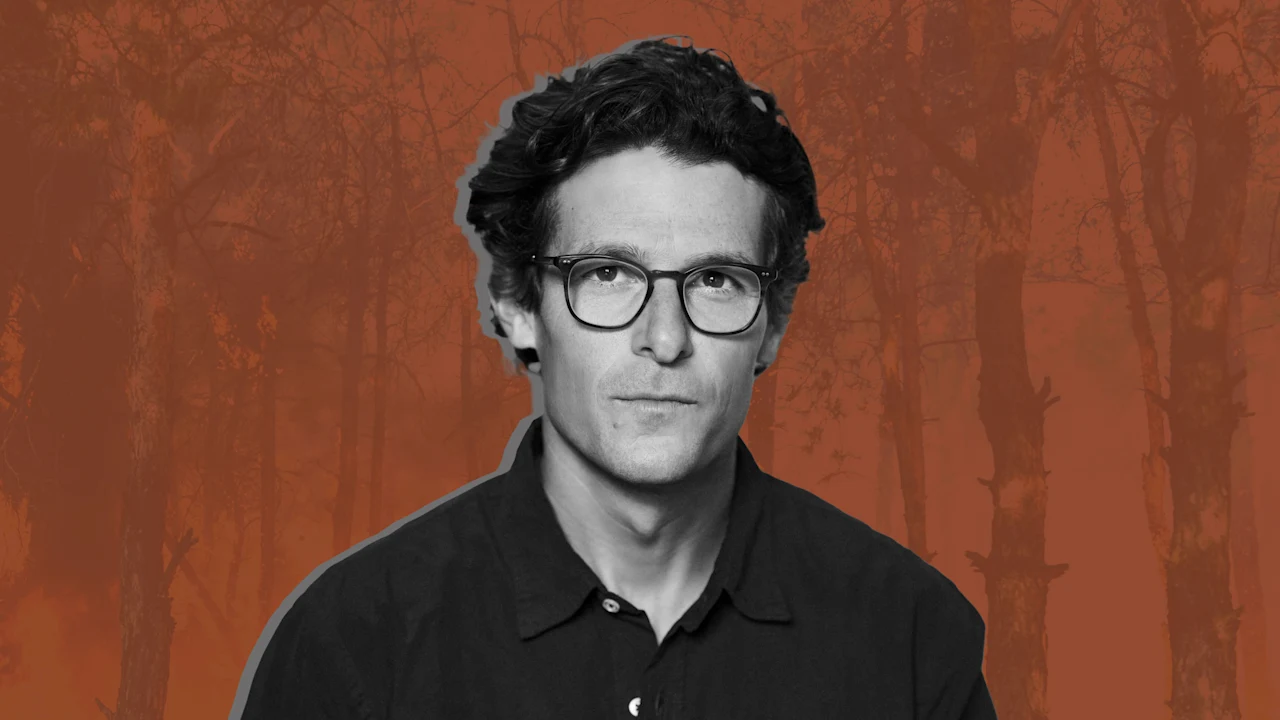
One year on from the catastrophic LA wildfires, journalist, author, and MS NOW correspondent Jacob Soboroff examines what the fires reveal about America’s growing age of disaster. Drawing from his new book Firestorm, Soboroff shares hard lessons from the aftermath, exposing systemic failures, unlikely heroics, and what today’s recovery efforts tell us about how the U.S. will respond to the next crisis.
This is an abridged transcript of an interview from Rapid Response, hosted by the former editor-in-chief of Fast Company Bob Safian. From the team behind the Masters of Scale podcast, Rapid Response features candid conversations with today’s top business leaders navigating real-time challenges. Subscribe to Rapid Response wherever you get your podcasts to ensure you never miss an episode.
You grew up in the Palisades, which were the heart of the fires. For our listeners who haven’t been there, can you describe the Palisades? What it looks like, what type of place it is, and then what happened when the fire swept through and the aftermath?
Pacific Palisades is a coastal enclave, I think you could say, in between Santa Monica and Malibu, the iconic Malibu, and it’s nestled along the Pacific Coast. And it’s actually on the absolute opposite side of Los Angeles County from Altadena where the Eaton fire also burned. And the reason it’s the costliest wildfire event in the history of the country is that both of these massive urban conflagrations unfolded at the same time.
The Palisades fire due to a holdover fire from an arson fire seven days earlier up at the top of Lachman Lane in the Santa Monica Mountains, and the Eaton Fire in Altadena because of, the prevailing theory goes, faulty electrical equipment that energized and led to a spark, that when there were hurricane force Santa Ana wind gusts 80 miles per hour or greater, which by the way, were predicted by the National Weather Service as a particularly dangerous situation, one spark like that led to what they knew was going to be a catastrophic situation.
And so the Palisades, the fire raced down from the Santa Monica Mountains and engulfed the community of tens of thousands, and the same exact thing happened in Eaton Canyon on the other side of Los Angeles County, engulfing Altadena.
You said that the winds were predicted. There are some folks who talk about how the conditions were unprecedented, these hurricane force winds, and dry landscape, and densely populated homes altogether. Folks weren’t really prepared to handle what unfolded.
No, definitely not, and growing up in the Palisades, I evacuated the house that we lived in as a kid, and you always return home and the house is fine. And certainly, there have been homes lost in these fires, but nothing like this. Nothing like thousands of homes, 31 people killed, hundreds of thousands of people displaced. This was something that I don’t think any of us had ever seen, and as you mentioned, the conditions were such that we had received barely any rain at all in the late part of 2024 and into the beginning of 2025, and so Los Angeles was a tinderbox ready to go.
And I think what I’ve uncovered, discovered, learned about what it was that I experienced was that this was really the fire of the future. I thought it was a time machine into my past, but really, it was a look into the future that my children and our children will inhabit. And when I say the fire of the future, this was a senior emergency manager working for the federal government that said to me in a clandestine meeting after the fires, who this guy had been to every mass casualty fire in the last five years working for the federal government, there’s not one proximate cause.
And certainly, there’s lots of investigative reporting to be done about whether or not there were predeployed firefighters in the right places or the reservoir was full, and it wasn’t full and should have been and who’s to blame for that? Or should Karen Bass, the mayor of LA, have been in town or out of town? Did Gavin Newsom do what he said? Did Donald Trump’s misinformation and disinformation affect this as the president elect?
But really, this man, Jonathan White, from the Commissioned Health Service Corps, said to me, he took my notebook and he said, “Let me draw an X on it.” And on the forums of the X were obviously climate change, infrastructure falling apart, changes in the way we live, thousands of electric car batteries, another new technology exploding during the fires. And then the big one is the misinformation and the disinformation in terms of how people got notified, or didn’t, about what was happening in Los Angeles.
And all of those things together is what made this not only the Great Los Angeles Fires, but also in some measure, the new age of disaster, America’s new age of disaster where it isn’t just a spark. It’s a spark combined with our politics, it’s a spark combined with the ways we live, it’s a spark combined with hurricane force winds in bone dry Los Angeles in the middle of the winter. It’s all of those things combined.
You write in the book about people fighting to save their homes or spraying down their own property with flames all around them. What’s our individual responsibility in a disaster versus what we should be expecting of our government? The tales of people spraying down their own houses, it seems dangerous.
I think it certainly was. My own brother spent a long time considering whether or not to leave their house that ultimately burned down that he was living in, his in-laws’ home. And I know many stories like that, that people didn’t leave till the very last second, and I think it’s human nature to want to stand up and defend what is yours. These men and women of the LA County Fire Department, of the LA City Fire Department, of the mutual aid efforts from all over not just Southern California, but the American West and Mexico and Canada, firefighters came from everywhere, thousands and thousands of firefighters. They did everything they could to stop this blaze.
There’s a firefighter, Eric Mendoza, who I write about, who laid on his stomach in the middle of El Medio Street in the Palisades with his hose, two and a half diameter hose, biggest hose they could flow open full bore with thousand plus degree temperatures, automobile metal melting around them, and saying to himself, “I’m going to have black shit in my lungs and be coughing up stuff for days and weeks. I can barely see. I need to go into a house to wash my eyes out.”
The question is what’s our government’s role? Our government’s role is to provide services to us to mitigate and ideally stop, but the reality is it’s not going to be possible. And as I said, are there questions to ask about could there have been more pre-deployed firefighters in the Palisades? Of course, those are important questions to ask.
But to me, it’s also as much a story, if it’s a story about failures, it’s a story about hope, because I got to meet and spend time around incredible people, not just the firefighters from the Palisades and from Altadena, wildlife biologists who studied the animals that were the first to repopulate these areas, federal government employees like the meteorologists that predicted this stuff. All of them give me hope in the way in which they have approached this. Day laborers, by the way, who are out rebuilding and cleaning up, despite the fact that they’re under the crosshairs of this administration.
I always find that in a catastrophe, there are hopeful threads. It’s easy to think about the negative parts of this, but to me, I’m also as uplifted as I’ve ever been after having a really hard year, and I think that that’s what this book was for me as much as anything, which was a cathartic process to work through.