

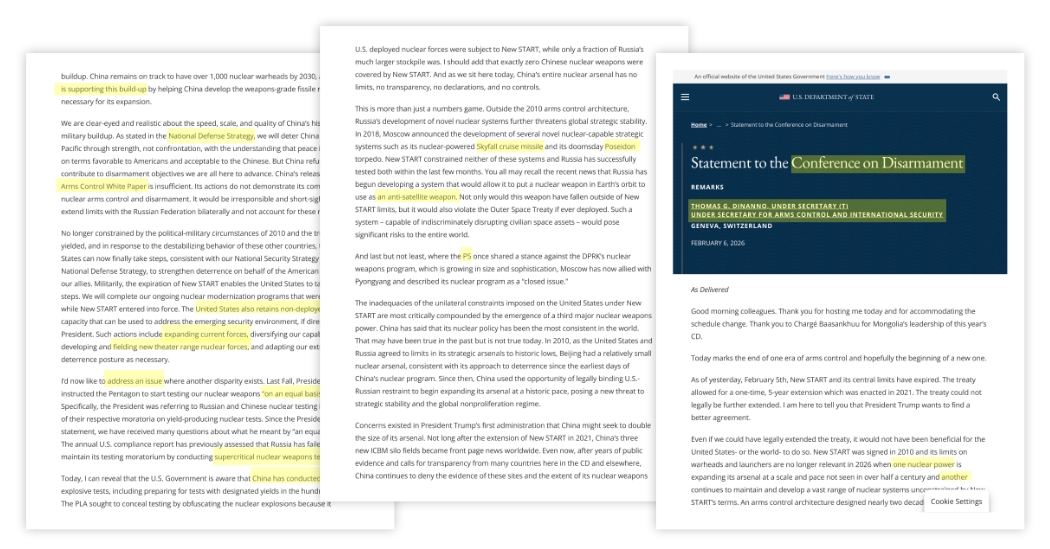
Within hours of the expiration last week of the final arms control treaty between Moscow and Washington, the State Department sent its top arms diplomat, Thomas G. DiNanno, to Geneva to lay out Washington’s vision for the future. His public address envisioned a future filled with waves of nuclear arms buildups and test detonations.
The views of President Trump’s administration articulated in Mr. DiNanno’s speech represent a stark break with decades of federal policy. In particular, deep in the speech, he describes a U.S. rationale for going its own way on the global ban on nuclear test detonations, which had been meant to curb arms races that in the Cold War had raised the risk of miscalculation, and war.
This annotation of the text of his remarks aims to offer background information on some of the specialized language of nuclear policymaking that Mr. DiNanno used to make his points, while highlighting places where outside experts may disagree with his and the administration’s claims.
What remains unknown is the extent to which Mr. DiNanno’s presentation represents a fixed policy of unrestrained U.S. arms buildups, or more of an open threat meant to spur negotiations toward new global accords on ways to better manage the nuclear age.
New York Times Analysis
Next »
1
Established in 1979 as Cold War arsenals grew worldwide, the Conference on Disarmament is a United Nations arms reduction forum made up of 65 member states. It has helped the world negotiate and adopt major arms agreements.
2
In his State Department role, working under Secretary of State Marco Rubio, Mr. DiNanno is Washington’s top diplomat for the negotiation and verification of international arms accords. Past holders of that office include John Bolton during the first term of the George W. Bush administration and Rose Gottemoeller during Barack Obama’s two terms.
3
This appears to be referring to China, which has 600 nuclear weapons today. By 2030, U.S. intelligence estimates say it will have more than 1,000.
4
Here he means Russia, which is conducting tests to put a nuclear weapon into space as well as to develop an underwater drone meant to cross oceans.

New York Times Analysis
« Previous Next »
5
In this year’s federal budget, the Trump administration is to spend roughly $90 billion on nuclear arms, including basic upgrades of the nation’s arsenal and the replacement of aging missiles, bombers and submarines that can deliver warheads halfway around the globe.
6
A chief concern of many American policymakers is that Washington will soon face not just a single peer adversary, as in the Cold War, but two superpower rivals, China and Russia.

New York Times Analysis
« Previous Next »
7
The 1987 Intermediate-Range Nuclear Forces Treaty or I.N.F. banned all weapons capable of traveling between 500 and 5,500 kilometers, or 310 and 3,420 miles, whether armed with nuclear or conventional warheads. The Trump administration is now deploying a number of conventionally armed weapons in that range, including a cruise missile and a hypersonic weapon.
8
The destructive force of the relatively small Russian arms can be just fractions of the Hiroshima bomb’s power, perhaps making their use more likely. The lesser warheads are known as tactical or nonstrategic nuclear arms, and President Vladimir V. Putin of Russia has repeatedly threatened to use them in Ukraine.
9
Negotiators of arms control treaties have mostly focused on long-range weapons because the delivery vehicles and their deadly warheads are considered planet shakers that could end civilization.

New York Times Analysis
« Previous Next »
10
This underwater Russian craft is meant to cross an ocean, detonate a thermonuclear warhead and raise a radioactive tsunami powerful enough to shatter a coastal city.
11
The nuclear power source of this Russian weapon can in theory keep the cruise missile airborne far longer than other nuclear-armed missiles.
12
Russia has conducted test launches for placing a nuclear weapon into orbit, which the Biden administration quietly warned Congress about two years ago.
13
The term refers to the five permanent members of the United Nations Security Council—China, France, Russia, the United Kingdom and the United States.

New York Times Analysis
« Previous Next »
14
A top concern of American officials is that Beijing and Moscow might form an alliance to coordinate their nuclear forces. Their joint program to develop fuel for atom bombs is seen as an indication of this emerging threat.
15
This Trump administration plan is dated November but was made public in December.
16
Released last year, this Chinese government document sought to portray Beijing as a leader in reducing the global threat of nuclear weapons.
17
Typically, arms control treaties have not required countries to destroy warheads so their keepers put them into storage for possible reuse. The United States retains something on the order of 20,000 small atom bombs meant to ignite the larger blasts of hydrogen bombs.
18
An imminent surge centers on the nation’s Ohio-class submarines. The Trump administration has called for the reopening of submarine missile tubes that were closed to comply with the New START limits. That will add as many 56 long-range missiles to the fleet. Because each missile can hold multiple arms, the additional force adds up to hundreds more warheads.
19
This refers to weapons meant for use on a battlefield or within a particular geographic region rather than for aiming at distant targets. It is often seen as synonymous with intermediate-range weapons.
20
Here, the talk turns to the explosive testing of nuclear weapons for safety, reliability and devising new types of arms. The United States last conducted such a test in 1992 and afterwards adopted a policy of using such nonexplosive means like supercomputer simulations to evaluate its arsenal. In 1996, the world’s nuclear powers signed a global ban on explosive testing. A number of nations, including the United States and China, never ratified the treaty, and it never officially went into force.
21
In new detail, the talk addresses what Mr. Trump meant last fall when he declared that he had instructed the Pentagon “to start testing our Nuclear Weapons on an equal basis” in response to the technical advances of unnamed foreign states.
22
Outside experts say the central issue is not whether China and Russia are cheating on the global test ban treaty but whether they are adhering to the U.S. definition. From the treaty’s start in 1996, Washington interpreted “zero” explosive force as the compliance standard but the treaty itself gives no definition for what constitutes a nuclear explosion. Over decades, that ambiguity led to technical disputes that helped block the treaty’s ratification.
23
By definition, all nuclear explosions are supercritical, which means they split atoms in chain reactions that become self-sustaining in sufficient amounts of nuclear fuel. The reports Mr. DiNanno refers to told of intelligence data suggesting that Russia was conducting a lesser class of supercritical tests that were too small to be detected easily. Russian scientists have openly discussed such small experiments, which are seen as useful for assessing weapon safety but not for developing new types of weapons.
24
This sounds alarming but experts note that the text provides no evidence and goes on to speak of preparations, not detonations, except in one specific case.

New York Times Analysis
« Previous
25
The talk gave no clear indication of how the claims about Russian and Chinese nuclear testing might influence U.S. arms policy. But it repeated Mr. Trump’s call for testing “on an equal basis,” suggesting the United States might be headed in that direction, too.
26
The talk, however, ended on an upbeat but ambiguous note, giving no indication of what Mr. DiNanno meant by “responsible.” Even so, the remark came in the context of bilateral and multilateral actions to reduce the number of nuclear arms in the world, suggesting that perhaps the administration’s aim is to build up political leverage and spur new negotiations with Russia, China or both on testing restraints.

