

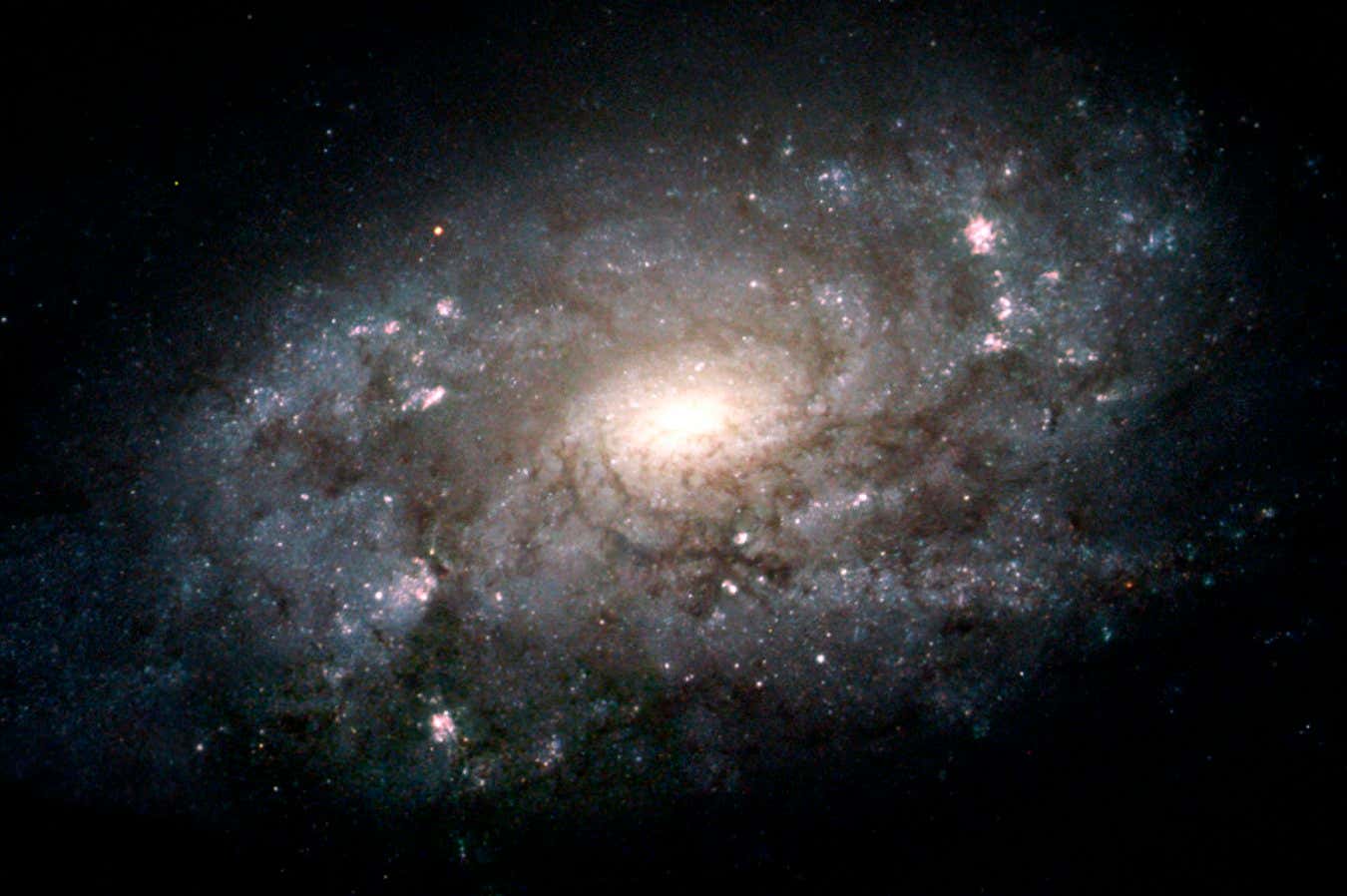
Did the black hole at the centre of this galaxy begin before the galaxy formed?
NASA, ESA, STScI, AURA; S. Smartt/The Queen’s University of Belfast
If, as novelist-philosopher Samuel Butler wrote in 1878, “a hen is only an egg’s way of making another egg”, then a galaxy may only be a black hole’s way of making another black hole. To put it another way, in the problem of which came first, it seems the black hole wins out.
Every massive galaxy we’ve ever seen, across the entire universe, has a supermassive black hole at its centre. The two are inextricably linked: all the stuff of the galaxy feeds the black hole, which, in turn, shapes the galaxy’s evolution. But how that symbiosis begins is a long-standing question in cosmology. Does a black hole form and then gather material around it to create a galaxy, or does a galaxy grow and then collapse in the middle to forge a black hole?
A key part of that question is the seeming impossibility of supermassive black holes themselves. They are simply too big to exist. Or at least they’re too big to have started to exist when they did, which was less than 500 million years after the big bang. That might sound like a lot of time to grow, but if the lifetime of the universe were a calendar, with the big bang being 1 January and today being 31 December, the first supermassive black holes were already hundreds of millions of times the mass of the sun by the middle of January. According to the laws of physics as we understand them, there is no obvious way they could have grown so enormous so fast.
There are four ways, that we know of, to make supermassive black holes. The most intuitive is through mergers of regular old stellar-mass black holes that form when massive stars collapse – but even just growing a star takes hundreds of millions to billions of years, and then they have to collapse and then go on to merge. There wasn’t enough time to get to all this. The second is through the formation of what’s called a massive seed, which would probably be a very large one of the earliest stars, called primordial stars, or a star made of dark matter or even a stellar cluster. That just kicks the can down the road, though, because you still have to form that seed extremely early in the universe and, again, we only have 500 million years to work with and that’s not enough. So we’re left with two viable options: direct collapse, in which a huge cloud of gas is kept from forming stars due to powerful radiation until it gets so massive that it turns directly into a black hole without any other intermediate steps, and primordial black holes.
Primordial black holes are particularly controversial because there is no hard evidence for them, but they would also be particularly useful if they did exist. They would also be extra weird, so while I’m personally very sceptical about their existence, I hope they are out there. If they do exist, they would have formed in the first moments after the big bang, not from stars (stars didn’t exist yet) but simply because of the extreme pressure of the early universe. Most of the interest in them is because they could be much smaller than any other type of black hole, but that’s not the thing that we care about here. When it comes to galaxy formation, the sort we care about would actually be huge, because they would have started bigger and formed earlier than any of the other options.
If primordial black holes are real and also the method by which supermassive black holes got so big so early on, that’s a definitive answer to the chicken-or-the-egg problem. Galaxies could not have possibly formed as early as these black holes. But we don’t have any evidence for them.
Or at least, we didn’t. Thanks to the James Webb Space Telescope (JWST), lately we’ve been able to see closer than ever to the beginning of the cosmic year, and every time period we look at seems to already have supermassive black holes. The structure of galaxies changes as we look further and further back, though. The biggest and flashiest example of that from JWST has been the emergence of distant galaxies dubbed little red dots, which we had never seen before but which JWST has spotted hundreds of. They are, as their name suggests, small, red, and really, really far away.
It took a while to fully confirm that these were, in fact, galaxies, but now we’re fairly certain about it. Assuming that they are galaxies, the black holes at their centres are unusually big and spinning extraordinarily fast. There are several other mysteries, too, but the size of those black holes is the really weird one. When researchers figured out in 2024 that the black holes were probably between 20 and 70 per cent the masses of these galaxies – most supermassive black holes are significantly less than half the masses of their host galaxies – it seemed there was no real way to reconcile that.
JWST to the rescue again. Plus, a coincidence of geometry that magnified the light of a little red dot called Abell 2744-QSO1 (or just QS01), which gave astronomers an unprecedented view of a galaxy that existed just 700 million years after the big bang. By measuring the velocity of the gas orbiting the centre of it, which is moving extraordinarily fast, they managed to calculate the masses of QS01 and its central black hole – a measurement that has never before been made for any black hole within a billion years of the big bang. The black hole, it turns out, is about 50 million solar masses. The entire galaxy is at most around 75 million.
There are only two ways to explain that, either direct collapse or a primordial black hole, and neither involve the galaxy forming before the black hole. So it seems that the black hole at the centre of this particular galaxy, at least, was the egg, and came first. Problem solved.
Of course, it’s never quite so easy as that. We now need to check as many other little red dots as we can to see if QS01 is typical, and try to figure out how exactly its black hole formed and what the rest of the galaxy is made of. Undoubtedly the answers to those questions will bring up another slew of mysteries. But it’s worth celebrating a win, and just this once we can finally say: the egg came first.
Topics: