
Close Menu
    Trending
    • England vs Croatia – World Cup 2026: Kane, predictions, TV channel, kickoff | World Cup 2026 News
    • Nike hoping two-time NBA MVP will save struggling brand
    • Why employers should treat domestic violence as a workplace issue
    • Math predicts humans could go extinct in about 17,000 years
    • Among Mexico’s World Cup Fans: Merlin the Duck
    • Kevin Warsh And The End Of The Powell Era
    • Hints About Why Jelly Roll Ended Bunnie Xo Marriage Surface
    • Macron winds up G7 with AI, Trump dinner
    Benjamin Franklin Institute
    Wednesday, June 17
    • Home
    • Politics
    • Business
    • Science
    • Technology
    • Arts & Entertainment
    • International
    Benjamin Franklin Institute
    Home»Science»Watch NASA test its new X-59 jet designed to go faster than the speed of sound
    Science

    Watch NASA test its new X-59 jet designed to go faster than the speed of sound

    Team_Benjamin Franklin InstituteBy Team_Benjamin Franklin InstituteMay 2, 2026No Comments3 Mins Read
    Share Facebook Twitter Pinterest Copy Link LinkedIn Tumblr Email VKontakte Telegram
    Share
    Facebook Twitter Pinterest Email Copy Link


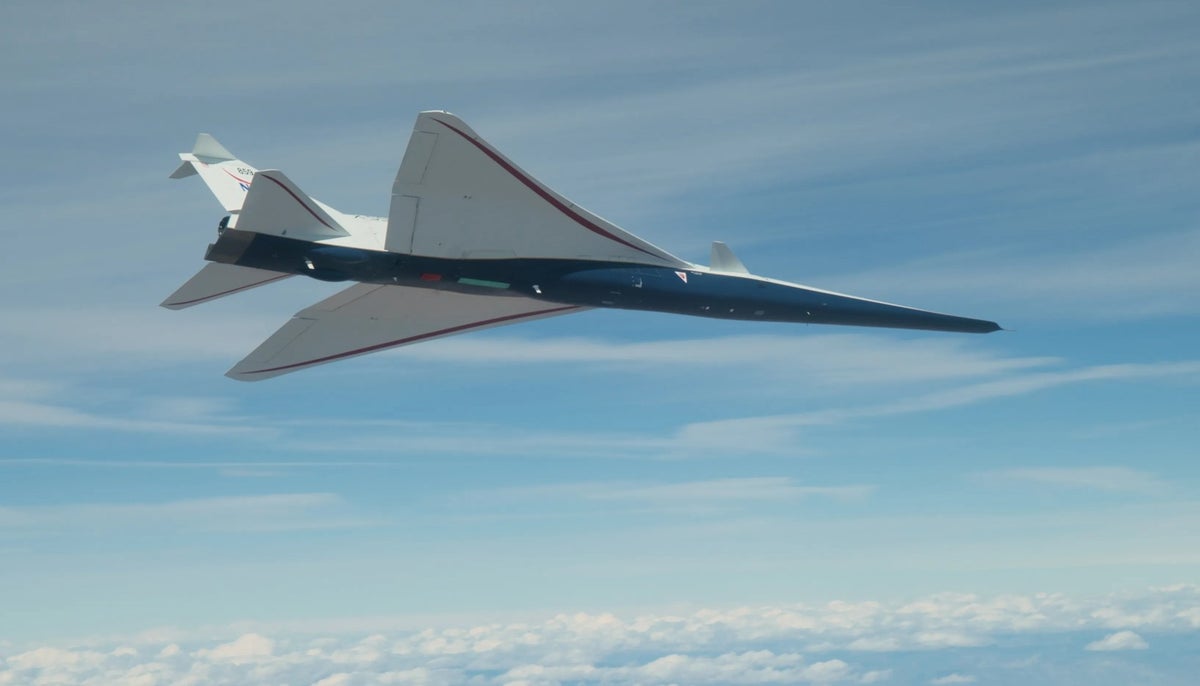
    NASA wants to make supersonic travel quieter. On Thursday the agency released new footage of its X-59 jet, a still-in-development plane that is designed to break the sound barrier over land—but with a sonic “thud” rather than a boom.

    Faster air travel speeds mean shorter flights. But when an aircraft travels more rapidly than the speed of sound, it creates shock waves, generating a sonic boom. Those sonic booms can be a nuisance for people living nearby and can even cause damage to homes and startle animals.

    The X-59 jet is NASA’s answer to that problem. Featuring a needlelike tip, it’s designed to travel at more than 1,000 miles per hour—about twice as fast as a commercial jet—while limiting the noise of the boom. NASA expects its sonic “thump” to be as loud as “distant thunder” or the thud of a car door closing down the block.


    On supporting science journalism

    If you’re enjoying this article, consider supporting our award-winning journalism by subscribing. By purchasing a subscription you are helping to ensure the future of impactful stories about the discoveries and ideas shaping our world today.


    NASA’s X-59 quiet supersonic research aircraft sits inside Hangar 4826 at the agency’s Armstrong Flight Research Center in Edwards, Calif., on November 18, 2025.

    NASA/Christopher LC Clark

    The new test footage shows the X-59 jet performing various in-air maneuvers, including rolling from side to side, up, and down and deploying its landing gear, above the Mojave Desert in California.

    Eventually, NASA hopes to deliberately fly the jet over neighborhoods in the U.S. and to survey residents about their experience with hearing the reduced sound.

    It’s Time to Stand Up for Science

    If you enjoyed this article, I’d like to ask for your support. Scientific American has served as an advocate for science and industry for 180 years, and right now may be the most critical moment in that two-century history.

    I’ve been a Scientific American subscriber since I was 12 years old, and it helped shape the way I look at the world. SciAm always educates and delights me, and inspires a sense of awe for our vast, beautiful universe. I hope it does that for you, too.

    If you subscribe to Scientific American, you help ensure that our coverage is centered on meaningful research and discovery; that we have the resources to report on the decisions that threaten labs across the U.S.; and that we support both budding and working scientists at a time when the value of science itself too often goes unrecognized.

    In return, you get essential news, captivating podcasts, brilliant infographics, can’t-miss newsletters, must-watch videos, challenging games, and the science world’s best writing and reporting. You can even gift someone a subscription.

    There has never been a more important time for us to stand up and show why science matters. I hope you’ll support us in that mission.


    Source link

    Share. Facebook Twitter Pinterest LinkedIn Tumblr Email Telegram Copy Link

    Related Posts

    Science

    Math predicts humans could go extinct in about 17,000 years

    June 17, 2026
    Science

    Proposed White House regulations could kill 5,000 clinical trials, analysis finds

    June 17, 2026
    Science

    Ozempic maker Novo Nordisk breach exposed patients’ clinical trial data

    June 16, 2026
    Science

    The secrets to keeping your brain sharp in old age

    June 16, 2026
    Science

    Walking shark found in Papua New Guinea is new to science

    June 16, 2026
    Science

    Technology is changing our perspective on nature – at every scale

    June 16, 2026
    Editors Picks

    Trump tells US that Iran war victory near, but vows big strikes

    April 2, 2026

    Sydney welcomes New Year with spectacular fireworks

    December 31, 2025

    Unintended Consequences of Video Surveillance

    June 10, 2026

    War Is Now Appearing In Inflation Data

    June 11, 2026

    Wild CFP stat shows how indelible Nick Saban’s legacy is

    January 3, 2026
    About Us
    About Us

    Welcome to Benjamin Franklin Institute, your premier destination for insightful, engaging, and diverse Political News and Opinions.

    The Benjamin Franklin Institute supports free speech, the U.S. Constitution and political candidates and organizations that promote and protect both of these important features of the American Experiment.

    We are passionate about delivering high-quality, accurate, and engaging content that resonates with our readers. Sign up for our text alerts and email newsletter to stay informed.

    Latest Posts

    England vs Croatia – World Cup 2026: Kane, predictions, TV channel, kickoff | World Cup 2026 News

    June 17, 2026

    Nike hoping two-time NBA MVP will save struggling brand

    June 17, 2026

    Why employers should treat domestic violence as a workplace issue

    June 17, 2026

    Subscribe for Updates

    Stay informed by signing up for our free news alerts.

    Paid for by the Benjamin Franklin Institute. Not authorized by any candidate or candidate’s committee.
    • Privacy Policy
    • About us
    • Contact us

    Type above and press Enter to search. Press Esc to cancel.