

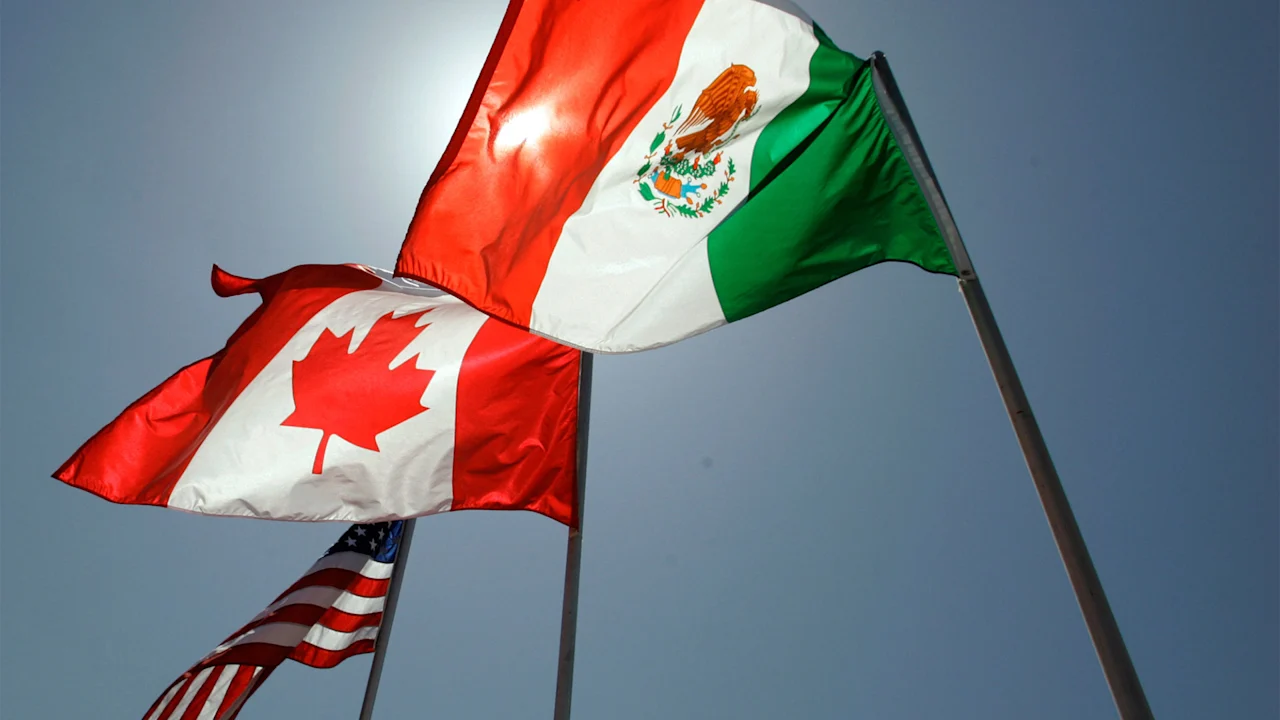
Every day more than $4 billion worth of goods cross the United States’ borders with Canada and Mexico—U.S. auto parts headed for car factories in northern Mexico, cartons of Mexican avocados bound for California supermarkets, Canadian aluminum destined to become cans of Campbell Soup.
Much of this bustling cross-border commerce is duty-free, thanks to the US-Mexico-Canada Agreement, or USMCA, that President Donald Trump negotiated with America’s northern and southern neighbors during his first term.
But the future of the USMCA , which took effect July 1, 2020, is cloudy as the three countries begin what could be a tempestuous attempt to renew the pact this year. The United States is demanding changes to the treaty, and the top U.S. trade negotiator told Politico in December that Trump would be willing to pull the United States out of the pact if he can’t get the deal he wants. Trump also suggested last fall that the United States could negotiate separate deals with Canada and Mexico, ending the three-country North American bloc that previous administrations saw as crucial to competing economically with China and the European Union.
The talks kick off Monday between U.S. and Mexican trade officials.
The North American economies could agree to renew USMCA as it is for another 16 years— a prospect that appears unlikely. Or they could keep working on ways to improve it; under a convoluted renewal process, they have until 2036 to reach an agreement — or the pact expires.
Meantime, any USMCA country can pull out of the pact provided it gives its two partners six months’ notice – an option that Canada and Mexico, heavily dependent on trade with the United States, fear the impulsive Trump might end up choosing.
At stake is $1.6 trillion worth of annual trade in goods between the United States and its two USMCA partners. Mexico and Canada are far ahead of China in both exports to and imports from the United States. American farmers are especially keen to see the deal renewed: Last year, they shipped nearly $31 billion in agricultural products to Mexico and $28 billion to Canada.
U.S. imports from Canada and Mexico were spared the worst of Trump’s 2025 tariffs; many goods compliant with USMCA rules continued to enter the United States duty free. Still, a number of products did not get protection from the U.S. levies, including medium- and heavy-duty trucks, which face a 25% tariff. A 50% tariff on steel, aluminum and copper remains in effect, as does a 17% tariff on Mexican tomatoes.
The USMCA replaced the 1994 North American Free Trade Agreement negotiated by President George H.W. Bush and signed into law by President Bill Clinton.
Trump and other critics had criticized NAFTA as a killer of U.S. jobs because it encouraged U.S. companies to relocate factories south of the border to take advantage of low-wage Mexican labor and then send goods back to the United States duty free.
The USMCA, ratified by Congress with rare support from Republicans and Democrats alike, ended up being very similar to NAFTA. But it did contain provisions designed to encourage factories in the region to pay higher wages and make sure that more of what they made originated in North America.
The new pact updated North American trade rules for the digital age. The USMCA, for instance, bars the United States, Mexico and Canada from slamming each other with import taxes on music, software, games and other products sold electronically.
A proud Trump declared the USMCA “the fairest, most balanced and beneficial trade agreement we have ever signed.”
But the president’s enthusiasm seems to have waned. In January, he expressed little interest in the upcoming talks to renew the agreement. The effort, he said, offered “no real advantage to us. It’s irrelevant to me.”
The USMCA did little to ease one of Trump’s biggest complaints: The U.S. deficit in the trade of goods with Mexico, which rose last year to a record $197 billion as the United States reduced its reliance on Chinese imports. The U.S. also ran a merchandise trade deficit with Canada of $46.4 billion last year, a decrease from 2024.
“Improvements are required for it to deliver the high-wage U.S. manufacturing powerhouse and balanced trade (Trump) promised and we need,” said Lori Wallach, director of the Rethink Trade program at the American Economic Liberties Project.
The United States plans to push for a series of changes, including stronger rules to ensure that goods from China won’t slip into the United States under USMCA; to encourage more production in the United States; and to ensure more access to Canada’s protected dairy market for U.S. farmers.
Mexico’s core priorities are to avoid a major rewrite of the agreement and to make rules of origin more flexible —allowing imports of parts from outside North America when they are not available in the region. Mexican negotiators also want assurances that anything agreed to will stick, providing insurance against Trump’s unpredictability and his enthusiasm for tariffs.
Mexico wants to minimize tariffs as much as possible. Mexican Economy Secretary Marcelo Ebrard said Mexico wants to strengthen the dispute resolution system already in place under the treaty. That would not eliminate the possibility of tariffs, but it would provide clear, swift channels for seeking solutions when problems arise, he said.
Mexican President Claudia Sheinbaum’s administration will have to simultaneously manage existing security issues, which are ongoing after the killing of Jalisco New Generation Cartel’s leader in late February, and which could influence economic matters.
Mexico anticipates that Canada will join the talks later, but its top priority in the coming months is to reach agreements and maintain the free trade with the United States, its main commercial partner.
Mexico is pushing the idea that the treaty is also good for the US. “The integration of our countries is an absolute prerequisite for the United States to remain competitive,” Ebrard said recently. “We must move forward together; otherwise, we will not succeed.”
—Paul Wiseman and María Verza, Associated Press