

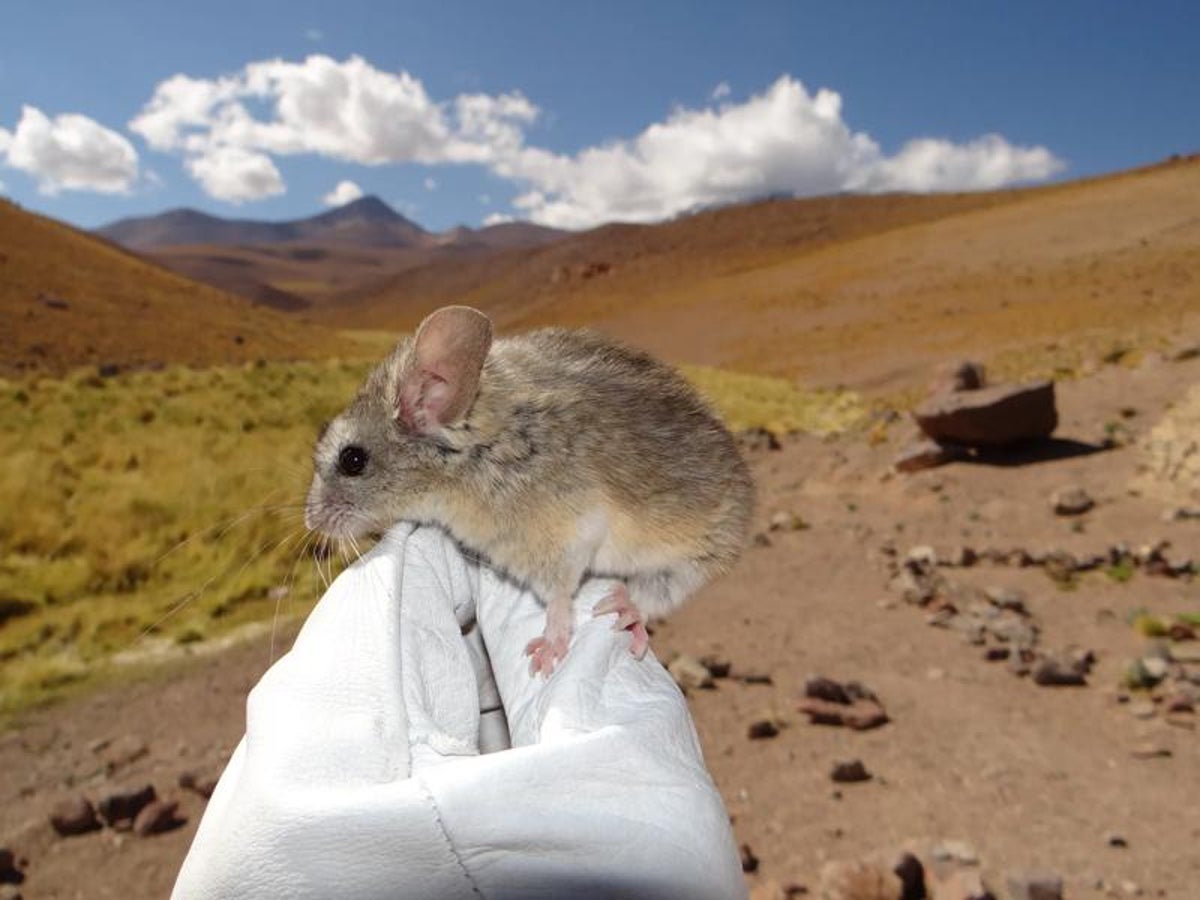
More than 22,000 feet above sea level—and 6,000 feet higher than the highest human settlement—you might find an Andean leaf-eared mouse, the highest-dwelling mammal in the world.
Six years ago a mountaineering research team spotted one of these mice living at the highest-known altitude for a mammal. Now a new study delves into just how the mice survive at such high altitudes, which afford less than half of the oxygen available at sea level.
Jay Storz, an evolutionary biologist at the University of Nebraska and a co-author of the paper, scooped up the Andean leaf-eared mouse specimen at the highest altitude in 2020.
On supporting science journalism
If you’re enjoying this article, consider supporting our award-winning journalism by subscribing. By purchasing a subscription you are helping to ensure the future of impactful stories about the discoveries and ideas shaping our world today.
“This study is focused on how they evolved the physiological ability to cope with the reduced oxygen availability and the constant freezing temperatures,” Storz says.
The mouse also has the largest known elevational dwelling range of any known mammal. Some Andean leaf-eared mice live on Chile’s desert coasts, while others abide on the frigid peaks of the Andes Mountains. Storz and his team studied 167 specimens collected from across the species’ entire range. The researchers probed the animals’ physiology and genetics to understand how they can thrive at sea level and the highest reaches of the world.
The team found that the high-altitude mice have a heightened capacity to produce heat, largely because of distinct adaptations to their skeletal muscle, which means they can shiver in such a way that they stay warm even in cold temperatures.
On a genomic level, the researchers found sequences of genes that are typically seen in other high-altitude animals, such as genes adapted for hypoxia, or a lack of oxygen. But they also came across a surprise: the high-altitude mice had gene sequences that allowed them to eat and metabolize desert plants that would be toxic for other animals. These plants are commonly found in the arid Andes Mountains, suggesting that the mice likely evolved to weather both harsh atmospheric conditions and nutritional challenges.
Storz emphasizes how difficult it is to evolve for this climate—in part because he has been in it himself.
“We’ve continually been surprised by the ability of these animals to live in these super hostile environments, and when you’re out there working, you have a really direct experience of how hostile those environments are,” he says.
Beyond a “fascinating discovery about a weird animal,” Storz says, understanding the inner workings of these mice allows scientists to understand how other animals, including humans, might adapt to low-oxygen environments. Specifically, this research could help guide the design of treatments for diseases that cause a lack of oxygen.
The study is a “point of inflection” for understanding high-altitude biology, says Jorge Salazar-Bravo, an associate professor of biology at Texas Tech University, who was not involved in the work. More research is needed to fully answer how the mouse adapted to its habitat, he says.
“Each one of these units—the genomics and genetics and physiology—tells a good story, but it seems to me that a few things are diluted,” Salazar-Bravo adds.
For the team, this is a “first stab” at learning about the species, says Schuyler Liphardt, the study’s co-lead author and a bioinformatics data scientist at the University of Montana.
“We don’t know the mechanism here; we don’t know the function there. And that’s what we want to go into further: digging into the specifics of how this actually works and what is happening here and ‘What are they eating?’ and what is inducing these kinds of things,” he says.
“There’s definitely a lot more to pursue.”
It’s Time to Stand Up for Science
If you enjoyed this article, I’d like to ask for your support. Scientific American has served as an advocate for science and industry for 180 years, and right now may be the most critical moment in that two-century history.
I’ve been a Scientific American subscriber since I was 12 years old, and it helped shape the way I look at the world. SciAm always educates and delights me, and inspires a sense of awe for our vast, beautiful universe. I hope it does that for you, too.
If you subscribe to Scientific American, you help ensure that our coverage is centered on meaningful research and discovery; that we have the resources to report on the decisions that threaten labs across the U.S.; and that we support both budding and working scientists at a time when the value of science itself too often goes unrecognized.
In return, you get essential news, captivating podcasts, brilliant infographics, can’t-miss newsletters, must-watch videos, challenging games, and the science world’s best writing and reporting. You can even gift someone a subscription.
There has never been a more important time for us to stand up and show why science matters. I hope you’ll support us in that mission.