

Unlock the White House Watch newsletter for free
Your guide to what Trump’s second term means for Washington, business and the world
It is all too easy — and all too dispiriting — to imagine how future historians might chronicle 2025 as the year that ended the multilateral vision. For three decades the idea of multilateralism as a global public good has flowered. The spirit may have flickered at times. But the international agenda has been increasingly shaped by gatherings dedicated to global issues from climate change to tax and trade. These summits and their ambitions have all had a calamitous year.
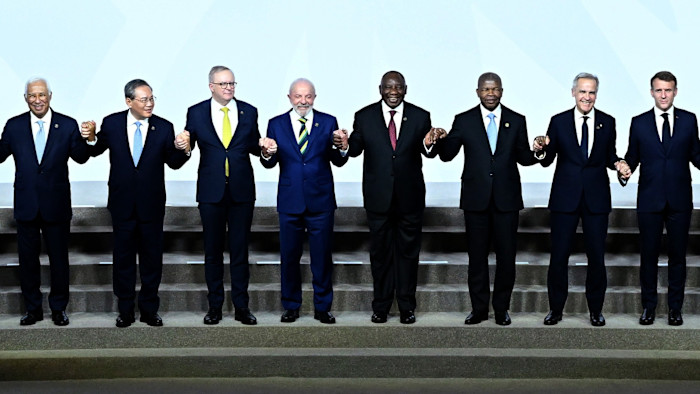
The UN General Assembly, the COP30 climate talks and now most recently the summit of the Group of 20 leading economies all limped to a close on a desultory note. The thin closing statements underlined how rapidly, and how far, the world has retreated from the sweeping shared vision of a decade or so ago for a collective approach to its challenges.
The principal driver of this change is US President Donald Trump, with his disdain for the idea that all nations should have a say in how the world is run — and his disparagement of the issues most in need of a multilateral global approach, from climate change to free trade. In truth, the world’s largest economy has over the years blown hot and cold on multilateralism. But its decision, in essence, to abandon the cause — the Trump administration did not attend the G20 leaders’ summit in South Africa last month — is a hammer blow.
It would be unfair, though, to blame the malaise of multilateralism on Trump alone. The cause was losing its mojo even before he began his second term in office. It never really had a golden era. Other states are happily slipstreaming in America’s wake and resiling from commitments. Then there is the role of China, America’s great power rival. Beijing talks the language of co-operation but it too has pursued a mercantilist path and is complicit, for example, in the enfeeblement of the World Trade Organization.
Some of the new groupings of recent years have clearly peaked, or at least are redundant for now. Take the G20. Previously an unwieldy grouping of disparate powers, it needed a clear and pressing emergency to galvanise it to act in concert: in 2009, during the global financial crisis, its leaders agreed on a massive, co-ordinated financial injection. In that year, the G20 seemed poised to supplant the G8, declaring itself the “premier forum for international economic co-operation”. In recent years, it has often struggled even to agree a closing statement.
The grand old body of multilateralism, the UN, also badly needs a reboot under new leadership. It should sharpen its focus on how to avert the two greatest risks to humanity right now: war between great powers and climate change.
True believers in multilateralism, however, should keep the faith. For now they should focus on a new, nimbler form of co-operation. The buzzword of the day is plurilateralism, the idea of bespoke gatherings of like-minded countries, sometimes regional, focusing on particular issues. This is the way to go. As an example of this flexible spirit, Southeast Asian trade ministers cite the expansion of the Comprehensive and Progressive Agreement for Trans-Pacific Partnership to include the UK. The EU is pursuing closer ties, too.
Such multilateralism is, of course, a pale shadow of the uplifting ambition of 20-odd years ago. And in a more contested world even this is not going to be easy. But there are challenges the world can regulate without the US, including trade, development and the biosphere. On some of these issues, too, it is just possible that the US may in time decide it wants to be involved after all.