

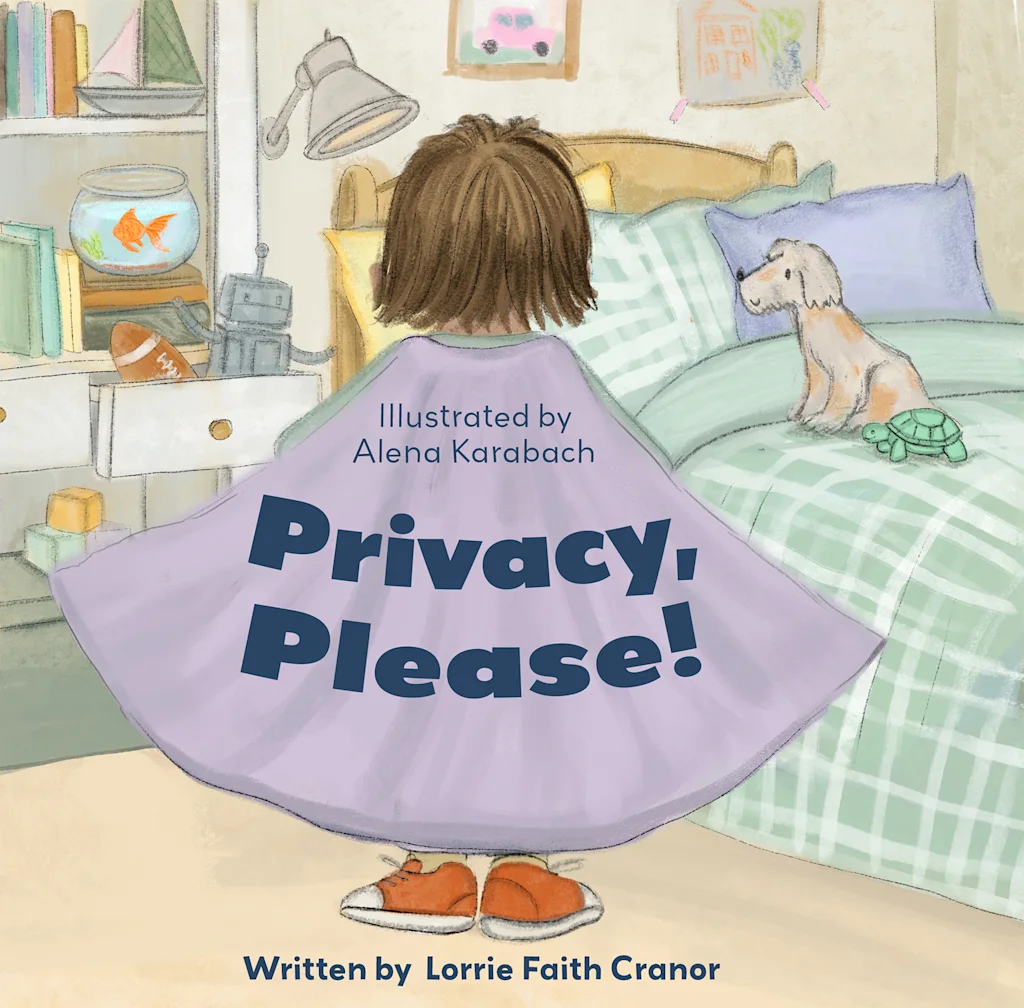
Lorrie Faith Cranor’s latest effort to educate people about privacy is a short, colorfully illustrated book written for an audience who probably can’t read it yet.
Cranor, a professor at Carnegie Mellon University and director of the Pittsburgh school’s CyLab Usable Privacy and Security Laboratory, wrote Privacy, Please! after publishing more than 200 research papers, spending a 2016–2017 stint as the Federal Trade Commission’s chief technologist, and making a quilt and dress illustrated with commonly used weak passwords.
In a Zoom video call, Cranor says she got the idea for this self-published children’s book when planning for a privacy-outreach event at a local library and getting input from the librarians there revealed an unmet need for one. “I asked them for their recommendations, and they didn’t know of any children’s books about privacy,” she recounts. “And you know, there really isn’t much out there.”
Especially for a younger audience. The Eyemonger, a frequently recommended kid’s book by George Washington University Law School professor Daniel J. Solove published in 2020, is aimed at readers ages 6 to 9. “Then I started thinking about, well, what would I want in a book for preschool kids about privacy?” Cranor says.
The answer: 25 pages of her words and artwork by illustrator Alena Karabach, in which our nameless protagonist, often accompanied by a pet dog, turtle, and goldfish, explains basic concepts of privacy.
• “Sometimes I want to be alone. I don’t want anyone to see me, hear me, or come too close. This is called privacy.”
• “Sometimes I listen to music on my headphones so that only I can hear.”
• “When my best friend comes over we play in my clubhouse. It’s our private space!”
• “Sometimes I want to create artwork without anyone watching.”
• “Privacy can help us have more fun! Superheroes need privacy to put on their costumes.”
• “My parents lock their phones so nobody can see their private things.”
• “When I play games online I use a funny name and picture so strangers don’t know who I really am.”
• “It’s nice to put my technology away and play outside where there’s lots of privacy.”
Cranor took inspiration for this from an earlier public-outreach project: Privacy Illustrated, a workshop she started in 2014 to invite people of many ages to draw depictions of what they thought the concept looked like.
That, for instance, is where the turtle came from, she recalls. “I had never thought about turtles this way until I saw people drawing pictures of turtles and saying turtles carry their privacy with them.” The goldfish, meanwhile, is a finned metaphor for having no privacy at all. “I told the illustrator, make the goldfish look as sad as you possibly can,” Cranor says.
The first draft also included a dog giving himself some privacy by retreating into a doghouse. But the preschool teachers Cranor consulted pointed out that none of their city-kid students had doghouses and might not recognize a Peanuts reference anyway. Instead, the dog hides underneath a bed.
At no point do we see this child’s entire face, a choice Cranor made early on.
“I also wanted the main character to be a little ambiguous as to whether they’re a boy or a girl and what race they are,” she says—the idea being to give any child reading it a chance to see some part of themselves there.
There’s also little technology on display, aside from one page that shows the main character sitting before an iMac G4 that would now be at least 21 years old and so must be some sort of hand-me-down.
And any adult reader looking for explain-like-I’m-5 advice about reading lengthy privacy policies won’t find it in this slim volume. “A lot of the more complicated lessons about online privacy just didn’t seem appropriate for this audience,” Cranor says. “But I didn’t want to not have digital privacy there at all, because, well, they’re already playing with their parents’ phones.”
Plus, it won’t be too long before the members of the book’s preschool audience will need some grounding in the basics of tech privacy. “You know, next year they will be online, and so I wanted to plant the seeds for that,” Cranor says.
As for the parents, aunts and uncles, and other grownups reading the book aloud to children, Cranor says she hopes this work will encourage them to listen a little more. “It’s okay to say you don’t want your picture taken, and this is a struggle for parents because parents love to take their kids’ pictures,” she says.
The book’s website includes a discussion guide for parents as well as a door-hanger exercise for kids that invites them to make a version of a hotel’s door tag (“Privacy, Please!” or “Let’s Play!”) for their rooms from a cut-up cereal box.
Cranor expects a large chunk of the sales of this $14.99 book—which she chose to self-publish after realizing that would take vastly less time than finding an agent to sell a traditional publisher on the idea—will involve other privacy professionals. “They all want to buy it for the children in their lives,” she explains.
But another potential target market comes to mind: founders of large tech companies with a demonstrated record of paying inadequate attention to privacy and missing people’s tastes in technolog—in particular founders with young children of their own.
By which I mean, Mark Zuckerberg. Has Cranor sent him a copy of the book? “I have not,” she says. “I mean, it’s probably worth trying.”