

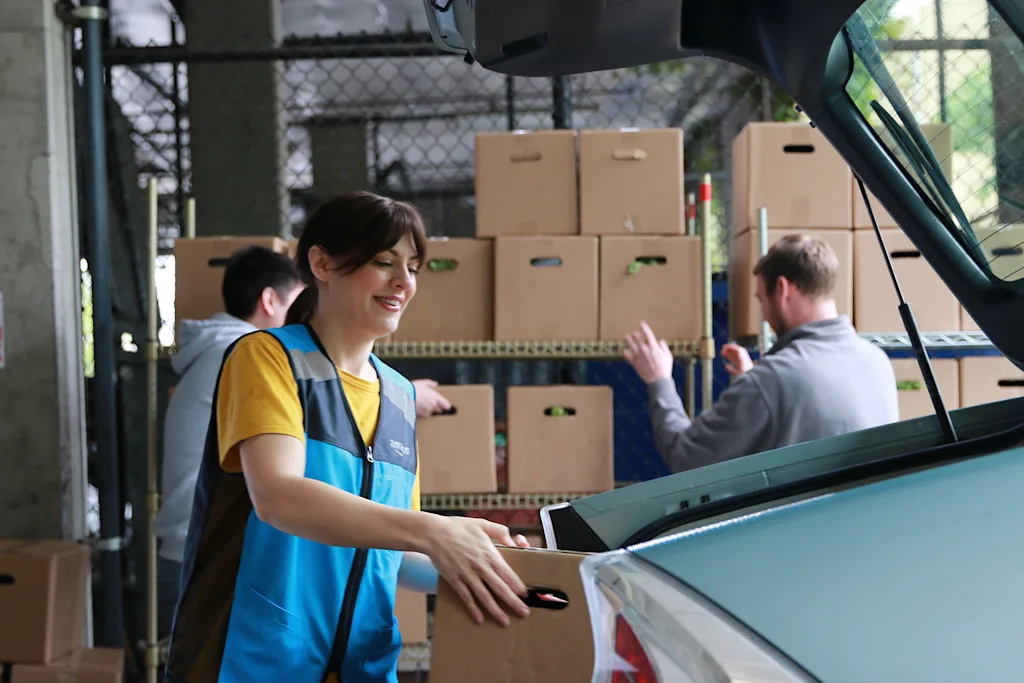
In some cities, as Amazon delivery vans make the rounds with your latest order, they’re also delivering something different—free food to people who rely on food banks.
In a program that quietly started during the pandemic, the company has used its logistics infrastructure to deliver enough groceries for 60 million meals to families facing food insecurity. Today, Amazon announced that it’s extending the program with its food bank partners through 2028.
The Community Delivery program began early in the pandemic as the company’s disaster relief team saw long lines at food banks and looked for ways to help people stuck at home.
“We started talking to our operational teams here at Amazon and said, we’re doing this for our customers—we’re delivering food to their doorstep,” says Bettina Stix, director of Amazon Community Impact. “What if we did that same delivery, but instead of coming from our Amazon grocery fulfillment, it would come from the food bank?”
As pandemic restrictions ended, they realized that there was still a clear need for delivery. In a study with Feeding America last year, they found that 46% of visitors to food pantries had skipped visits because of transportation challenges. (Unsurprisingly, that number jumps to 60% for people without a car.) Others might work multiple jobs and simply not have enough time. Some recipients who use the delivery program said that they’d never been able to access free food from a pantry in the past.
“There are many people who, because of disability or transportation or schedule constraints, can’t get to a pantry, or stand in line at a pantry, or transport a 25-pound bag of groceries home,” says Seth Harris, associate director of home-delivered groceries at the San Francisco-Marin Food Bank, one of more than 40 food banks that now works with Amazon. Picking up groceries from a food pantry might involve two hours of travel and trying to navigate a bus with a heavy package.
Some food banks already offered limited home delivery, but it’s resource-intensive and typically relies on volunteers, making it difficult to scale. “At some point, you end up in a world where you have more deliveries than can be done by a single route,” says Josh Hirschland, principal product manager for food security at Amazon Community Impact.
“So then you start to think about, okay, how do we divide up the packages across multiple routes? How do you set the order of the different stops to be the most efficient, and how do you divide that up? How do you manage all of these orders? How do you figure out which ones have been picked up? Have you made sure that they’re being delivered?” Hirschland adds.
The San Francisco-Marin Food Bank had a delivery program before working with Amazon, but was able to significantly expand it. The nonprofit now makes around 1,000 home deliveries a day, primarily to seniors and adults with disabilities.
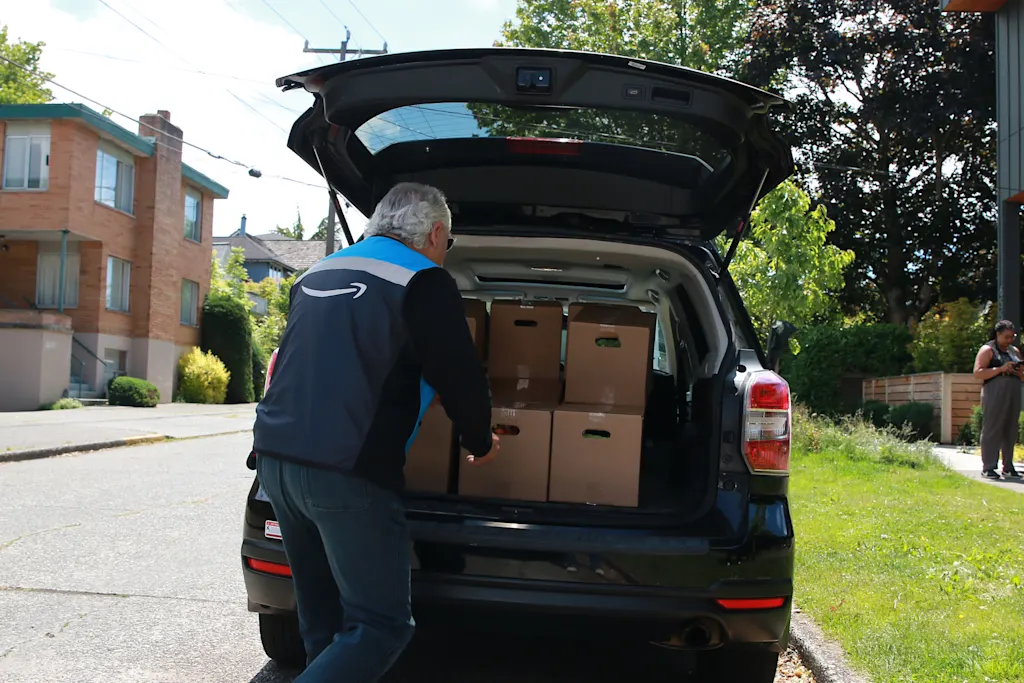
In many cases, Amazon works with its network of Flex drivers, gig workers who use their own cars, to make the deliveries. Instead of picking up a shift for Amazon Fresh, a driver can choose to pick up a carful of prepacked boxes from a food bank and deliver them over the next hour or two. Amazon foots the bill. The program, like the rest of its Community Impact work, isn’t a separate philanthropic arm of the company, but part of a business strategy to find ways to benefit communities by using its existing infrastructure and technology.
The company adapted software that it had initially used for Amazon Restaurants, a food delivery service that the company shut down in 2019. Engineers created a portal that food banks can use to add and track orders.
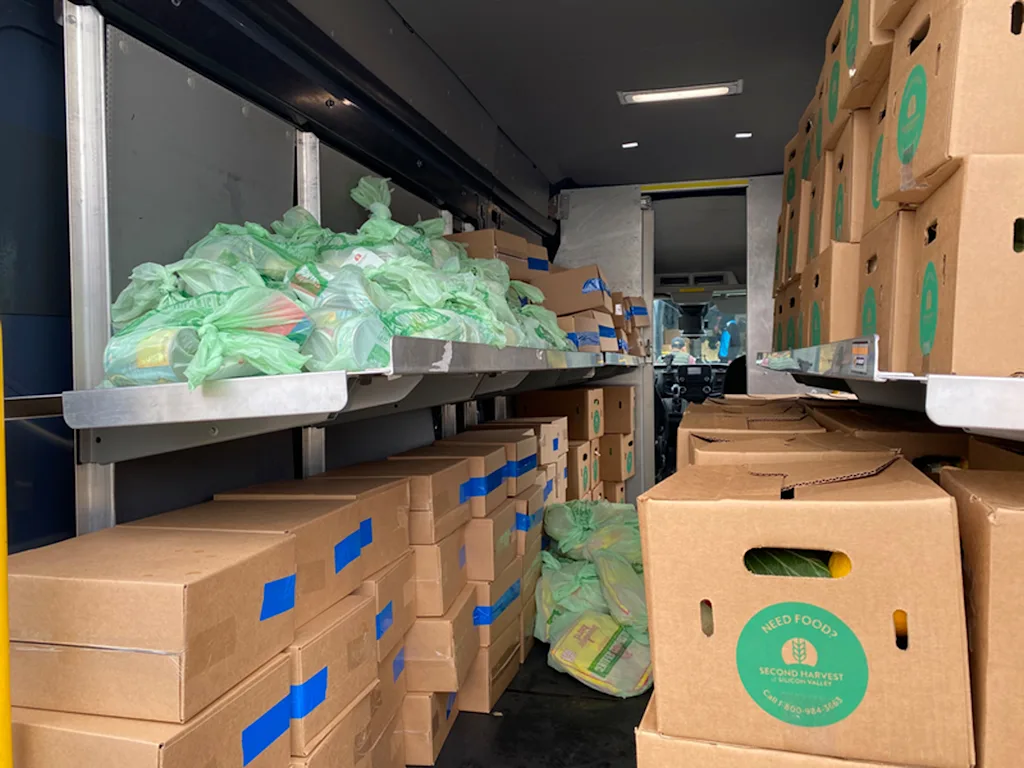
In some cities, like Los Angeles and Austin, food banks pack shelf-stable food that doesn’t need to be delivered immediately, and the boxes can be incorporated into regular Amazon delivery routes. Larger trucks pick up pallets of boxes at food banks and take them to Amazon sort centers.
“At the sort center, those boxes start to be comingled with iPhone cables and jigsaw puzzles, and then get sent down to a truck where they are driven to the delivery station,” Hirschland says. At the company’s last-mile delivery stations, boxes are loaded onto racks and then head out on vans. Using vans helps make it easier to reach rural areas, he says, where it’s often even harder for families to access food pantries.
The company now has a team of engineers dedicated to continuing to improve the technology behind the philanthropic initiative. One recent feature, for example, tracks how long each package is with the driver, from pickup to delivery.
Since the program started, Amazon has been renewing it with its food bank partners each year. But now, with a longer three-year extension, the nonprofits will be better able to plan. “If you are running a home delivery program as a food bank, even if the transportation is free, there are still any number of costs that you’re looking at,” Hirschland says. Food banks also don’t want to offer the service and then have to unexpectedly cancel it. The longer commitment “is something that we’ve been trying to do for a long time,” he says.
The need keeps growing: The cost of food is now nearly 30% higher than it was in 2020. Tariffs are pushing up the cost of imported foods like bananas and coffee. The Department of Labor warned last week that current immigration policies are causing a shortage of workers on farms, and that’s also threatening the food supply chain and food prices.
The budget bill that President Trump signed in July made steep cuts to SNAP, the federal food assistance program, that will soon begin rolling out. Earlier in the year, the Department of Agriculture cut $1 billion in funding for food banks and school nutrition programs to buy food from local farms. With rents and energy prices also rising, buying food has become even more of a strain.
The delivery program can’t solve the larger issues that make hunger a logistics problem. But in a strained system, it’s become a critical tool for food banks.