

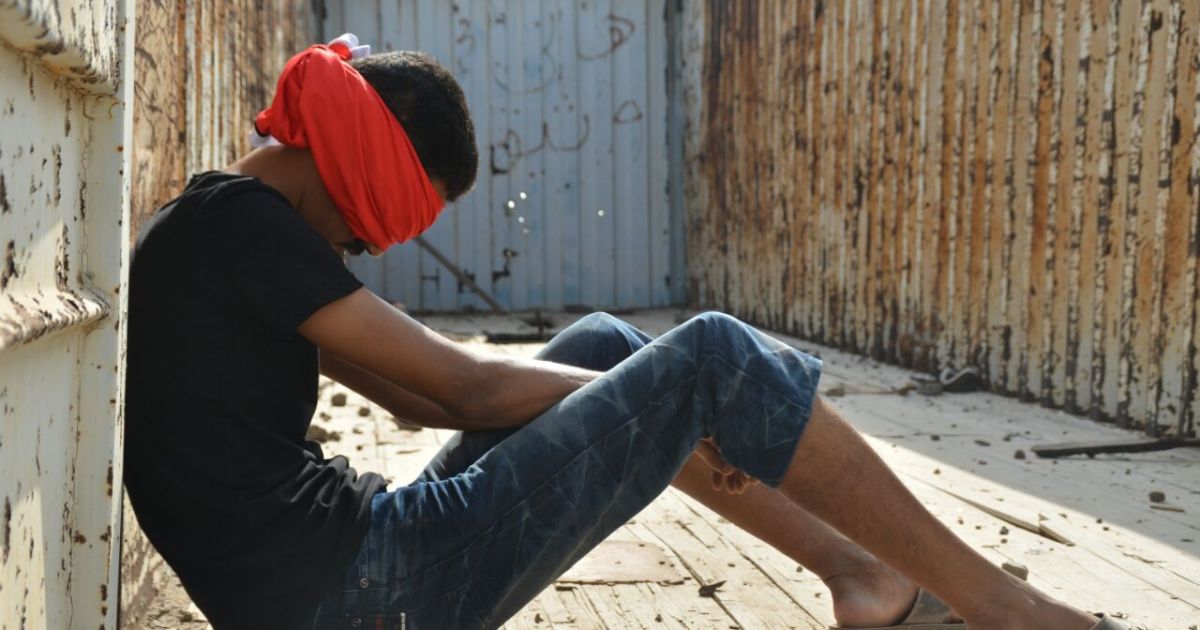
It’s been more than six years since Ali Hassan Ali Bakhtiyan was released from a secret prison in eastern Yemen’s Hadramout Governorate, but he cannot forget the horrors he underwent during his more than two years in detention.
“It was a very bitter and extremely painful experience,” the 30-year-old man said, adding he was lodged inside the secret prison run by the United Arab Emirates (UAE) and local Yemeni troops called the Hadrami Elite Forces (HEF) inside Hadramout’s Presidential Palace.
Recommended Stories
list of 4 itemsend of list
“They stripped me naked and used cold water. I was interrogated first by members of the Hadrami Elite Forces, then they handed me to the Emiratis officers,” Ali told Al Jazeera over the phone, saying he was detained twice – first in 2016 and then again in 2017.
The prison, Ali says, was not even suitable for animals. “Closed, dark rooms, hands tied and blindfolded. Twenty days went by without a chance to clean your body. They used physical and body torture, solitary confinement several times, beating many times,” Ali recalls.
The 30-year-old says he was first detained following a bomb blast in Hadramout. “I was falsely accused of being a member of the Islah Party,” he said, denying he was a member of the party, which is the main opposition party in Yemen. The country’s Muslim Brotherhood also falls under its umbrella.
“I do not have any affiliation with any political party. Even the interrogator later told me, ‘I have nothing against you, but the Emiratis wanted you,’” Ali said.
In 2019, he was transferred to the central prison in Hadramout and appeared before a judge, following which, he was released without charge.
UAE secret prisons
Ali’s case and many other prisoners have come under the spotlight again after Hadramout Governor Salem al-Khanbashi on Monday announced the discovery of “secret prisons at sites where UAE forces were stationed”.
The governor “expressed his regret at what was found inside the UAE bases and camps – especially in the vicinity of Rayyan International Airport – of equipment and contents unrelated to regular armies, including explosives, detonators and dangerous components usually used by terrorist groups, in addition to the discovery of secret prisons at those forces’ deployment sites,” according to the state-run Yemeni News Agency (SABA).
The UAE forces withdrew from Yemen on January 3 after Yemen’s Presidential Leadership Council (PLC) chairman Rashad al-Alimi annulled a joint defence agreement with Abu Dhabi and asked UAE forces to leave within 24 hours.
This came after the UAE-backed Southern Transitional Council (STC) forces took control of Hadramout and al-Mahrah provinces in early December. The STC control of Hadramout, which borders Saudi Arabia, was seen as a national security threat by Riyadh.
Saudi Arabia-led coalition forces bombed Mukalla, the capital of Hadramout, targeting what Riyadh said was a UAE-linked weapons shipment destined for the STC. Soon, government forces, backed by the Saudi-led coalition, regained the two provinces in early January, triggering the collapse of the STC. The UAE denied supplying weapons to the southern separatists.
Deputy Governor of Hadramout al-Jilani told Al Jazeera that “four illegal detention sites” affiliated with UAE forces in the governorate had been “identified”.
“Such practices are a blatant violation of the Yemeni constitution, applicable laws, and all international and humanitarian charters and agreements that criminalise detention outside the judicial framework,” he said, adding that local authorities in the governorate will carry out comprehensive and transparent investigations and hear the testimonies of victims and witnesses to gather evidence to hold those responsible accountable.
In the meantime, the UAE’s Ministry of Defence issued a statement categorically denying the accusations, describing them as “false and misleading allegations and claims that are not based on any evidence or fact”.
“These allegations are attempts to mislead the public opinion and to defame the armed forces of the United Arab Emirates, the statement read.
Shocking scenes
The government’s National Commission to Investigate Alleged Violations of Human Rights (NCIAVHR) has been tasked with investigating the cases of torture in prisons. Officials from the body have visited prisons and are speaking with victims.
”The secret detention centres were in state institutions and service facilities, such as al-Rayyan Airport [in Mukalla], the Republican Palace, al-Dhabba Port, and the central prison known as ‘Al-Manoura Prison’,” committee member Ishraq Al-Maqtari told Al Jazeera, adding that Emirati forces had converted them into private, secret detention centres after adding some inhumane modifications.
“Most of the modifications included building very small, extremely narrow rooms unfit for human detention, some far from public life in the desert, and some of them were constructed underground,” she said.
Al-Maqtari further described that detention centres were built with “punitive specifications, such that a detainee could not stand in them even for short periods, let alone attempt to sit or sleep”.
“Some rooms were also used as presses for torture, where a person is held for very long periods, even though they are unfit to remain in for a few hours,” she told Al Jazeera.
Justice and accountability
Since the UAE forces withdrew, protests have been regularly held demanding disclosure of the fate of hundreds of abducted and forcibly disappeared people in UAE prisons, particularly in the interim capital, Aden.
The NCIAVHR has said it will head to other governorates where secret detention facilities have been reported, including in the Socotra Archipelago governorate, Aden, Lahj, Taiz and Al Hodeidah.
NCIAVHR member al-Maqtari, who has been meeting victims and their families, says “they demanded the need to hold accountable the bodies and individuals who detained and tortured them, along with restoring their dignity and compensating them for the horrific, inhumane torture and humiliations they were subjected to.”