


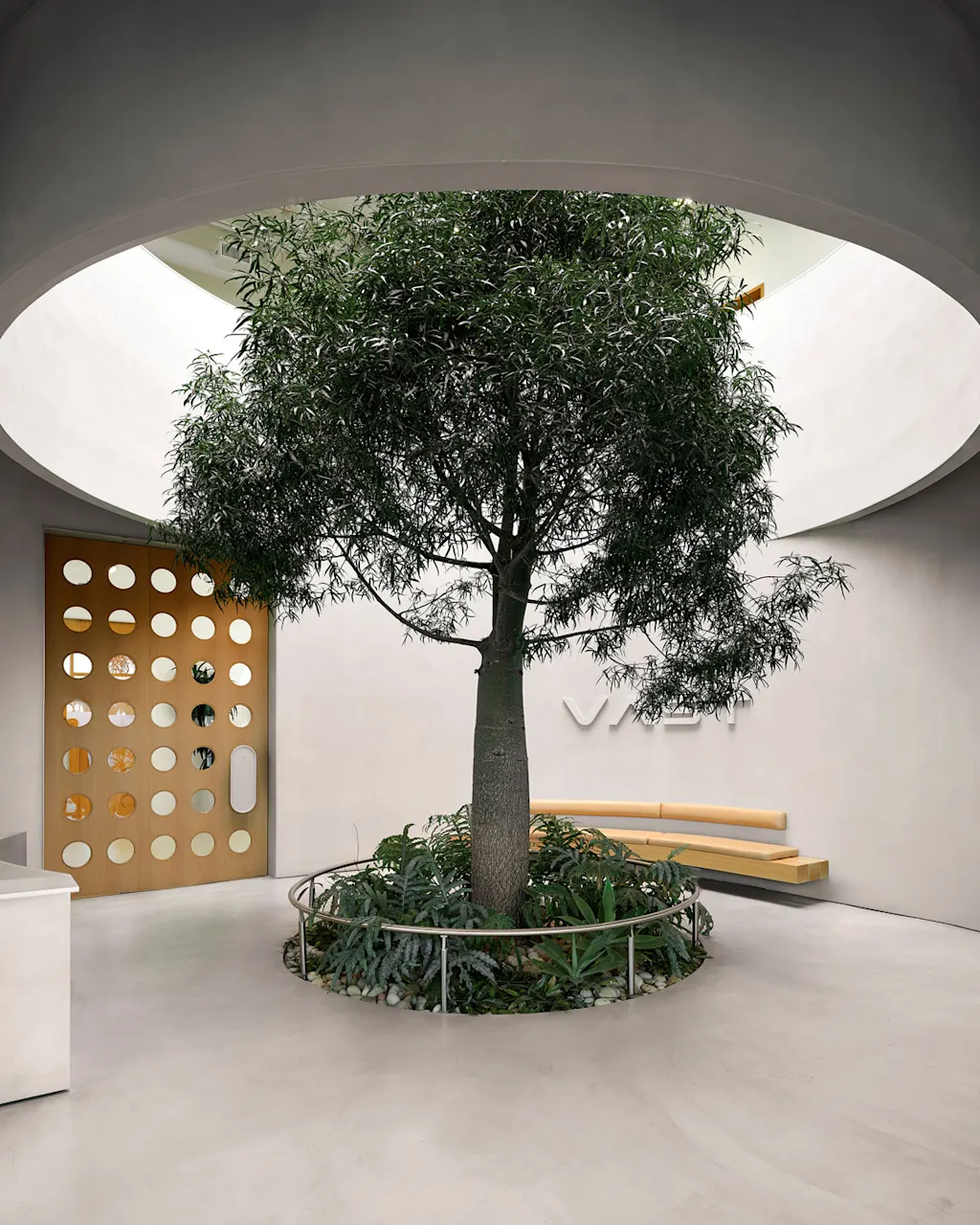
A tall baobab tree greets people inside the Long Beach, California, headquarters of Vast, an aerospace company that is building the space station of the future. It’s planted beneath a skylight in the center of a white-painted circular lobby furnished with a sleek aluminum reception desk and built-in wood banquette that follows the curve of the walls.
The tree and the room are symbolic. The former references trees in The Little Prince, a 1943 novella with a character who travels between planets, and the latter has the same diameter of a Haven-1 module, which the Vast team hopes will become home to researchers, astronauts, and travelers and eventually succeed the International Space Station.
“There are these timeless stories of, ‘Why is humanity reaching for the stars? Why are we going to space?’” says Hillary Coe, Vast’s chief design and marketing officer. “Those Easter eggs start to ground you in the ‘why’ while you’re simultaneously understanding the ‘what’—the important engineering and structural feats that we’re doing.”
The space race of the 21st century is tourism, with new companies like Vast rapidly developing the technology and physical infrastructure that will enable human habitation in the cosmos. Here on Earth, they’re also inventing new types of workspaces for this growing industry, which is expected to reach $87 billion by 2035.
Vast’s new 49,000-square-foot headquarters, a collaboration between its in-house team and the New York-based multidisciplinary design studio Civilian, does all those things, in a sophisticated expression of how architecture can support high-performance work and reinforce brand.
“Form empowering function”
The space is minimalist, with polished concrete floors, custom-made white oak doors, and a palette of white and gray. But this wasn’t merely a stylistic choice; it reinforces the work Vast is seeking to do.
“Form being able to empower function is really the core of what we’re dealing with,” Coe says. “And when you see that clean aesthetic, it’s very much for the sake of capability and efficiency.”
The headquarters has a few jobs: First, it needs to meet the high-stakes performance requirements of Vast’s engineers, astronauts, creative teams, R&D, and more all working under the same roof. It also serves the purpose of communicating who Vast is to clients, customers, and potential employees. And, importantly, it helps establish trust for a product and service that are firsts of their kind.
The office and the space station design have a similar look because they are optimized for human health and well-being. As Ksenia Kagner, who cofounded Civilian with Nicko Elliot, explains, the look and tactility of finishes, the quality of light, and acoustics “either hijacks people’s nervous systems or calms them down.”
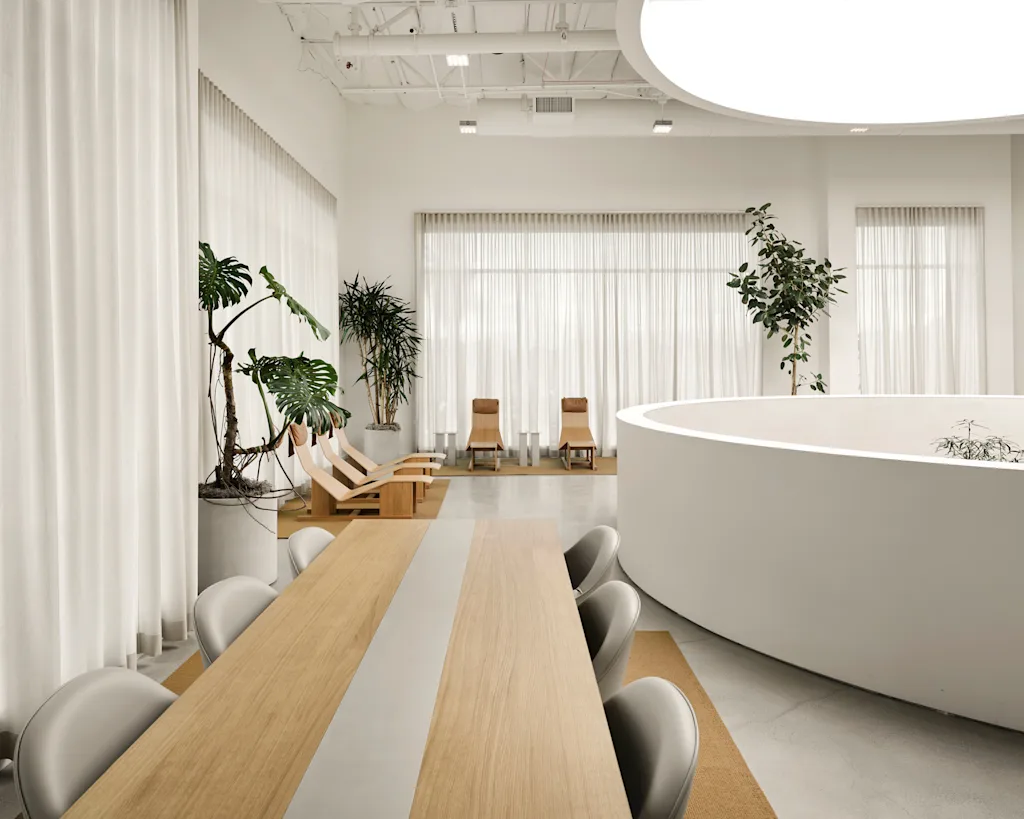
To that end, the office leans into biophilic design, which has been shown to reduce stress through natural materials, ample daylight, and plenty of plants. This also helps keep people focused on the task at hand instead of being distracted by their environments.
Even though Vast is designing technology for the future, its workspace doesn’t bear the hallmarks of a too-slick, tech-forward vision of aerospace. “There’s a level of optimism and faith in humanity behind what they’re doing, which could be in contrast to some of the more dystopic ‘get into space and pull up the drawbridge’ fantasies that also run in this arena,” Elliott says.
Mapping “user journeys”
Vast operates under the belief that its competitive advantage is vertical integration. Design, engineering, testing, and production all occur in-house. Having communication among these teams was important to Coe.
“You get to walk down the hall to ask somebody, ‘Hey, what do you think about this?’ Or ‘Hey, how did this actually work?’” she says. “In aerospace, having all of those teams in one place, talking with each other, seeing each other’s work, is actually pretty revolutionary.”
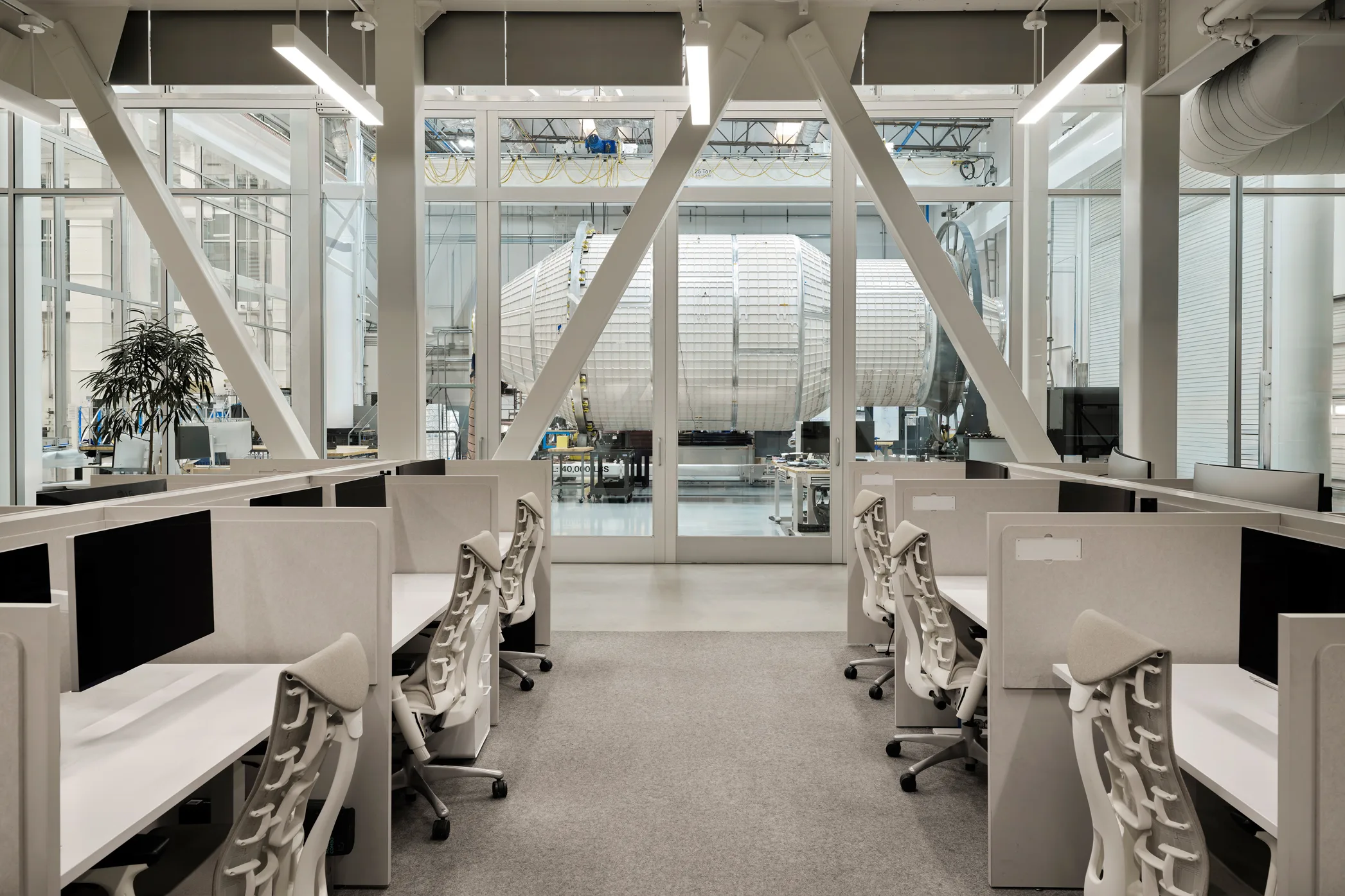
Civilian devised a floor plan that reinforces the company’s integration. On one end of the building, there’s the clean room, where heavy-duty manufacturing takes place. On the opposite end is mission control, where astronauts and researchers would be stationed 24/7 when a space mission is underway.
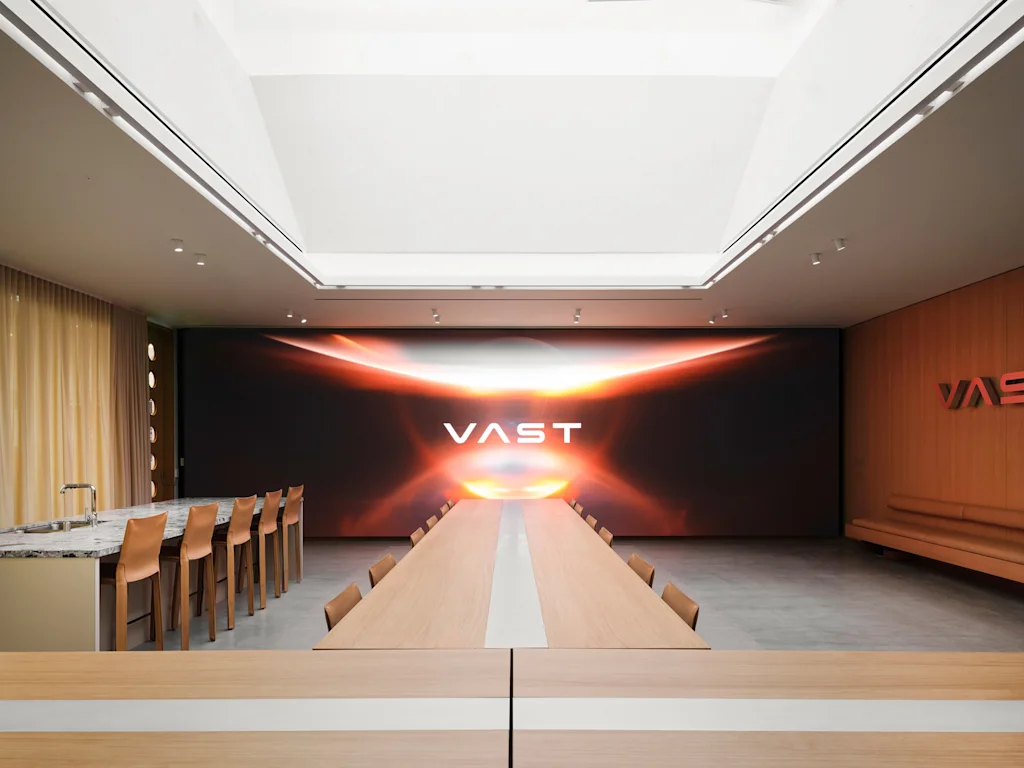
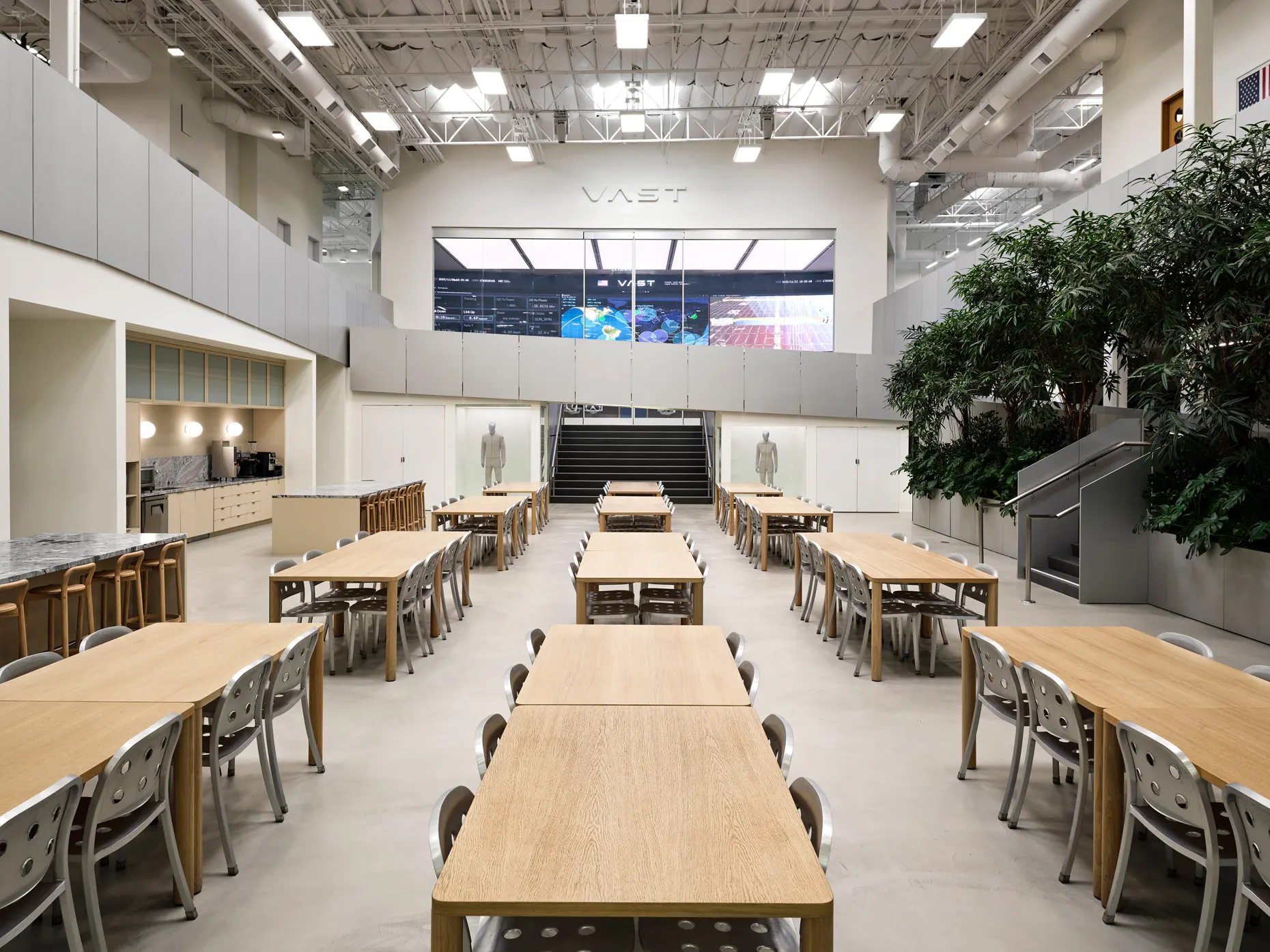
An all-hands space with a kitchen and lounge sits at the center of the building. The internal walls are mostly glass (with very high acoustic properties so you don’t hear drilling while doing heads-down work), providing visual transparency among the teams and assuring that the thing everyone is working toward—the space station—is constantly in view.
A ramp, finished in custom aluminum (the primary material Vast uses in its spacecraft), connects them all. “It became this way of creating a user-experience journey,” Elliott says. “You are then brushing against all these different business groups and divisions as you move through the space.”
21st-century mission control
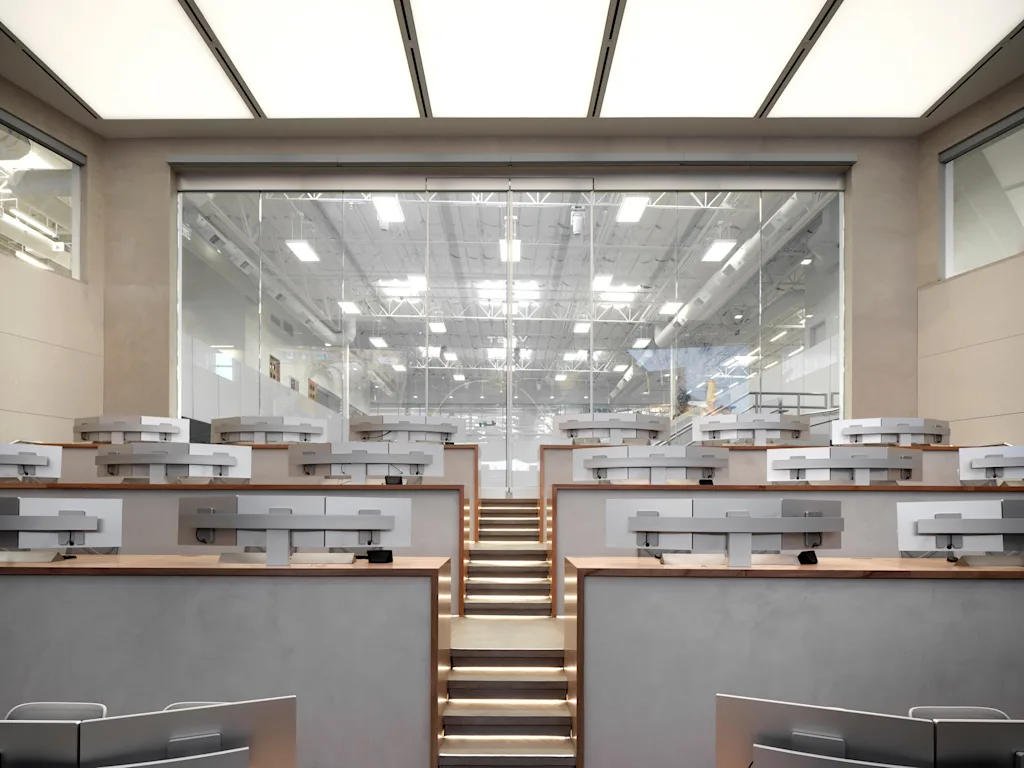
One of the most demanding design challenges involved the mission control room, a 2,500-square-foot area where staff would be present at all hours during a space mission. (Vast has yet to send someone to space.) “They were very intent on the idea of eliminating nonengineering information from the field of vision,” Elliott says.
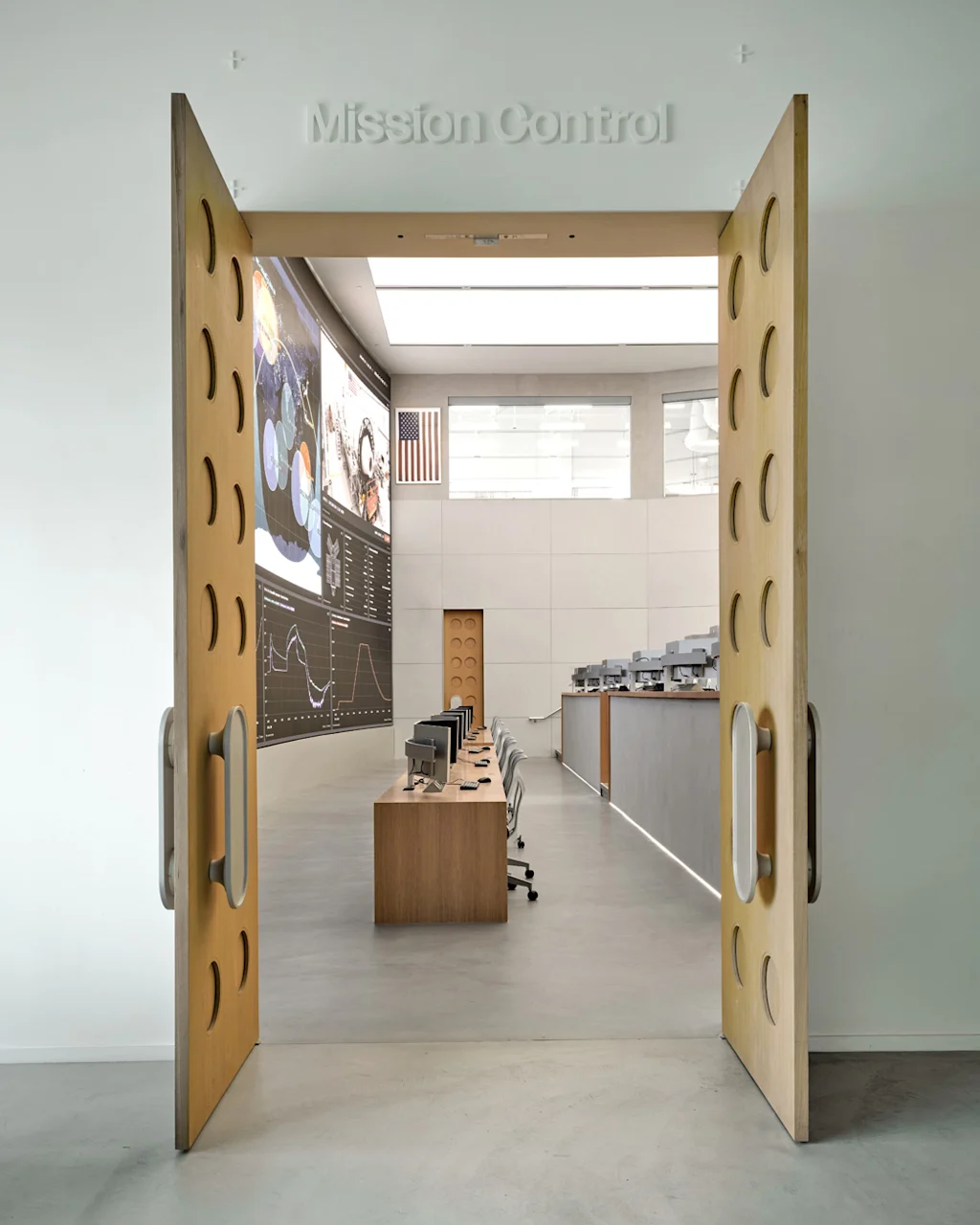
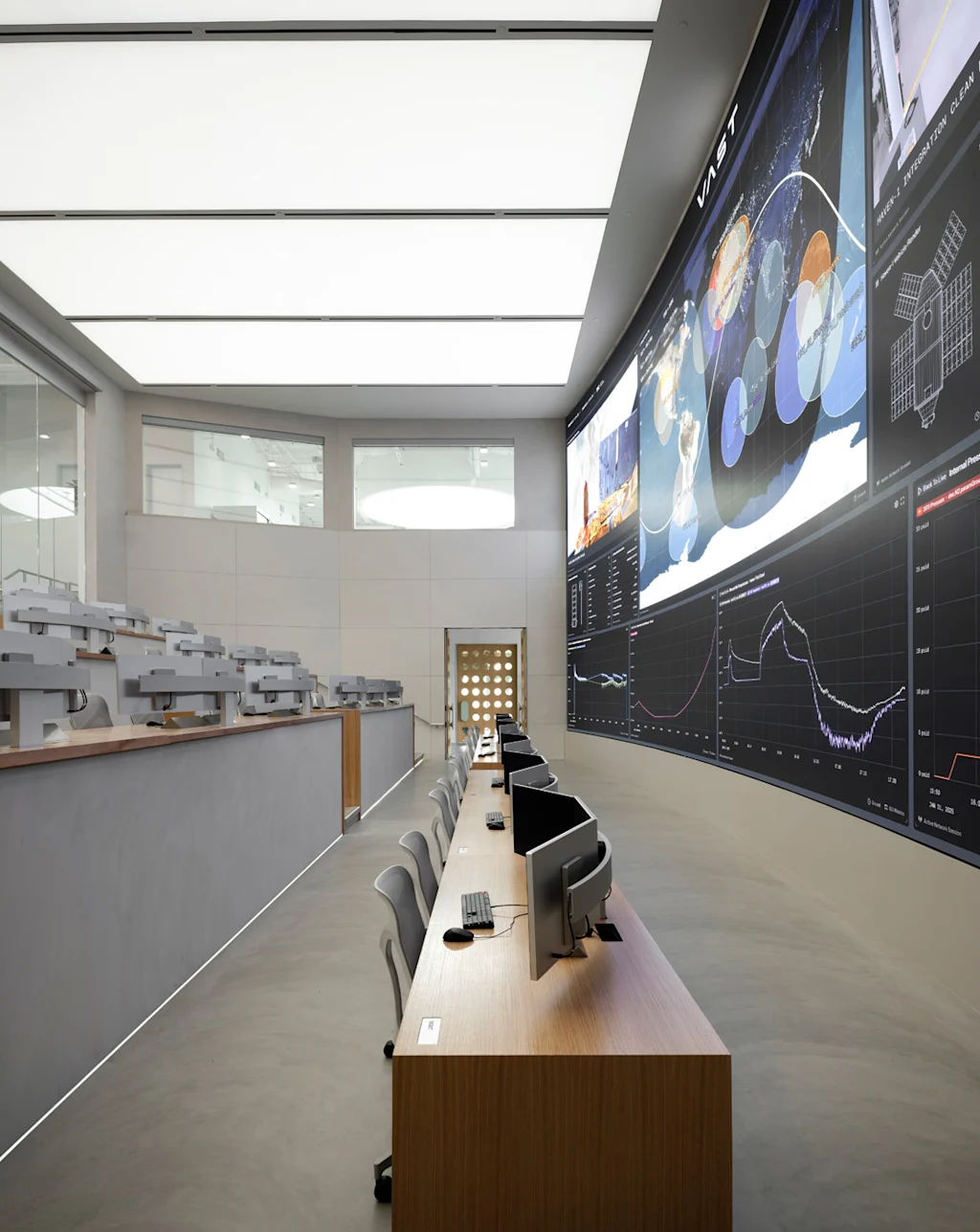
The room is spare—just tiers of custom white-oak desks facing a 30-foot-long curved LED screen where critical data will be displayed. Sensory comfort is even more important in this area than the rest of the headquarters. Civilian designed an illuminated ceiling, which disperses even light across the control room, and covered the walls in acoustical panels made of wool in a similar shade of gray as the floors and the IT access panels on the desks.
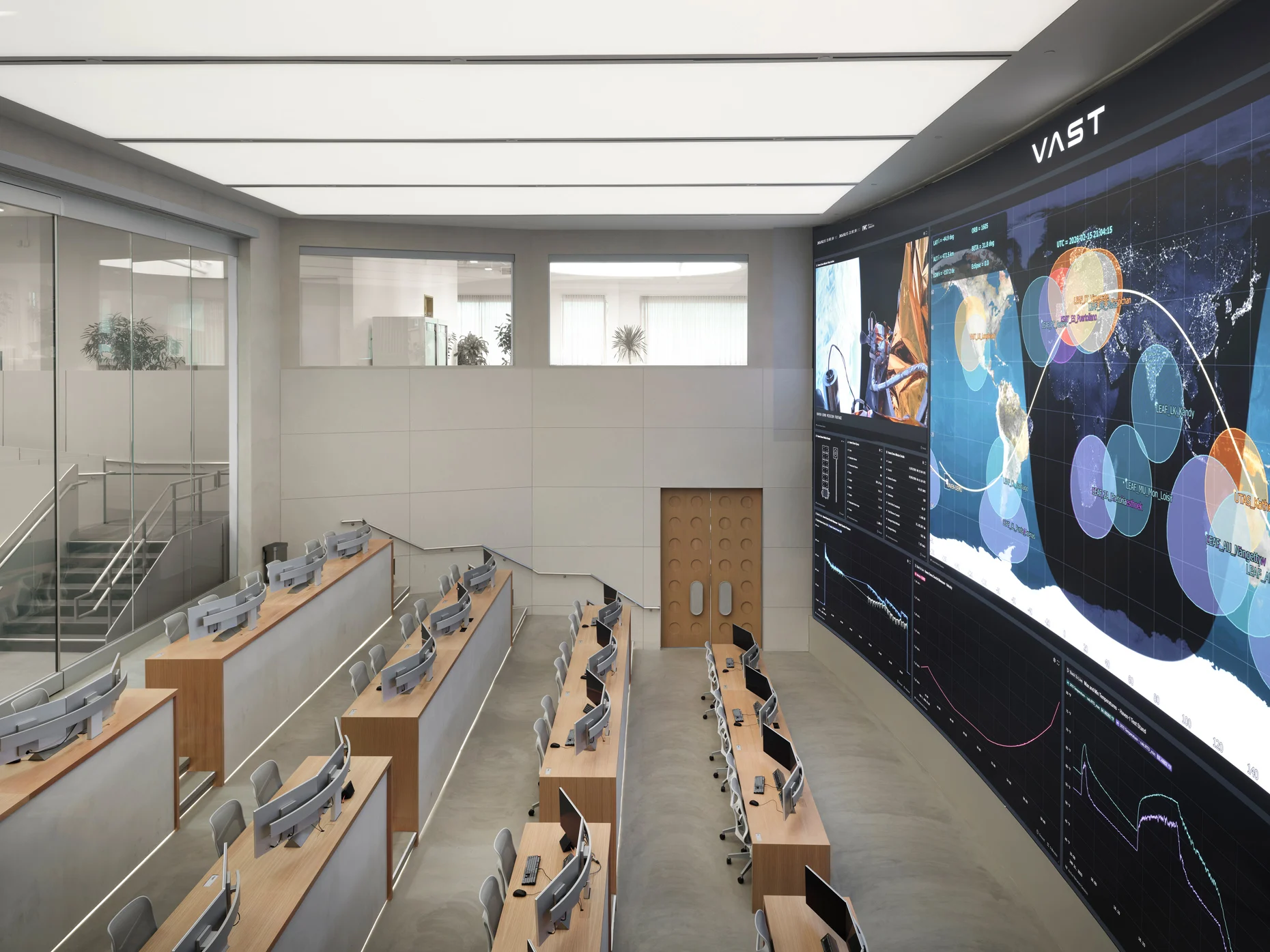
“If you’ve got astronauts’ lives on the line and you’re trying to look to see where the information is to be able to make and assess those quick decisions, you need a space that is designed so that it’s optimizing for decision-making,” Coe says.
The high-stress work involved with 24/7 mission control staffing also influenced other areas of the headquarters, including a space furnished with chaise longues for resting and recharging, a gym, and a meditation room.
Making space travel approachable
Part of making the office look approachable and human-centered is to reflect trustworthiness. If the design is well-thought-out and the team is open and transparent with what it’s making, then there’s more confidence in working with the company. As space commercialization heats up, attracting talented employees and investors is critical. In the future, private travelers, too. It makes space travel seem “more accessible and normal,” Kagner says. “The customer is also critical, because this is ultimately a private business.”
The headquarters was completed in 2025. Since then, the feedback Coe has received is that the space makes people feel integrated with Vast’s vision. “That’s what leads to that feeling of ‘I can trust this commercial company . . . with my life, with my research, with my product,” she says. “And that’s really important.”