

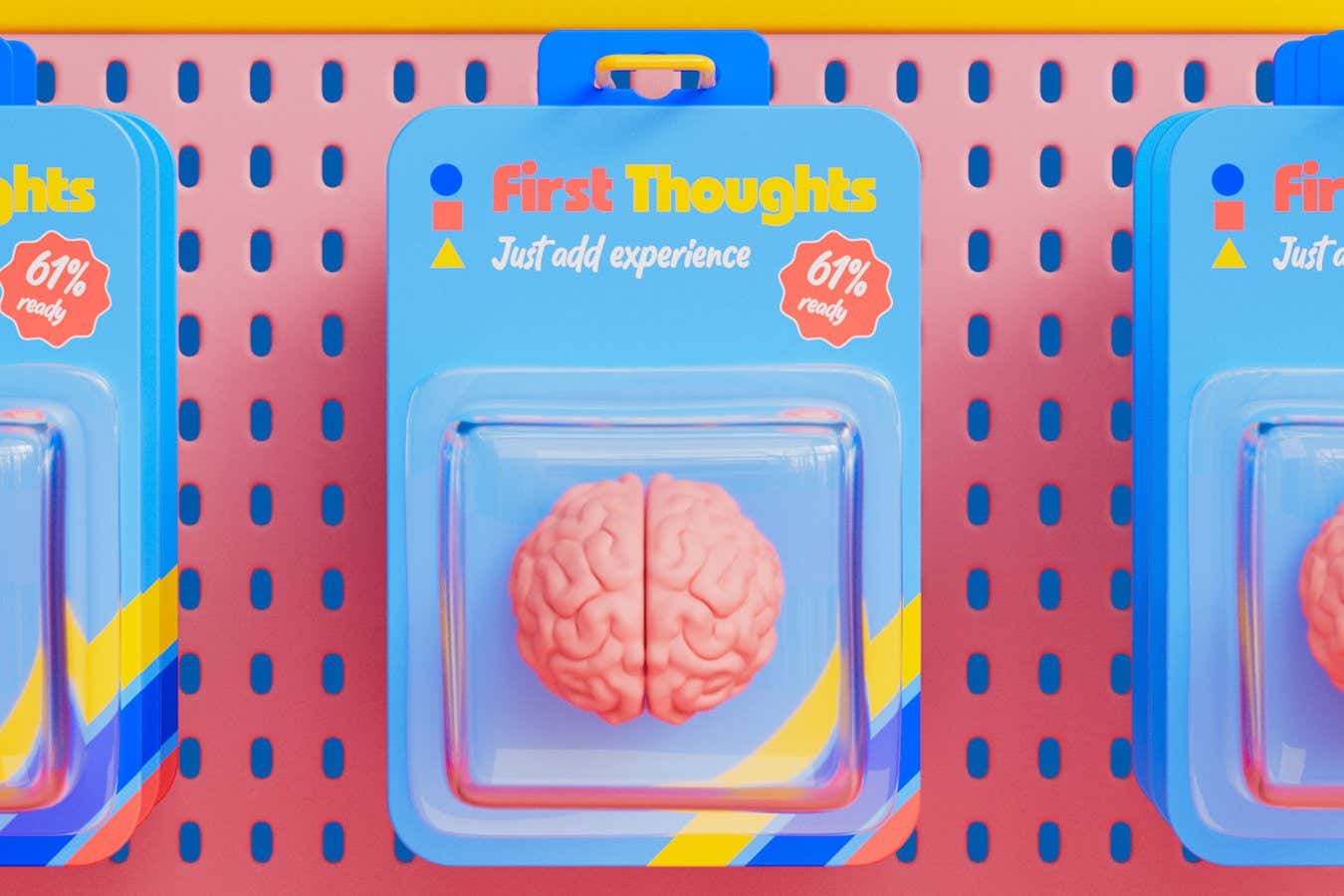
Newborn babies’ brains look remarkably similar to those of adults
Craig Boylan
We are born with the essential architecture of our brain raring to go. Over the previous nine months – give or take – some 100 billion neurons have sprung from a single 3 millimetre “neural tube” in the embryo that forms the blueprint for the entire central nervous system.
This sizeable number of neurons is dwarfed only by the 100 trillion or so connections that form between them, much like the lines between station hubs in a city’s metro system. “They’re forming in a smart way to make the system more efficient,” says developmental neuroscientist Moriah Thomasonat New York University.
Shortly before birth, the brain already looks remarkably like an adult brain: the connectome of the fetus shares 61 per cent of the same functional organisation as an adult brain. “That really is bananas,” says Thomason, but we shouldn’t mistake a fetus’s brain for a mini-adult brain. Some animals, like foals, are born with the ability to walk, feed and even gallop. But humans, with our exceptionally long childhoods, are highly social and dependent creatures.
“You want the brain to be unfinished because you want the environment into which you’re born to finish it off,” says philosopher of mind Timothy Bayne at Monash University in Australia. “It would be really bad for evolution to finish the brain such that you had to speak Swahili, and you’re born into a country which speaks Russian.”
Being born is an especially transformative event for the brain. “It’s almost an assault,” says Thomason. Newborns suddenly feel the full force of gravity rather than the buoyancy of the womb, temperatures start to fluctuate, and there’s a cascade of new visual information to comprehend. In response, insulating layers called myelin sheaths increasingly form throughout the nervous system, forging connections and separating brain networks that become increasingly specialised. “These pruning processes begin to get aggressive,” says Thomason. “You’re locking it in.”
As this happens, our ability to find our way in the world becomes more sophisticated, as higher-level cognitive abilities build on lower-level abilities. For instance, objects become distinguished from one another, then we begin to track the motion of these objects, and then recognise faces and emotions. “You want to be able to track emotions really early, because that gives you all these cues about people’s mental states,” says Bayne.
With brain scanners, we can now observe the formation of brain networks and connections in adults and fetuses. But what this all means for the development of experience is a much trickier question. Patterns of brain activity and behaviours observed in the womb suggest that aspects of conscious awareness are present in fetuses. “There certainly could be snippets of experience before birth, and the capacity for consciousness is probably there,” says Bayne. Yet, his hunch is that consciousness in any meaningful sense doesn’t emerge until babies face the onslaught of the outside world.
Still, even if we knew how conscious experience relates to brain biology, philosophers are still divided on the connection between thought and consciousness. “Can you have thought without consciousness? Can you have consciousness without thought?” asks philosopher of consciousness Philip Goff at Durham University in the UK. Bayne suggests that thoughts have more to do with our ability to act in the world. A few months after birth, for instance, babies discover that they can make an overhead mobile move through their own actions. “I wonder if the first kind of thought that babies will have is frustrated intentions, or pleasure in having achieved an intention,” he says.
The idea that thoughts and consciousness don’t meaningfully exist until babies are born might seem like common sense. Cognitive scientist Anna Ciaunica at the University of Lisbon in Portugal cautions that this is a biased, adult-centric assumption. We assume that experiences are rooted in the brain, and that thinking involves layers of sophisticated concepts. But studies suggest that sensory experiences are integrated into a basic sense of self through actions early on during pregnancy, says Ciaunica. That process of interacting and learning is at the core of experience and our ability to survive. The ancient evolutionary origins of neurons in our gut and the speed with which our olfactory system specialises in the developing fetus are indicative of this. “Existence comes first, knowledge later,” she says.
More than anything, the proto-world of a fetus revolves around its mother. “In the womb, we’re constantly negotiating against the other presence,” says Ciaunica, noting that studies show newborns cry differently if their mother is bilingual. “The first thought that I think we have is: ‘I’m not alone.’”
Why do some people retain sharp minds well into later life, while others don’t? Join your fellow subscribers and neuroscientist Emily Rogalski for a live discussion exploring the science of healthy ageing. Hosted by Olivia Goldhill. Online | 7 July 2026 | 6-7pm BST/ 1-2pm EDT Topics:
Secrets of the SuperAgers