

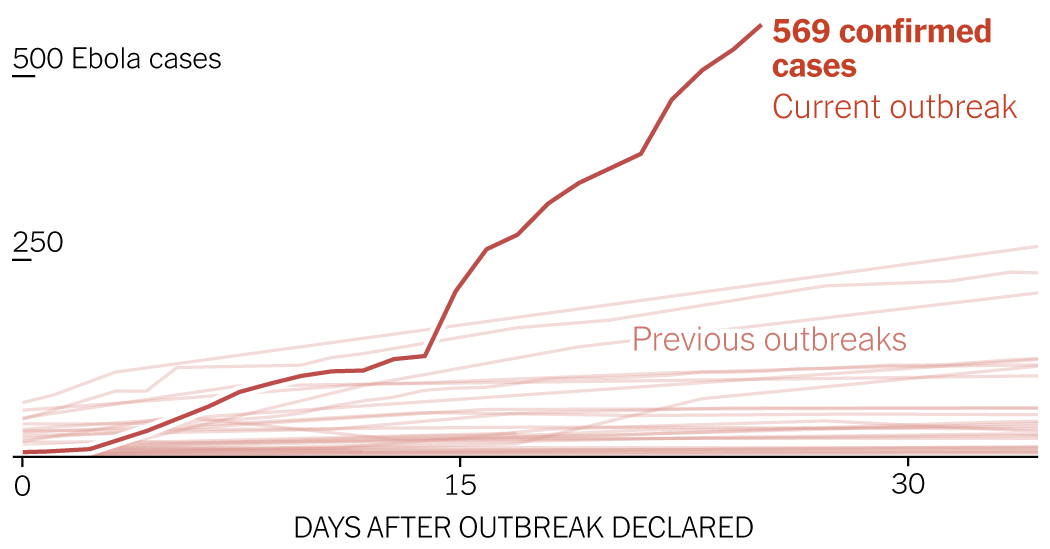
In August 2014, I traveled to Liberia and witnessed firsthand how devastating an uncontrolled Ebola outbreak can be. I was serving as the director of foreign disaster assistance at the U.S. Agency for International Development and coordinating the U.S. government’s response to that outbreak. At a hospital in Monrovia where several prominent doctors had died from the virus, the maternity ward stood eerily silent. Hospital staff explained that fear of Ebola was deterring mothers from coming to the hospital. Cases across the city were rising so rapidly that Ebola treatment units were over capacity and turning away patients. The outbreak overwhelmed all efforts to contain it.
That surge in cases grew into an epidemic 67 times as large as any prior Ebola outbreak — a warning of what the virus is capable of if not contained early. It came to an end because the international community, led by the United States, stepped up to help frontline health workers and leaders in Liberia, Sierra Leone and Guinea in their fights against the virus. Wealthy countries sent doctors and nurses, military resources, mobile laboratories, masks, gloves and other supplies, and built trust with local leaders to stop transmission in their communities.
When Ebola emerged in 2018 in the eastern areas of the Democratic Republic of Congo, a region embroiled in conflict for decades, the international community stepped up again to support local responders, this time with the World Health Organization coordinating and ample U.S. government backing. Even with more than 700 W.H.O. officials deployed to reinforce the Congolese Ministry of Health, it took two years to contain it, and the outbreak claimed 2,300 lives.
The current situation in eastern Congo and Uganda combines some of the most dangerous aspects of the 2014 and 2018 outbreaks — the worst Ebola outbreaks in history. The virus was already spreading for several months before it was detected in May, and there are no approved vaccines or treatments for this particular form.
As bad as this situation is, we have a playbook for addressing such crises. But it requires a huge team effort — and this time, the United States has undermined its ability to help by shuttering U.S.A.I.D., cutting staff at C.D.C. and withdrawing from the W.H.O. Thousands of people could pay the ultimate price for that recklessness.
To understand why the current outbreak could get much worse, consider its location. The two largest Ebola outbreaks to date grew in part because they occurred in urban areas, conflict zones or both.
The 2014 outbreak originated in Guinea near its borders with Sierra Leone and Liberia. Once it spread to the Liberian and Sierra Leonean capitals, it became much harder to contain, resulting in over 28,000 cases and 11,000 deaths.
The 2018 outbreak in the eastern Democratic Republic of Congo broke out in major urban areas as well as a region with a long-running armed conflict. Widespread insecurity and misinformation created huge security risks; attacks on health facilities resulted in 11 deaths and 86 injuries over the course of the outbreak.
The conflict in eastern Congo has worsened over the past few years, with more than 3.4 million people now displaced from their homes. About a million of them are in the military-controlled province of Ituri, where the first cases in the current outbreak appeared. Other cases have popped up in Kampala, Uganda.
To contain the virus, the international community will need to pool hundreds of millions of dollars to set up specialized clinics, buy lab diagnostics, carry out large-scale contact tracing, manage safe burials, send personal protective equipment to health workers and build trust with skeptical community members.
Conditions on the ground in eastern Congo will pose even bigger hurdles than in 2018. Security has deteriorated markedly as the government has lost control of large parts of the area. Over 100 armed groups are now active in the region, many of them hostile to the national government and international groups. Goma, a key humanitarian and logistical hub, is under the control of the Rwanda-backed M23 rebel group, and the city’s airport, which is essential to aid operations, has been closed since January 2025.
This profound instability poses security risks for Ebola responders, who will also have to navigate the kind of mistrust of health authorities that recently led some community members to set fire to Ebola clinic tents and attack burial teams. The ongoing displacement of local people could help spread the virus, too. Some 3.4 million people are displaced in Congo’s eastern provinces, nearly a million of them in the outbreak’s epicenter, Ituri province.
Amid these challenges, the resources and people to help keep the virus in check have been painfully slow to materialize. This is not surprising, given that aid organizations were forced to dramatically cut back operations in eastern Congo last year after U.S.A.I.D.’s departure. In 2024, after years of steadily increasing its support for Congo, U.S.A.I.D. sent the country $545 million. This year, funding has plummeted to $84 million.
The Trump administration cut aid to the Democratic Republic of Congo
Other donor countries have also cut back funds as global aid budgets have fallen and defense spending has increased, leaving health facilities across the region without the supplies in place to combat the virus.
The task ahead is enormous. The virus has a dangerous head start, and getting out in front of it now will take leadership, resources and research to develop approved vaccines and treatments. The United States must shore up its response capacities, and restore support to humanitarian organizations it has abandoned. Other countries with sufficient resources and expertise must rapidly increase their support as well. Ebola can still be contained – but only if the world finds the will to do it.
Sources: World Health Organization; Centers for Disease Control and Prevention; Humanitarian Data Exchange; Democratic Republic of Congo Institut National De Sante Publique; United Nations High Commissioner for Refugees, Operational Data Portal; ForeignAssistance.gov.