

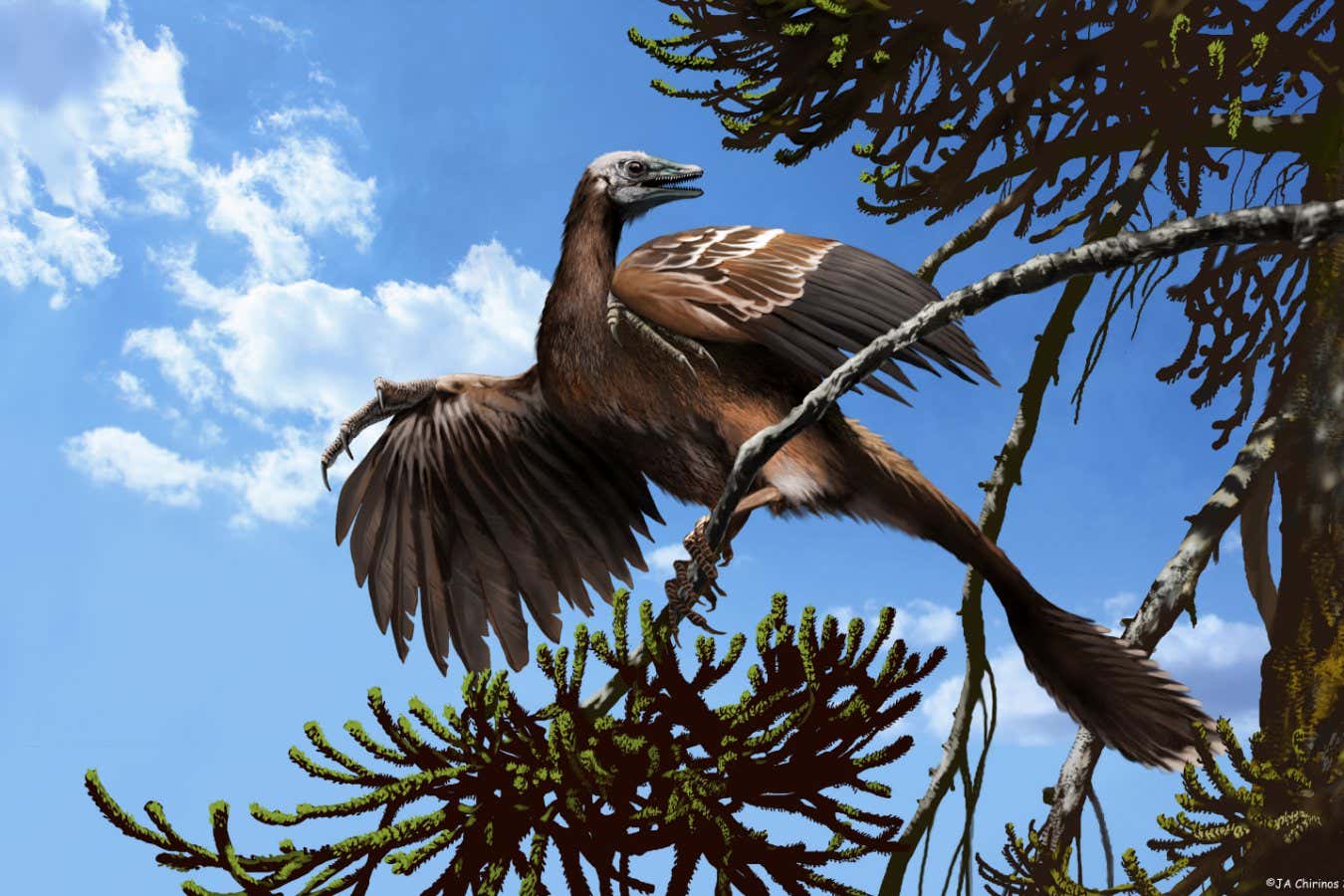
An artist’s impression of Archaeopteryx
JA CHIRINOS/SCIENCE PHOTO LIBRARY
The Story of Birds
Steve Brusatte, Picador (UK); Mariner Books (US)
Steve Brusatte is three for three. His debut book for general audiences, The Rise and Fall of the Dinosaurs, was a big hit, and he followed it with The Rise and Reign of the Mammals, which I enjoyed very much. Now comes his third palaeontological tale, The Story of Birds and, once again, he manages to combine a rigorous account of the science with a readable narrative.

Brusatte is a palaeontologist at the University of Edinburgh, UK, who has worked extensively on the fossils of dinosaurs, birds and mammals. He has excavated on the Isle of Skye, off the west coast of Scotland, where the bones and footprints of Jurassic-era animals are beautifully preserved. Alongside this, he has built up a career as a science communicator: partly by acting as palaeontology consultant to the Jurassic World films, and partly through his books.

An artist’s impression of Compsognathus
Florilegius/Alamy
The Story of Birds, subtitled An evolutionary history of the dinosaurs that live among us, does exactly what it says on the tin. Brusatte recounts the evolution of birds from their origins deep in the dinosaur era, through their diversification, to their position today as one of the most successful animal groups.
“
The dramatic discovery of Archaeopteryx bolstered Huxley’s case that birds evolved from dinosaurs
“
He begins in 1868, when the idea that birds evolved from dinosaurs was first publicly proposed by Thomas Henry Huxley, partly to shore up the then-nascent theory of evolution by natural selection. Charles Darwin’s On the Origin of Species had come out almost a decade before and contained strong evidence that populations can be gradually changed by all kinds of pressures, driving the emergence of new body types and, ultimately, the great diversity of the natural world. Darwin had done great work, but the idea still had some issues.

An artist’s impression of Falcatakely, an enantiornithine
MARK P. WITTON/SCIENCE PHOTO LIBRARY
Birds were a particular problem, as they are so unlike other animals. For one thing, they have feathers: “by far the most complex things that grow from the skin of any animal”, as Brusatte puts it. They have wings, supported by “outlandishly long arms”, and beaks. What’s more, “they stand only on their hind legs, a most unusual posture that we take for granted as humans, but which is exceedingly rare in the animal kingdom”.
Huxley solved this problem, and put birds in their correct place, by linking them to another newly identified group: dinosaurs. Their skeletons had many bird-like characteristics, to the point that the hind legs of the diminutive Compsognathus were almost indistinguishable from those of an embryonic chicken.
The dramatic discovery of Archaeopteryx, a fossil bird with feathers and wings, but also teeth, and claws on its wings, bolstered Huxley’s case. Birds evolved from dinosaurs. In fact, as Brusatte makes clear, they are a kind of dinosaur. The asteroid that struck Earth 66 million years ago didn’t wipe out the dinosaurs completely, because some of the birds survived, and birds are dinosaurs.
From Archaeopteryx, Brusatte proceeds through the fossil record of birds during the dinosaur era. He explores how and why they evolved feathers and powered flight.
He paints a vivid picture of Mesozoic bird diversity, when groups like the enantiornithines – so-called opposite birds that split from modern birds between 150 million and 130 million years ago – spread around the world. Then comes the big rock from space, which wipes out almost all of them: Brusatte is in his element discussing which groups of birds survived the calamity and why, when so many others (including all the enantiornithines) were destroyed.
In the second half of the book, Brusatte brings the story up to the present. Post-impact, birds diversified enormously to fill many of the niches left behind by the lost species – even as mammals did the same. He gives equal attention to present-day bird groups like penguins and songbirds, and to extinct marvels like terror birds and (evidently a particular favourite) demon ducks.
As someone who writes a fair bit about palaeontology, it is difficult for a book like this to really surprise me. Much of the material is at least somewhat familiar, and there are some species, like Archaeopteryx, that simply must be re-described because they are so central to the story.
Yet, Brusatte managed to startle me with the opening of chapter seven. There he discusses Zealandia: the relatively recently discovered eighth continent, mostly submerged by rising seas, of which New Zealand is part. Zealandia, Brusatte says, is the one place where the age of dinosaurs continued until almost the present day. No large mammals reached Zealandia, so the ecosystems were dominated by large birds like moas and Haast’s eagles.
“Zealandia was brimming with dinosaurs,” writes Brusatte, only slightly facetiously. This changed only when the first Māori settlers arrived, probably in the 1300s. If it hadn’t been for the arrival of humans, dinosaurs would still dominate Zealandia today.
To close the book, Brusatte steps away from palaeontology to describe his work with Pavel Němec and Kristina Kverková: neuroscientists who study the brains of present-day birds. They have tried to explain how birds can display such prodigious intelligence, from recognising themselves in mirrors to making tools and solving puzzles, when they have such small brains – necessarily so because, in order to fly, they have reduced their weight. Their brains are proportionally large, compared with their bodies, but smart birds like crows “have brains that are merely the weight of a walnut”.
The solution the team has alighted on is that bird brains, though small, are absolutely stuffed with neurons: “a given bird has about twenty-one times more neurons in its brain than a reptile of similar body mass”, writes Brusatte. I suspect there will be more to it than that – what are all those neurons doing? – but this does seem like a key finding.
The Story of Birds, then, is pretty much an unqualified success from beginning to end – and I’m already looking forward to (I’m guessing here, but I would definitely read it) The History of Reptiles in a few years’ time.
Michael Marshall is a science writer based in Devon, UK
Three more great reads about the evolution of life

A Bird’s IQ: Innovation, intelligence, and problem solving in the avian world
by Louis Lefebvre
Biologist Louis Lefebvre (in this translation by Pablo Strauss) explores the evidence for innovation and culture in bird societies, in a book rich with intriguing findings but sadly scattershot in its storytelling.

How Flowers Made Our World: The story of nature’s revolutionaries
by David George Haskell
The tale of flowering plants (angiosperms) runs in parallel to that of birds, with each group having profound influences over the other, so this makes an ideal companion to The Story of Birds.

Other Minds: The octopus and the evolution of intelligent life
by Peter Godfrey-Smith
In this modern classic, philosopher of science Peter Godfrey-Smith explores the origins of consciousness and intelligence in animals that are very different from humans.
Topics: