
Close Menu
    Trending
    • Singapore pledges US$2 million to support Ebola response in DR Congo and Uganda
    • Bangkok bar fire death toll rises to 30 as police probe possible negligence | News
    • NASCAR Quaker State 400 takeaways: Blaney dominates overtime thriller
    • How to Scale Without Compromising Your Company’s Core Values
    • Scientists overwhelmingly against rule change that would give political appointees say over science grants
    • Turkish FM Believes Israel A Global Security Threat
    • Madonna Grateful For The Success Of ‘Confessions II’
    • US immigration agents involved in another fatal shooting
    Benjamin Franklin Institute
    Tuesday, July 14
    • Home
    • Politics
    • Business
    • Science
    • Technology
    • Arts & Entertainment
    • International
    Benjamin Franklin Institute
    Home»Science»NASA plans a base on the moon spanning hundreds of square kilometres
    Science

    NASA plans a base on the moon spanning hundreds of square kilometres

    Team_Benjamin Franklin InstituteBy Team_Benjamin Franklin InstituteMay 27, 2026No Comments4 Mins Read
    Share Facebook Twitter Pinterest Copy Link LinkedIn Tumblr Email VKontakte Telegram
    Share
    Facebook Twitter Pinterest Email Copy Link


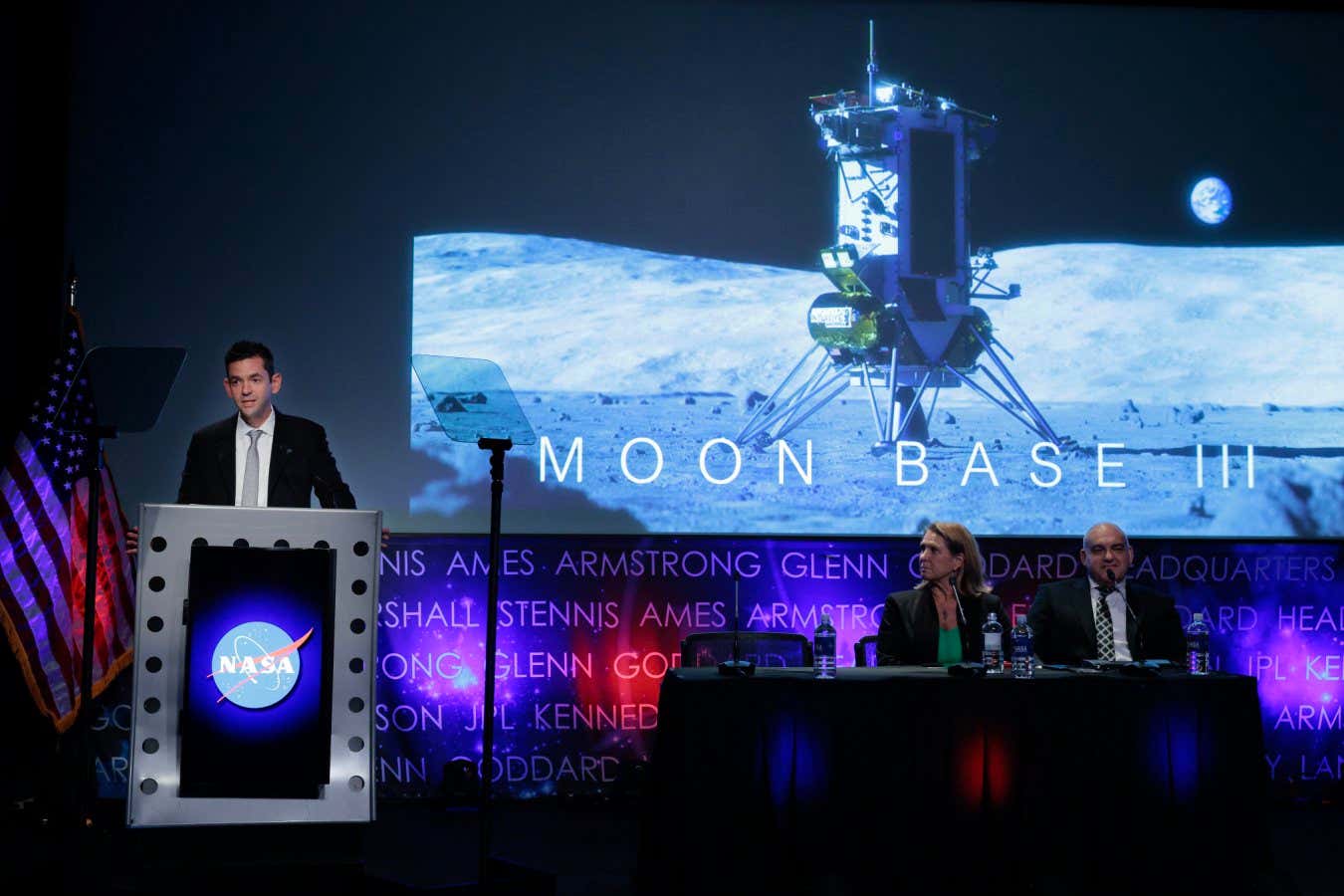
    NASA administrator Jared Isaacman (left) announced plans to establish a permanent presence on the moon during a press conference at the agency’s headquarters in Washington DC on 26 May

    Chip Somodevilla/Getty Images

    NASA has revealed details of its plans to build a permanent base on the moon. Initially, this will see autonomous rovers and hopping drones scouting out the lunar surface. Down the line, the plan is for astronauts to build a future lunar home, slated to be hundreds of square kilometres in size.

    Plans for a lunar base have been part of NASA’s Artemis programme for years, but its main focus has been landing astronauts on the moon for the first time since the 1970s. The human space-flight part of the project has been successful so far, with the Artemis II mission sending four astronauts on a path around the moon and back to Earth in April this year. But until recently, NASA had released fewer concrete details about a timeline for building a moon base.

    On 26 May, it announced that the first three missions to build a lunar base will be targeted for this year, with at least a further nine to be announced before 2027. The overall programme will consist of three phases, with the first lasting until 2029 to “secure reliable access” to the moon’s surface. The second will last until 2032 for “initial moon base operating capability”, and the actual base itself is to be built near the lunar south pole in the third and final phase, lasting up to 2036.

    An artist's illustration depicting astronauts, rovers, power systems and cargo operations at the planned base

    An artist’s illustration depicting astronauts, rovers, power systems and cargo operations at the planned base

    NASA

    This year’s missions won’t be crewed and will look to study the lunar surface in detail in order to reduce the risks for future landing missions, as well as to test out autonomous rovers to help guide the design of future moon vehicles. The first of these missions, Moon Base I, will launch towards the end of this year and will feature a lander built by Jeff Bezos’s space company Blue Origin, which hasn’t yet tested a lunar lander.

    Moon Base II and III are also planned for launch this year, though with no launch window yet, and each will involve a lander from two different private companies: Astrobotic, which will launch its Griffin lander and an autonomous rover, and Intuitive Machines, which has already attempted two lunar landings, neither of which were fully successful.

    As well as these upcoming missions, NASA has also announced that two companies, Astrolab and Lunar Outpost, will each be given more than $200 million dollars to develop future lunar-terrain vehicles, as part of the agency’s Commercial Lunar Payload Services programme. Astrolab’s will be a bulkier, human-operated design, capable of carrying nearly 1000 kilograms and travelling at nearly 10 kilometres per hour. Lunar Outpost’s design will be nimbler, travelling at more than 14 km/h, and will be capable of moving autonomously.

    NASA has also given further details of its MoonFall mission, which will see four drones make short hopping journeys across the lunar surface in 2028, taking high-resolution pictures to find suitable landing sites for future Artemis missions. While NASA will make the drones in house at its Jet Propulsion Laboratory in California, the company Firefly Aerospace will build the spacecraft that takes the drones from Earth to the moon.

    However, there are still scant details of crucial elements of a future moon base, such as how it might be powered, constructed and shielded from the harsh radiation in outer space. Previous NASA administrator Sean Duffy had announced that a nuclear fission reactor would be built on the lunar surface by 2030, but there were no updates about this in the most recent announcement from NASA, which is now led by Jared Isaacman.

    Topics:


    Source link

    Share. Facebook Twitter Pinterest LinkedIn Tumblr Email Telegram Copy Link

    Related Posts

    Science

    Scientists overwhelmingly against rule change that would give political appointees say over science grants

    July 14, 2026
    Science

    Why have their been so many record-breaking heat waves this summer?

    July 14, 2026
    Science

    We finally know the name of a Maya mathematician

    July 13, 2026
    Science

    Scientists spot sugar in interstellar space for the first time ever

    July 13, 2026
    Science

    Mathematicians still don’t know the fastest way to multiply numbers

    July 13, 2026
    Science

    RFK, Jr. is turning his attention to the U.S. Preventive Services Taskforce

    July 13, 2026
    Editors Picks

    Browns are better positioned for future after Myles Garrett trade

    June 1, 2026

    Should you trust AI to do your taxes?

    March 28, 2026

    Commentary: The tech workers building AI are scared of it, too

    May 27, 2026

    Taylor Swift’s Reaction To ‘Housemaid’ Song Use Left Director Speechless

    December 22, 2025

    Intermittent fasting probably doesn’t help with weight loss

    February 16, 2026
    About Us
    About Us

    Welcome to Benjamin Franklin Institute, your premier destination for insightful, engaging, and diverse Political News and Opinions.

    The Benjamin Franklin Institute supports free speech, the U.S. Constitution and political candidates and organizations that promote and protect both of these important features of the American Experiment.

    We are passionate about delivering high-quality, accurate, and engaging content that resonates with our readers. Sign up for our text alerts and email newsletter to stay informed.

    Latest Posts

    Singapore pledges US$2 million to support Ebola response in DR Congo and Uganda

    July 14, 2026

    Bangkok bar fire death toll rises to 30 as police probe possible negligence | News

    July 14, 2026

    NASCAR Quaker State 400 takeaways: Blaney dominates overtime thriller

    July 14, 2026

    Subscribe for Updates

    Stay informed by signing up for our free news alerts.

    Paid for by the Benjamin Franklin Institute. Not authorized by any candidate or candidate’s committee.
    • Privacy Policy
    • About us
    • Contact us

    Type above and press Enter to search. Press Esc to cancel.