

Through the Artemis Program, NASA hopes to establish a permanent human presence on the Moon in its southern polar region. China, Russia, and the European Space Agency (ESA) have similar plans, all of which involve building bases near the permanently shadowed regions (PSRs)—craters that contain water ice—that dot the South Pole-Aitken Basin. For these and other agencies, it is vital that these bases be as self-sufficient as possible since resupply missions cannot be launched regularly and take several days to arrive.
Therefore, any plan for a lunar base must come down to harvesting local resources to meet the needs of its crews as much as possible—a process known as In-Situ Resource Utilization (ISRU). In a recent study, researchers at The Ohio State University (OSU) proposed using a specialized laser-based 3D printing method to turn lunar regolith into hardened building material. According to their findings, this method can produce durable structures that withstand radiation and other harsh conditions on the lunar surface.
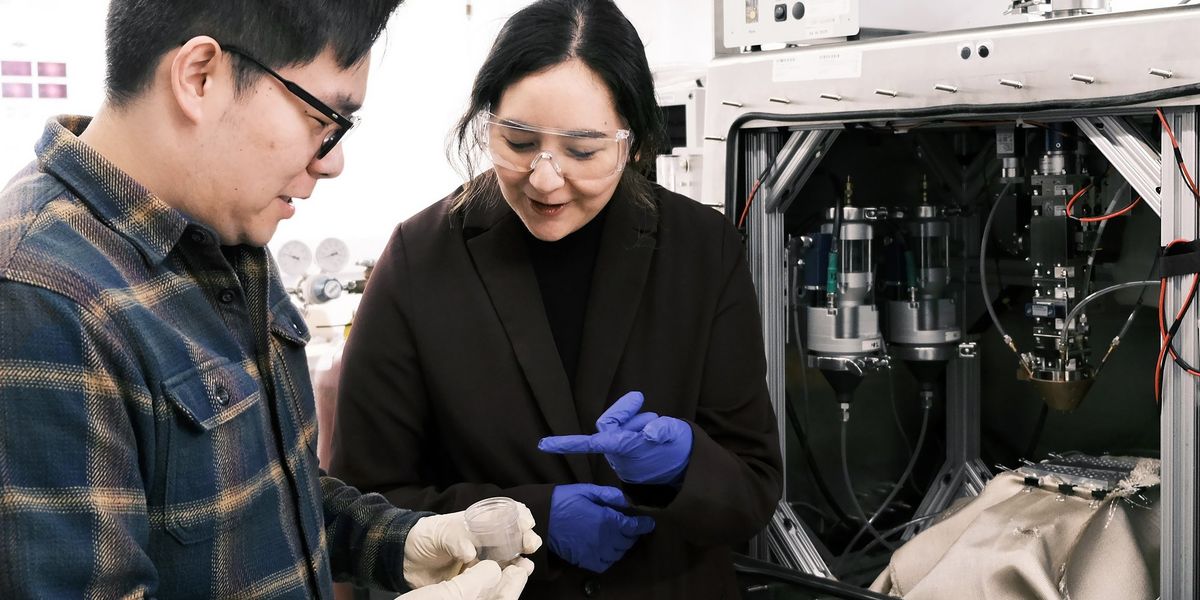
The research team was led by Sizhe Xu, a graduate research associate at OSU. He was joined by colleagues from OSU’s Department of Integrated Systems Engineering, Mechanical and Aerospace Engineering, and Materials Science & Engineering. Their paper, “Laser directed energy deposition additive manufacturing of lunar highland regolith simulant,” appeared in the journal Acta Astronautica.
Challenges of Lunar 3D Printing
The importance of ISRU for human exploration has prompted the rapid development of additive manufacturing systems, or 3D printing. These systems have proven effective at fabricating tools, structures, and habitats, effectively reducing dependence on supplies delivered from Earth. Developing such systems for long-duration missions is one of the most challenging aspects of the process, as they must be engineered to operate in the extreme environment on the Moon. This includes the lack of an atmosphere, massive temperature variations, and the ever-present problem of Moon dust.
Scientists use two types of lunar regolith for their experiments and research: Lunar Highlands Simulant (LHS-1) and Lunar Mare Simulant (LMS-1). As part of their research, the team used LHS-1, which is rich in basaltic minerals, similar to rock samples obtained by the Apollo missions. They melted this regolith with a laser to produce layers of material and fused them onto a base surface of stainless steel or glass. To assess how well these objects would fare in the lunar environment, the team tested their fabrication process under a range of different environmental conditions.
One thing they noticed was that the fused regolith adhered well to alumina-silicate ceramic, possibly because the two compounds form crystals that enhance heat resistance and mechanical strength. This revealed that the overall quality of the printed material is largely dependent on the surface onto which the regolith is printed. Other environmental factors, such as atmospheric oxygen levels, laser power, and printing speed, also affected the stability of the printed material.
Where 3D-Printed Material Could Help
Deployed to the Moon’s surface, this process could help build habitats and tools that are strong, resilient, and capable of handling the lunar environment. This has the added benefit of increasing independence from Earth, which is key to realizing long-duration missions on the Moon. In addition to assisting astronauts exploring the Moon in the near future (as part of NASA’s Artemis Program), this technology could also lead to resilient habitats that will enable a long-term human presence on the Moon, Mars, and beyond.
However, there are several unknown environmental factors that could limit the effectiveness of these systems on other worlds, and more data is needed before they can be addressed. In their study, the team suggests that instead of being powered by electricity, future scaled-up versions of their method could rely on solar or hybrid power systems. Nevertheless, the potential for space exploration is clear, and the technology also has applications for life here on Earth. Sarah Wolff, an assistant professor in mechanical and aerospace engineering and a lead author on the study, explained:
There are conditions that happen in space that are really hard to emulate in a simulant. It may work in the lab, but in a resource-scarce environment, you have to try everything to maximize the flexibility of a machine for different scenarios. If we can successfully manufacture things in space using very few resources, that means we can also achieve better sustainability on Earth. To that end, improving the machine’s flexibility for different scenarios is a goal we’re working really hard toward.
As the saying goes, “solving for space solves for Earth.” In environments where materials and resources are limited, laser-based 3D printing is one of several technologies that could support sustainable living. This applies equally to extraterrestrial environments and to regions on Earth experiencing the effects of climate change.
From Your Site Articles
Related Articles Around the Web