

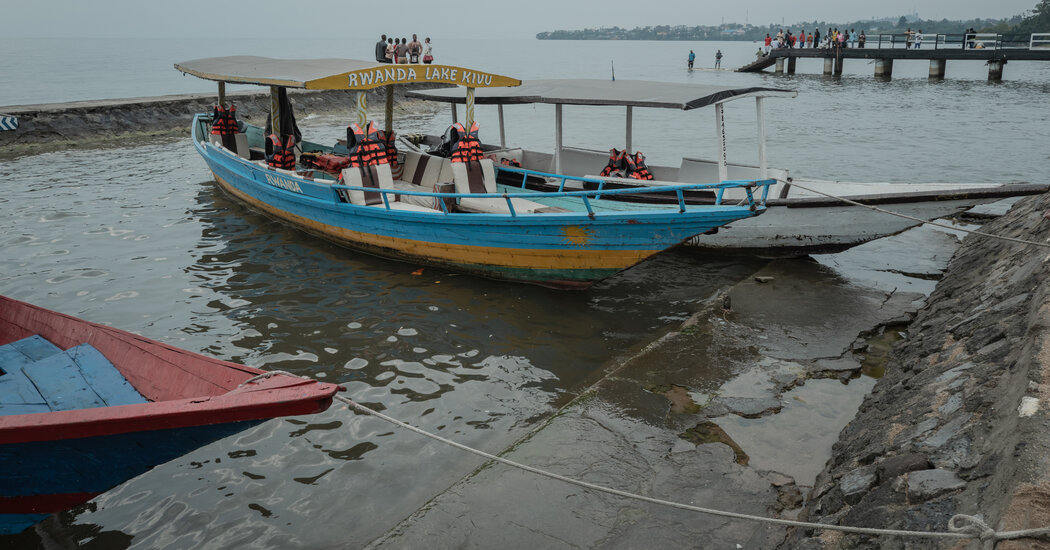
On one side of the lake, lovers glide on canoes, friends ride jet-skis and families pose for pictures in the hazy sunset. On the other side, less than two miles away, dead bodies washed ashore while ammunition and discarded weapons littered the water.
The shore of Lake Kivu in Rwanda offers leisure and relaxation. Across the border in the Democratic Republic of Congo, the same lake displayed devastation and misery after an armed group called M23 captured the lakeside city of Goma last month. Nearly 3,000 people were killed in the January offensive, according to the United Nations.
“It is peaceful here, unlike over there,” said Exauce Shalako, a 20-year-old man from Goma who was lounging on the shore of Lake Kivu in Rwanda one afternoon this month. Mr. Shalako, who said he had lost a friend in the fighting, had crossed into Rwanda for a day at the beach. “We need to unwind, to have a change of scene,” he said.
But while Rwanda appears peaceful at home, it is fueling war across the border. Thousands of Rwandan troops have invaded eastern Congo alongside fighters from M23, which is under Rwanda’s control, according to the United States and United Nations experts. Rwanda denies backing the rebels.
To cross from Goma to its sister city Gisenyi in Rwanda takes just minutes by land, but the two places feel worlds apart. In Gisenyi, a town of 50,000, restaurant owners adorn their beachfront properties with colorful decorations as the smell of roasted chicken fills the air. In Goma, a city of two million, the stench of death and the sounds of sirens wafted over the streets for days.
The neighboring countries share a painful history but have little in common these days.
Rwanda is seen as a model of development across Africa. A country nearly 90 times smaller than Congo, it sponsors top European soccer teams and is known for its high-end resorts, where affluent tourists stay during expeditions to marvel at gorillas. Being here can give an impression of political stability and affluence, but many say beneath that veneer lies widespread surveillance, repression and unequal development.
Congo, despite its dizzying natural resources, remains plagued by instability. Its eastern region is home to one of the world’s largest displacement crises, dating back to the aftermath of the Rwandan genocide 30 years ago.
“The living standards are so different,” said Théoneste Bitangimana, a Rwandan real estate agent and pastor who lives in Gisenyi and works on both sides of the border. “In Congo the rich get richer and the government doesn’t care. In Rwanda we’re constantly trying to improve the way we live.”
The Congolese have a different way of describing the wealth gap between the two nations: exploitation.
United Nations experts found that 150 tons of coltan — from which key minerals used in smartphone manufacturing are extracted — was smuggled out of Congo and into Rwanda by M23 last year.
“We’re being looted for others to get rich,” said Didier Kambale, a pastor in Goma walking on a debris-littered street this month. “Why are they coming here?” he asked about Rwandan troops. “Do Congolese wage war abroad?”
Though Rwanda’s leader has said that the war in eastern Congo is a Congolese problem, the M23 offensive on Goma brought it one step closer to Rwanda.
In its attempt to defend Goma, the Congolese army launched shells and bombs across the border in January, puncturing Rwandan homes and tearing roofs open. Sixteen people were killed and 160 injured in Rwanda. Thousands of people fleeing Goma found refuge in Rwanda.
Shattered glass and wood still littered the floors as rain fell into Mr. Bitangimana’s home this month. A shell had hit the roof of the real estate agent’s brick and cement house.
“We’re praying for the two countries, because we need to live in harmony,” he said.
In Gisenyi, children at school now talk of the war between Rwanda’s president, Paul Kagame, and his Congolese counterpart, Felix Tshisekedi.
“I don’t pick a side, it’s too complicated,” said Ariella, a 10-year-old living in Rwanda with a Congolese father and a Rwandan mother. Sitting at her home yards away from the border, Ariella said she played dead in her bed for hours one morning during the M23 offensive, fearing soldiers might “come to kill us.” The fighting paused shortly after.
Despite the two different worlds on each side of Lake Kivu’s shores, the beach in Gisenyi is also where people from Rwanda and Congo gather in peace. Mr. Shalako, the 20-year-old, said he crossed the border to tell his Rwandan friends that he was safe.
“Politicians want to make us believe that we are enemies, but we’re brothers,” he said.
In her living room, Ariella stopped her math homework to discuss the war. She said she was longing to visit her aunt who lives in Goma on her upcoming vacation, and “do all kinds of silly things over there.”
Sitting in her Spider-Man pajamas, Ariella asked a question about the presidents from both countries that left a silence in the room: “Why can’t they just make peace?”