

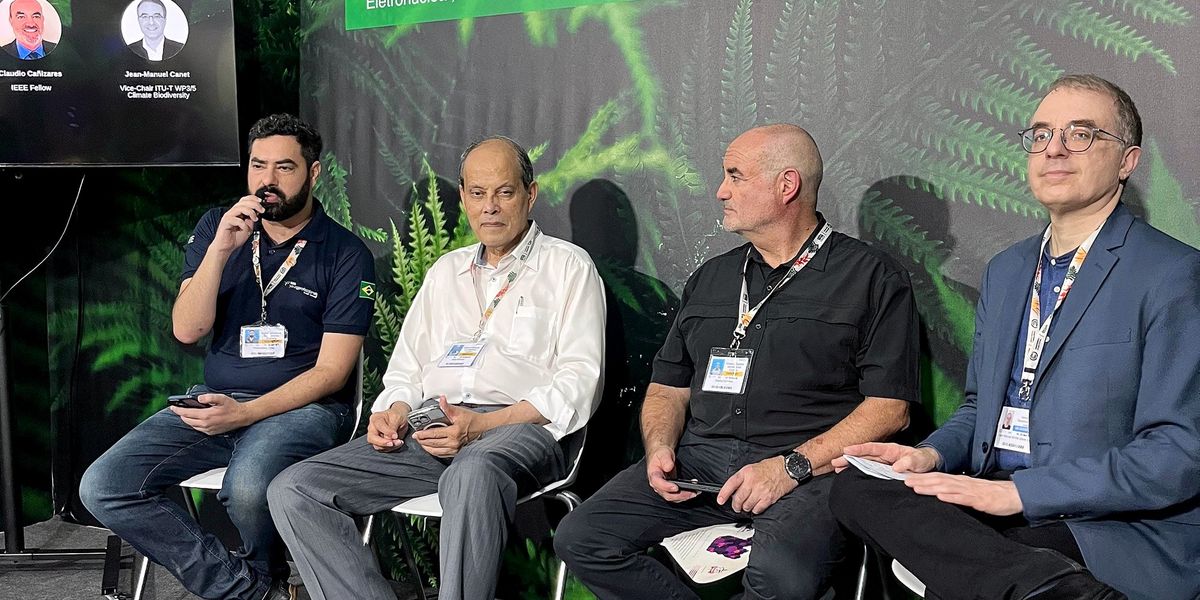
IEEE has enhanced its standing as a trusted, neutral authority on the role of technology in climate change mitigation and adaption. Last year it became the first technical association to be invited to a U.N. Conference of the Parties on Climate Change.
IEEE representatives participated in several sessions at COP30, held from 11 to 20 November in Belém, Brazil. More than 56,000 delegates attended, including policymakers, technologists, and representatives from industry, finance, and development agencies.
Following the conference, IEEE helped host the selective International Symposium on Achieving a Sustainable Climate. The International Telecommunication Union and IEEE hosted ISASC on 16 and 17 December at ITU’s headquarters in Geneva. Among the more than 100 people who attended were U.N. agency representatives, diplomats, senior leaders from academia, and experts from government, industry, nongovernment organizations, and standards development bodies.
Power and energy expert Saifur Rahman, the 2023 IEEE president, led IEEE’s delegation at both events. Rahman is the immediate past chair of IEEE’s Technology for a Sustainable Climate Matrix Organization, which coordinates, communicates, and amplifies the organization’s efforts.
IEEE’s evolving role at COP
IEEE first attended a COP in 2021.
“Over successive COPs, IEEE’s role has evolved from contributing individual technical sessions to being recognized as a trusted partner in climate action,” Rahman noted in a summary of COP30. “There is [a] growing demand for engineering insight, not just to discuss technologies but [also] to help design pathways for deployment, capacity-building, and long-term resilience.”
Joining Rahman at COP30 were IEEE Fellow Claudio Canizares and IEEE Member Filipe Emídio Tôrres.
Canizares is a professor of electrical and computer engineering at the University of Waterloo, in Ontario, Canada, and the executive director of the university’s sustainable energy institute.
Tôrres chairs the IEEE Centro-Norte Brasil Section (Brazil Chapter). An entrepreneur and a former professor, he is pursuing a Ph.D. in biomedical engineering at the University of Brasilia. He also represented the IEEE Young Professionals group while attending the conference.
In the Engineering for Climate Resilience: Water Planning, Energy Transition, Biodiversity session, Rahman showed a video from his 2024 visit to Shennongjia, China, where he monitored a clean energy project designed to protect endangered snub-nosed monkeys from human encroachment. The project integrates renewable energy, which helps preserve the forest and its wildlife.
Rahman also chaired a session at the Sustainable Development Goal Pavilion on balancing decarbonization efforts between industrialized and emerging economies.
Additionally, he participated in a joint panel discussion hosted by IEEE and the World Federation of Engineering Organizations on engineering strategies for climate resilience, including energy transition and biodiversity.
Rahman, Canizares, and Tôrres took part in a session on clean-tech solutions for a sustainable climate, hosted by the International Youth Nuclear Congress. The topics included fossil fuel–free electricity for communications in remote areas and affordable electricity solutions for off-grid areas.
The three also joined several panels organized by the IYNC that addressed climate resilience, career pathways in sustainability, and a mentoring program.
“Over successive COPs, IEEE’s role has evolved from contributing individual technical sessions to being recognized as a trusted partner in climate action.” —Saifur Rahman, 2023 IEEE president
The IYNC hosted the Voices of Transition: Including Pathways to a Clean Energy Future session, for which Tôrres and Rahman were panelists. They discussed the need to include underrepresented and marginalized groups, which often get overlooked in projects that convert communities to renewable energy.
Rahman, Canizares, and Tôrres visited the COP Village, where they met several of the 5,000 Indigenous leaders participating in the conference and discussed potential partnerships and collaborations. Climate change has made the land where the Indigenous people live more susceptible to severe droughts and wildfires, particularly in the Amazon region.
Rahman and Tôrres took a field trip to the Federal University of Para, where they met several faculty members and students and toured the LASSE engineering lab.
A meaningful experience
Tôrres, who says representing IEEE at COP30 was transformative, wrote a detailed report about the event.
“The experience reaffirmed my belief that engineering and technology, when combined with respect for cultural diversity, can play a critical role in shaping a more sustainable and equitable world,” he wrote. “It highlighted the importance of combining cutting-edge technological solutions with Indigenous wisdom and cultural knowledge to address the climate crisis.”
Rahman and Canizares give an overview of their COP30 experiences in an IEEE webinar.
“IEEE has a place at the table,” Rahman says in the video. “We want to showcase outside our comfort zone what IEEE can do. We go to all these global events so that our name becomes a familiar term. We are the first technical association organization ever to go to COP and talk about engineering.”
Canizares added that IEEE is now collaborating closely with the United Nations.
“This is an important interaction. And I think, moving forward, IEEE will become more relevant, particularly in the context of technology deployment,” he said. “As governments start technology deployments, they will see IEEE as a provider of solutions.”
ISASC takeaways
Rahman was the general chair of the ISASC event, which focused on the delivery and deployment of clean energy. Among the presenters were IEEE members including Canizares, Paulina Chan, Surekha Deshmukh, Ashutosh Dutta, Tariq Durrani, Samina Husain, Bruce Kraemer, Bruno Meyer, Carlo Alberto Nucci, and Seizo Onoe.
Sessions were organized around six themes: energy transition, information and communication technology, financing, case studies, technical standards, and public-private collaborations. A detailed report includes the discussions, insights, and opportunities identified throughout ISASC.
Here are some key takeaways.
- Although the technology exists to transition to renewable energy, most power grid systems are not ready. Deployment is increasingly constrained by transmission bottlenecks, interconnection delays, permitting challenges, and system flexibility. There’s also a skills shortage.
- Energy transition pathways must be region-specific and should consider local resources, social conditions, funding opportunities, and development priorities.
- Information and communication technologies are central to climate mitigation solutions, despite growing concerns about their environmental impact. Even though the technologies are used in beneficial ways, such as early-warning systems for natural disasters and smart water management, they also are driving the rapid growth of data centers for artificial intelligence applications—which has increased energy prices and driven up water demand.
- Technical standards are a means of accelerating adoption, interoperability, and trust in green technology. There needs to be greater coordination among standards development organizations, particularly at the convergence of energy systems, information technologies, and AI. Fragmented standards hinder interoperability. The lack of technical standards is a major constraint on project financing, limiting investors’ confidence and slowing technology deployment.
- Training and outreach efforts are important for successfully implementing standards, especially in developing regions. IEEE’s global membership and regional sections can be critical channels to address the needs.
A technology assessment tool
As part of ISASC, IEEE presented a technology assessment tool prototype. The web-based platform is designed to help policymakers, practitioners, and investors compare technology options against climate goals.
The tool can run a comparative analysis of sustainable climate technologies and integrate publicly available, expert-validated data.
IEEE can help the world meet its goals
The ISASC report concluded that by connecting engineering expertise with real-world deployment challenges, IEEE is working to translate global climate goals into measurable actions.
The discussions highlighted that the path forward lies less in inventing new technologies and more in aligning systems to deliver ones that already exist.
Summaries of COP30 and ISASC are available on the IEEE Technology for a Sustainable Climate website.
From Your Site Articles
Related Articles Around the Web