

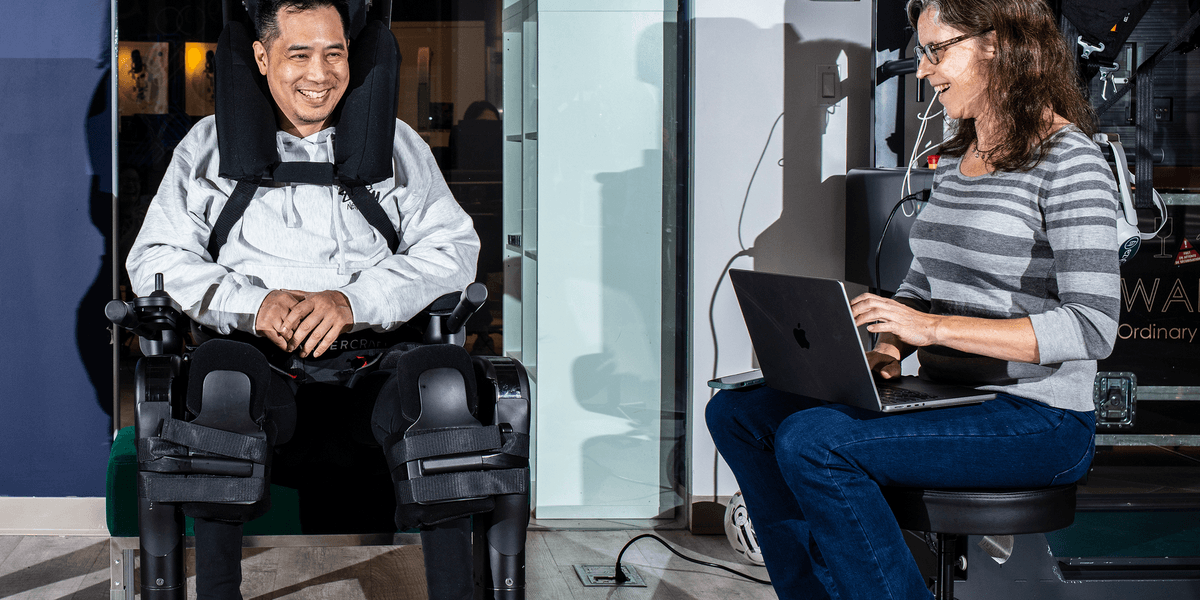
I first met Robert Woo in 2011, during his third time walking in a powered exoskeleton. The architect had been paralyzed in a construction accident four years earlier, but he was determined to get back on his feet. Watching him clunk across a rehab room in an exoskeleton prototype, the technology felt astonishing. I had the same reaction when reporting on early brain-computer interfaces (BCIs), which enabled paralyzed people to move robotic arms or communicate by thought alone. Both types of bionic technology seemed to verge on magic.
But that initial sense of awe, I’ve learned over many years of reporting on these technologies, is only a starting point. What matters is not what these systems can do in a carefully staged demo but how they perform in the real world. Do they work reliably? Can people with disabilities use them for their intended purposes? And what does it actually cost—in time, effort, and trade-offs—to do so? The question isn’t whether the technology looks impressive the first time but whether it holds up on the hundredth.
The special report in this issue, “Cyborg Tech From the Inside” takes that perspective seriously. In my feature article on Woo, an exoskeleton super-user who has spent 15 years testing these systems, the story of the technology is inseparable from the story of its use. Woo’s relentless feedback has driven steady, incremental improvements. In Edd Gent’s reporting on the pioneers testing the earliest BCIs, the experience of these extraordinary technologies likewise resolves into something more complex. As one trial participant notes, these early adopters are like the first astronauts, who barely reached space before coming back down to Earth. Together, these stories reframe these individuals not as passive medical patients but as the ultimate beta testers and co-engineers of the bionic age.
I saw the gap between demonstration and daily use firsthand when I interviewed Woo in a Manhattan showroom recently, where he was testing a new self-balancing exoskeleton from Wandercraft. The device is a striking advance that kept him upright without crutches, but it also revealed the friction of the real world. As Woo tried to walk out the door, barely an inch of slope on the Park Avenue sidewalk was enough to trigger the machine’s safety sensors and halt his progress. It was a stark reminder of how far these systems must evolve before they fit seamlessly into everyday life.
For the people who use them, that seamless integration is the ultimate goal. Getting there will depend not just on technical breakthroughs but on how well these systems hold up outside controlled environments, over time, and under real conditions. Looking from the inside doesn’t make these technologies any less remarkable, but it does change how we judge them—not by what they can do once for a photo but by what they can sustain over a lifetime. That’s the standard their users have been applying all along.
Our commitment to evaluating technology from the user’s perspective extends beyond this special report. To provide a necessary corrective to the “techno-solutionism” that often dominates coverage of assistive devices, IEEE Spectrum created the Taenzer Fellowship for Disability-Engaged Journalism, under which six writers with disabilities are contributing articles about the devices they rely on daily. As Special Projects Director Stephen Cass notes, these journalists “aren’t afraid to ask clear-eyed questions about the tech and are deeply aware of how it impacts humans.” You can read the fellows’ work at spectrum.ieee.org/tag/taenzer-fellowship.
From Your Site Articles
Related Articles Around the Web