

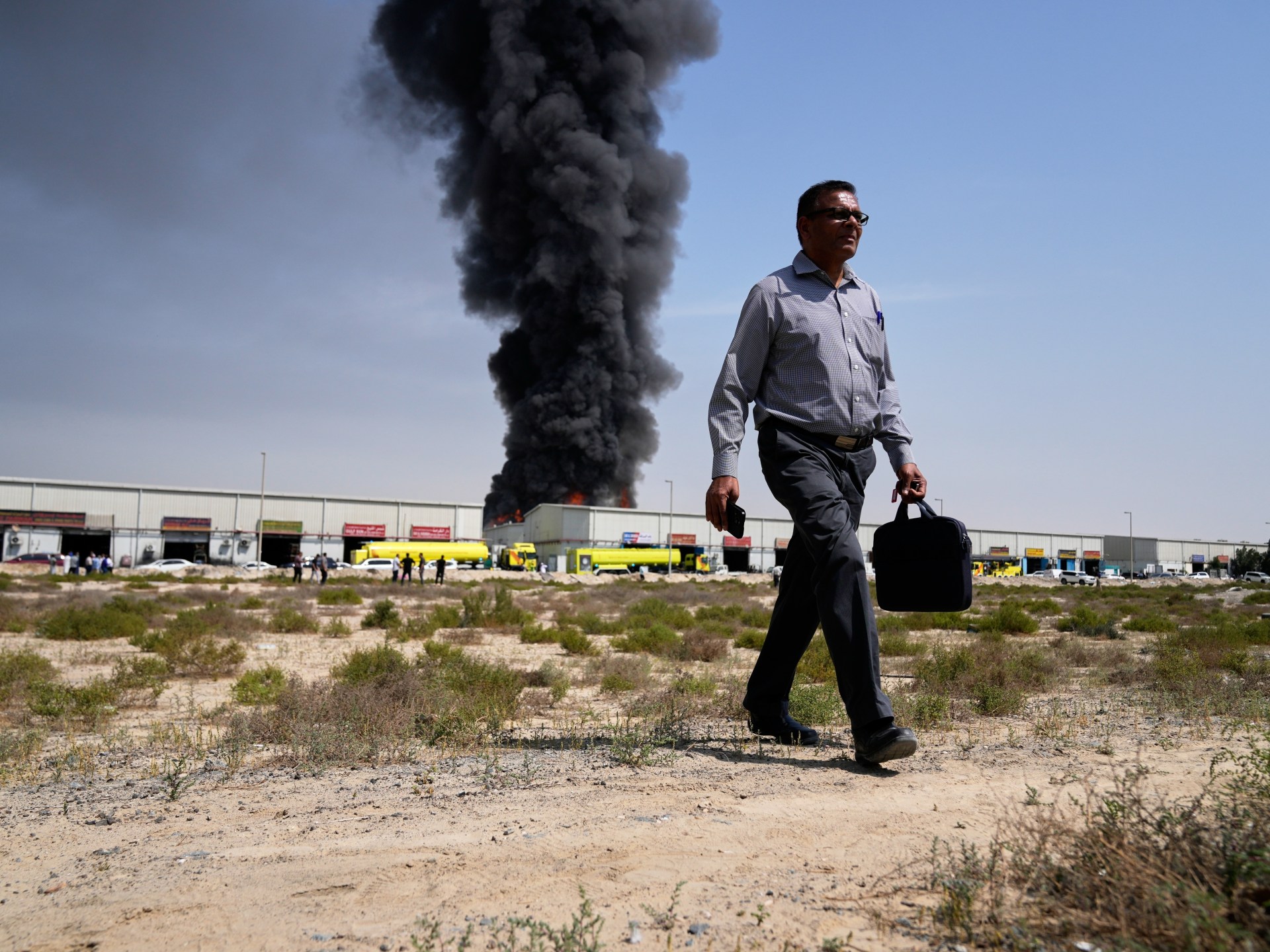
Bahrain has said an Iranian drone attack caused material damage to a water desalination plant in the country, marking the first time a Gulf nation has reported targeting any such facility during the eight days of the war between Iran and the US and Israel.
The attack on Sunday comes a day after Iranian Foreign Minister Abbas Araghchi said a freshwater desalination plant on Qeshm Island in southern Iran was attacked by the United States.
Recommended Stories
list of 3 itemsend of list
“Water supply in 30 villages has been impacted. Attacking Iran’s infrastructure is a dangerous move with grave consequences. The US set this precedent, not Iran,” he said on X on Saturday.
While Tehran has not yet commented on the Bahrain attack, it has raised questions about the vulnerability of the Gulf countries, which depend on desalination plants for the majority of their water supply.
How important are water desalination plants to the Gulf region? Can water security in the Gulf be guaranteed amid a widening of military targets to include energy and other civilian sites?
What are desalination plants?
A desalination plant primarily converts seawater into water suitable for drinking purposes as well as for irrigation and industrial use.
The process of desalination involves removing salt, algae and other pollutants from seawater using a thermal process or membrane-based technologies.
According to the US Department of Energy, desalination systems “heat water so that it evaporates into steam, leaving behind impurities, and then condenses back into a liquid for human use”.
Meanwhile, membrane-based desalination involves “a class of technologies in which saline water passes through a semipermeable material that allows water through but holds back dissolved solids like salts”.
Reverse osmosis is the most popular membrane technology. Most countries in the Gulf Cooperation Council (GCC) use reverse osmosis since it is an energy-efficient technique.
Why are desalination plants important to the Gulf?
Water is scarce in the Gulf region due to the arid climate and irregular rainfall. Countries in the Gulf also have very limited natural freshwater resources. Groundwater, together with desalinated water, accounts for about 90 percent of the region’s main water resources, according to a 2020 report by the Gulf Research Center.
But in recent years, as groundwater has also begun to deteriorate as a result of climate change, Gulf countries have begun relying heavily on energy-intensive seawater desalination to meet their water needs.
More than 400 desalination plants are located on the Arabian Gulf shores stretching from the United Arab Emirates (UAE) to Kuwait, providing water to one of the most water-scarce regions in the world.
According to a 2023 research paper published by the Arab Center Washington DC, GCC member states account for about 60 percent of global water desalination capacity, producing almost 40 percent of the total desalinated water in the world.
About 42 percent of the UAE’s drinking water comes from desalination plants, while that figure is 90 percent in Kuwait, 86 percent in Oman, and 70 percent in Saudi Arabia. Saudi Arabia also produces more desalinated water than any other country.
Desalination has also played a crucial role in enabling economic development in the region, according to Naser Alsayed, an environmental researcher specialising in the Gulf states.
He noted that after the discovery of oil in the late 1930s, Gulf states had very limited natural freshwater resources and could not meet the demands created by population growth and expanding economic activity.
“Desalination plants were therefore introduced,” he told Al Jazeera, adding that the importance of desalinated water in supporting the Gulf’s development is often overlooked.
“As a result, targeting or disrupting desalination facilities would place much of the region’s economic stability and growth at significant risk,” he said.
“Secondly, desalination is the main source of freshwater for most GCC states, especially smaller and highly water-scarce countries such as Bahrain, Kuwait and Qatar. Because this water is primarily used for human consumption, desalination carries a strong humanitarian dimension and is essential for sustaining daily life in the region, making any disruption to these facilities particularly significant for the population,” he added.
Iran also uses desalination plants, which have been installed in coastal areas such as Qeshm Island in the Gulf. But Iran also has many rivers and dams and is not as heavily reliant on desalination plants as other countries in the Gulf region.
If a desalination plant is attacked, what is the impact?
The Gulf’s heavy reliance on desalination plants has made it vulnerable during times of conflict.
During the 1990-1991 Gulf War, Iraqi forces intentionally destroyed most of Kuwait’s desalination capacity, and the damage to its water supply was severe.
A 2010 CIA report (PDF) also warned that while “national dependence on desalinated water varies substantially among Persian Gulf countries, disruption of desalination facilities in most of the Arab countries could have more consequences than the loss of any industry or commodity.”
According to Alsayed, the impact of a plant being attacked in the region, however, depends on the local scenario.
“For Saudi Arabia, which is the least dependent on desalination and has significant geographic space, facilities on the Red Sea provide resilience. The UAE has 45 days of water storage aligned with its 2036 water security strategy, so contingency plans are in place to manage potential disruptions,” he said.
“The effects are likely to be felt more acutely in smaller states that are highly dependent on desalination like Qatar, Bahrain, and Kuwait, which have minimal strategic reservoirs,” he noted.
“The most significant impact, in my view, is psychological,” Alsayed said. “Water is essential to human life, and the perception of risk can cause fear and panic, which is particularly challenging in the current environment in the region and where authorities are working to maintain calm.”
How can water security be guaranteed?
As attacks on Gulf countries continue, with energy and civilian infrastructure being targeted, Alsayed highlighted that it is important for GCC countries to view water security as a regional issue rather than an independent concern for each member state.
“The countries need to coordinate more closely and work together. The GCC has a strong platform to prepare for water challenges, but has not fully utilised it,” he said.
Alsayed noted that the GCC Unified Water Strategy 2035 called for all member states to have a national integrated energy and water plan by 2020, but this has not yet been achieved.
“Whether through unified desalination grids, shared regional strategic water reserves, or diversifying water resource goals, this is the way to usher a new era to strengthen Gulf water security,” he said.