
Close Menu
    Trending
    • Rescuers Reach Five Miners Trapped in Laos Cave
    • South Africa AI Policy Leverage as Africa’s Test Case
    • Even Therapists Have Become A Data Mine
    • Gayle King Details Catching Her Ex-Husband Cheating
    • UFC fighting cage rises on White House lawn for bout celebrating America’s 250th anniversary
    • Mogadishu gathers for Eid with prayers, family meals and outings | Religion News
    • Insider wouldn’t be ‘shocked’ if Mets made surprising Lindor decision
    • When transportation experts say the road project is worth it, they’re probably wrong
    Benjamin Franklin Institute
    Wednesday, May 27
    • Home
    • Politics
    • Business
    • Science
    • Technology
    • Arts & Entertainment
    • International
    Benjamin Franklin Institute
    Home»Technology»How a Cambridge Project Rescues Fading Floppy Disk Data
    Technology

    How a Cambridge Project Rescues Fading Floppy Disk Data

    Team_Benjamin Franklin InstituteBy Team_Benjamin Franklin InstituteMay 27, 2026No Comments3 Mins Read
    Share Facebook Twitter Pinterest Copy Link LinkedIn Tumblr Email VKontakte Telegram
    Share
    Facebook Twitter Pinterest Email Copy Link

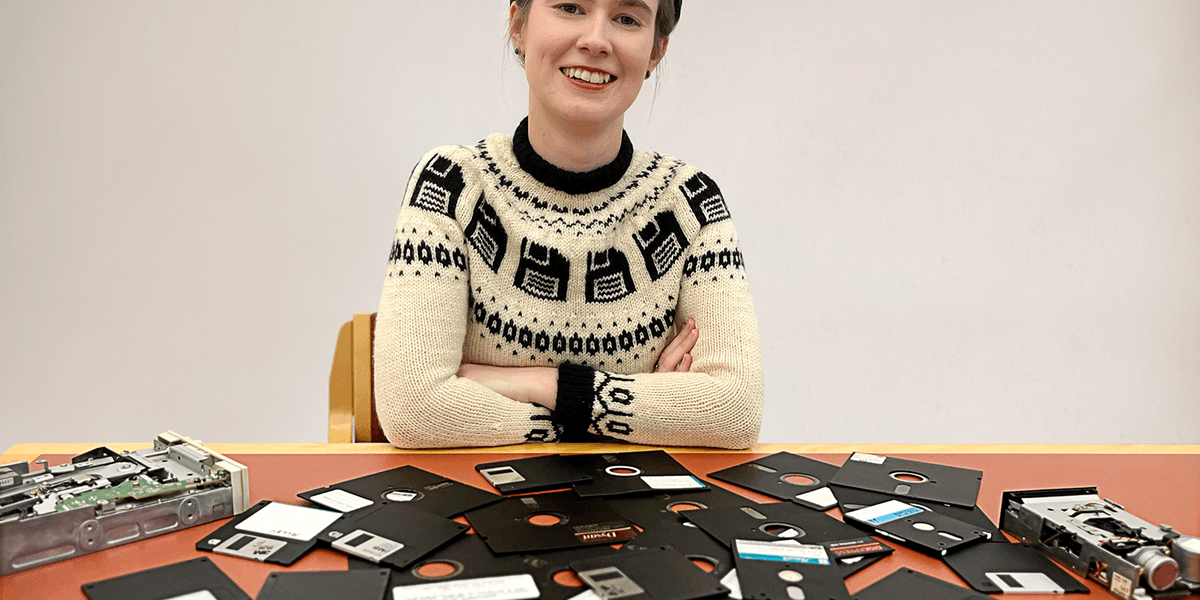
    Floppy disks are several decades old—many of the disks are degrading and the data stored on them is at risk of being lost. In response, Leontien Talboom, a technical analyst at Cambridge University Libraries and Archives, led a roughly year-long project preserving floppy disks called “Future Nostalgia,” which concluded in January.

    Leontien Talboom

    Leontien Talboom is a technical analyst at Cambridge University Libraries and Archives, where she transfers material from a wide range of storage media to make them accessible to archivists.

    IEEE Spectrum spoke to Talboom about her work preserving data from Cambridge’s collection of floppy disks and collecting knowledge about the disks themselves.

    Why is it important to preserve floppy disks now?

    Leontien Talboom: Two reasons. First, the physical media is starting to degrade. Floppy disks are made from plastic, but they’ve got a magnetic layer of iron oxide, and that’s deteriorating. A lot of floppy disks are found in attics or garages, which means they also suffer from mold.

    Second, a lot of people who developed floppy disks and systems that use floppy disks are starting to retire or pass away, which means that a lot of tacit knowledge is disappearing.

    Whom did you go to for that tacit knowledge?

    Talboom: I went to the retro computing community. Their work is more around preserving these machines to keep them running [than] the data that lives on the floppy disk. But they know their stuff about floppy disks.

    For example, they know that in a lot of the older disks, the inside of the disk—the doughnut—gets stuck to the top. So if you flex the casing, the doughnut falls down again. If I hadn’t known that, I would have assumed that those disks in our collection were broken or corrupt.

    What is the most difficult part of working with floppy disks?

    Talboom: Accessing the files can be quite challenging if we don’t understand the file system. Within libraries and archives, we get a lot of material from machines that are not as well loved. Many of the personal computers that you had at home, such as the Amstrad or ZX Spectrum or BBC Micro, are very well documented. But a bunch of our material comes from business or research systems. They’re not as nostalgic for people, so there’s not as big a community preserving this type of material.

    Do you have a favorite type of floppy disk?

    Talboom: Five and a quarter. The weirder the system, the more frustrating and fun it is. I quite like doing that detective work.

    The Amstrad disk has also really stolen my heart. The popularity of floppy disks is very geographically dependent. Our library, for example, has these Amstrad 3-inch disks. But if you go to the U.S., they’re really uncommon. They weren’t able to manufacture enough of these drives, and [3.5-inch disks] took over at a certain point. But they’re really cute.

    What’s the best method for sustainably storing data?

    Talboom: The main thing is actively looking after it. A lot of the floppy disks we get in the library haven’t been accessed for 20 or 30 years, which means that you need certain special hardware to actually read them, and then work with emulators or other tools to make these file formats accessible.

    Now that we’ve done that work and transferred it, we can monitor it and make sure it’s not suffering from anything like bit rot. We can also make decisions around migrating it to other file formats or working on specific file systems or unknown file formats in more detail.

    From Your Site Articles

    Related Articles Around the Web


    Source link

    Share. Facebook Twitter Pinterest LinkedIn Tumblr Email Telegram Copy Link

    Related Posts

    Technology

    South Africa AI Policy Leverage as Africa’s Test Case

    May 27, 2026
    Technology

    Tech Life – Teaching in the AI world

    May 26, 2026
    Technology

    Meet NASA Low Outgassing Standards With Adhesives for Aerospace and Optical Systems

    May 26, 2026
    Technology

    IEEE TryEngineering OnCampus Now At 7 Universities

    May 25, 2026
    Technology

    Social Engineering for Good – IEEE Spectrum

    May 25, 2026
    Technology

    AI with Model-Based Design: Virtual Sensor Modeling

    May 25, 2026
    Editors Picks

    End-to-end encryption: Best ideas of the century

    January 28, 2026

    Trump drops tariff threat over Greenland

    January 21, 2026

    Wall Street Journal Reporter Evan Gershkovich Detained In Russia

    December 27, 2024

    SpaceX offers free Starlink access to Iranian demonstrators amid internet blackout

    January 15, 2026

    Iran war may end ‘pretty quickly’: What Trump told Republicans | Donald Trump News

    March 10, 2026
    About Us
    About Us

    Welcome to Benjamin Franklin Institute, your premier destination for insightful, engaging, and diverse Political News and Opinions.

    The Benjamin Franklin Institute supports free speech, the U.S. Constitution and political candidates and organizations that promote and protect both of these important features of the American Experiment.

    We are passionate about delivering high-quality, accurate, and engaging content that resonates with our readers. Sign up for our text alerts and email newsletter to stay informed.

    Latest Posts

    Rescuers Reach Five Miners Trapped in Laos Cave

    May 27, 2026

    South Africa AI Policy Leverage as Africa’s Test Case

    May 27, 2026

    Even Therapists Have Become A Data Mine

    May 27, 2026

    Subscribe for Updates

    Stay informed by signing up for our free news alerts.

    Paid for by the Benjamin Franklin Institute. Not authorized by any candidate or candidate’s committee.
    • Privacy Policy
    • About us
    • Contact us

    Type above and press Enter to search. Press Esc to cancel.