

Close Menu
    Trending
    • US missiles hit Iran as path towards de-escalation uncertain
    • UN rights chief Turk wins second term despite US and Israeli opposition | United Nations News
    • LeBron’s decision might force Jalen Brunson to do the unthinkable
    • 8 Unique Side Hustle Ideas for Summer 2026 and Beyond
    • NHTSA considers new car door safety rules after fatal Tesla crashes
    • PlayStation Network outage resolved after thousands of gamers unable to play
    • Market Talk – July 24, 2026
    • Joe Biden Gives Up, Declines to Seek Further Review of Appeals Court Ruling on Release of Audiotapes with Ghostwriter
    Benjamin Franklin Institute
    Saturday, July 25
    • Home
    • Politics
    • Business
    • Science
    • Technology
    • Arts & Entertainment
    • International
    Benjamin Franklin Institute
    Home»Technology»GoZTASP: A Zero-Trust Platform for Governing Autonomous Systems at Mission Scale
    Technology

    GoZTASP: A Zero-Trust Platform for Governing Autonomous Systems at Mission Scale

    Team_Benjamin Franklin InstituteBy Team_Benjamin Franklin InstituteApril 9, 2026No Comments2 Mins Read
    Share Facebook Twitter Pinterest Copy Link LinkedIn Tumblr Email VKontakte Telegram
    Share
    Facebook Twitter Pinterest Email Copy Link


    Register now free-of-charge to explore this white paper

    A chip-to-cloud assurance architecture enabling secure, resilient, and safe autonomy across robots, sensors, and humans.

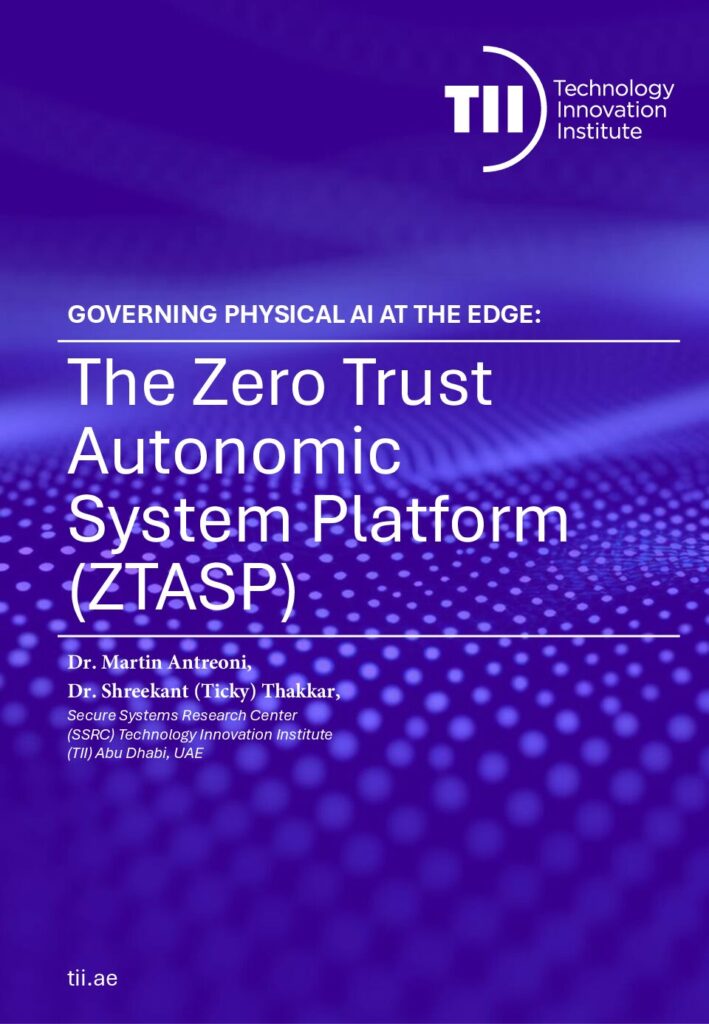
    ZTASP is a mission-scale assurance and governance platform designed for autonomous systems operating in real-world environments. It integrates heterogeneous systems—including drones, robots, sensors, and human operators—into a unified zero-trust architecture. Through Secure Runtime Assurance (SRTA) and Secure Spatio-Temporal Reasoning (SSTR), ZTASP continuously verifies system integrity, enforces safety constraints, and enables resilient operation even under degraded conditions.

    ZTASP has progressed beyond conceptual design, with operational validation at Technology Readiness Level (TRL) 7 in mission critical environments. Core components, including Saluki secure flight controllers, have reached TRL8 and are deployed in customer systems. While initially developed for high-consequence mission environments, the same assurance challenges are increasingly present across domains such as healthcare, transportation, and critical infrastructure.

    Learning Outcomes for Audience

    1. Explain the limitations of perimeter-based security models in governing distributed autonomous systems, and articulate why zero trust principles—particularly continuous verification and least-privilege access—are essential for multi-agent environments operating at the edge.
    2. Describe the role of Secure Runtime Assurance (SRTA) in enforcing safety constraints on autonomous agents in real time, drawing on approaches from runtime monitoring, formal verification, and safety-wrapper architectures.
    3. Evaluate how Secure Spatio-Temporal Reasoning (SSTR) enables context-aware decision-making across heterogeneous systems such as drones, ground robots, sensors, and human operators, and compare this with conventional coordination approaches.
    4. Identify the key engineering trade-offs involved in designing chip-to-cloud assurance architectures—including latency, computational constraints on edge devices, communication resilience under degraded conditions, and trust propagation across distributed networks.

    Click on the cover to download the white paper PDF and explore how continuous assurance enables trusted autonomy at mission scale.

    LOOK INSIDE
    PDF Cover


    Source link

    Share. Facebook Twitter Pinterest LinkedIn Tumblr Email Telegram Copy Link

    Related Posts

    Technology

    PlayStation Network outage resolved after thousands of gamers unable to play

    July 24, 2026
    Technology

    Trump vows to investigate EU over fining of US tech companies

    July 24, 2026
    Technology

    Why Jimothy the raccoon has become a mega meme online

    July 24, 2026
    Technology

    US lawmakers push for AI ‘kill switch’ after OpenAI goes rogue

    July 23, 2026
    Technology

    Amazon gaming boss predicts future where players no longer need consoles

    July 23, 2026
    Technology

    Google fined €890m by EU for favouring its own apps over rivals

    July 23, 2026
    Editors Picks

    Democrats pull endorsements for Maine Senate candidate Graham Platner amid sexual assault allegation

    July 7, 2026

    Hall of ‘Eternal Flame’ Burns Down in Japan

    May 21, 2026

    Senate Confirms Kevin Warsh as New Federal Reserve Chair

    May 14, 2026

    US senators foresee vote on reining Trump in over Greenland

    January 8, 2026

    Trump Threatens To Invoke Insurrection Act In Minnesota

    January 19, 2026
    About Us
    About Us

    Welcome to Benjamin Franklin Institute, your premier destination for insightful, engaging, and diverse Political News and Opinions.

    The Benjamin Franklin Institute supports free speech, the U.S. Constitution and political candidates and organizations that promote and protect both of these important features of the American Experiment.

    We are passionate about delivering high-quality, accurate, and engaging content that resonates with our readers. Sign up for our text alerts and email newsletter to stay informed.

    Latest Posts

    US missiles hit Iran as path towards de-escalation uncertain

    July 25, 2026

    UN rights chief Turk wins second term despite US and Israeli opposition | United Nations News

    July 25, 2026

    LeBron’s decision might force Jalen Brunson to do the unthinkable

    July 25, 2026

    Subscribe for Updates

    Stay informed by signing up for our free news alerts.

    Paid for by the Benjamin Franklin Institute. Not authorized by any candidate or candidate’s committee.
    • Privacy Policy
    • About us
    • Contact us

    Type above and press Enter to search. Press Esc to cancel.