

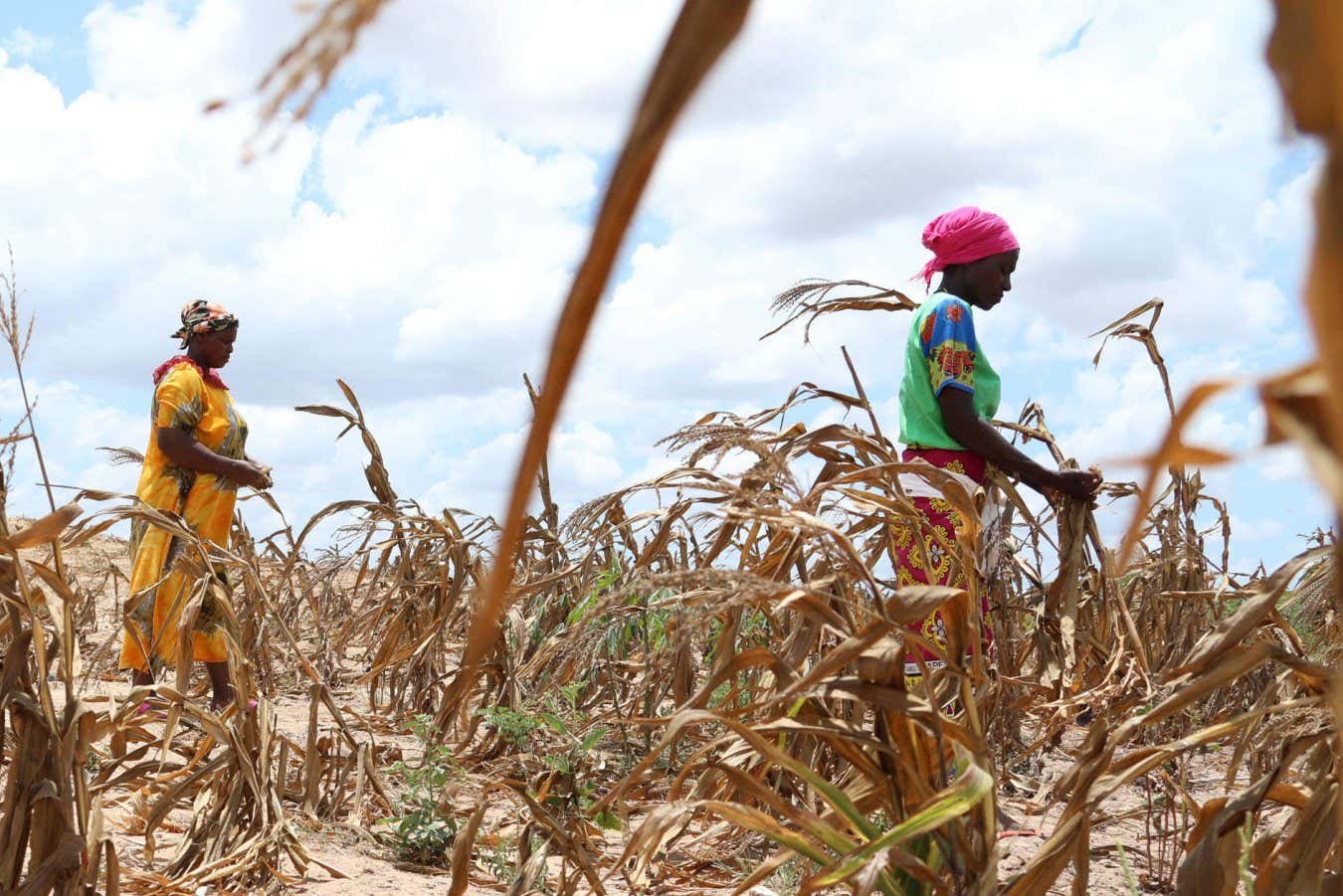
The economies of countries where many people work in farming will be hit the hardest
Imago/Alamy
Global warming-fuelled heat and drought is already hitting yields of maize, wheat and soybeans to the tune of $20 billion a year, a study has estimated. This could rise eightfold, to more than $160 billion by 2100, unless we slash emissions.
While the financial losses will be greatest for big producers such as the US, the impacts will be felt most in the lowest-income countries, where the majority of the population works in farming, says Yi Ling Hwong at the International Institute for Applied Systems Analysis (IIASA) in Austria. “If you look at the least-developed countries in Africa, the impact is much bigger.” This could lead to social unrest and increased migration, she warns.
There is great uncertainty about these kinds of projections, not least because so much depends on how farmers respond and adapt to a continually changing climate, for instance, by switching to different crops or adopting irrigation where it is possible. In fact, the whole point of this study is to raise awareness and encourage adaptation, to help ensure these projections turn out to be overestimates, says team member Kai Kornhuber, also at IIASA. “This is the entire mission of climate scientists: we make these cases for people to react, so our projections turn out to be wrong.”
The researchers started by gathering data on the yields per country of maize, wheat and soya from the UN Food and Agriculture Organization (FAO). Next, they took past climate data and calculated the drought level, using a standard approach that estimates soil moisture levels from rainfall and evaporation levels.
Past heat extremes and drought levels were then compared with the yields from 1974 to 2004 to estimate the impact of heat and drought. They then used these statistical correlations to estimate crop losses from 2007 to 2019. Their results suggest that increases in heat extremes and drought have caused a 3.5 per cent decline in yields relative to the 1974 to 2004 baseline. “Three per cent or so might not sound like much, but this is a major impact [on] the global food market, which regionally can trigger a severe crisis,” says Kornhuber.
The researchers then calculated the economic losses, based on FAO data showing how much farmers would have been paid for their produce at the time. Finally, they used the same approach to project future losses in several different emissions scenarios, assuming that some adaptation takes place.
In a high-emissions scenario, known as SSP3-7.0, global yields will fall by around 35 per cent by 2100, with annual losses rising to more than $161 billion. “The production losses caused by heat and drought are around 855 million tonnes a year,” says Hwong, who presented the results at a meeting of the European Geosciences Union in Vienna in May. “I think that is equivalent to what around 2 billion people consume over a year.”
This could be an underestimate of the full impact of climate change for a number of reasons: it’s just three crops, and it doesn’t include flood, storm or rain damage, or the possibility that shortages could lead to big price increases, as is already happening with some other crops such as coffee and cacao.
Jonas Jägermeyr at Columbia University in New York says the study’s reliance on the statistical relationships between yield losses and extreme heat and drought could result in it overestimating the impacts by 2100. “Statistical yield models are great for explaining what’s happening now, and in the near past [or] future, but they are inherently unreliable when pushed into vastly different environmental regimes, such as high-emission climate scenarios by the end of the century.” Computer models of how plants are affected by rising CO2 and temperatures are better for projecting what will happen by the end of the century, he says.
Karine Chenu at the University of Queensland, Australia, makes the same point. “Although models are not perfect, they are better suited for this type of extrapolation.” However, her team recently released a study, which hasn’t been peer-reviewed, showing that two widely used models for wheat make large errors and are especially poor at forecasting the combined effects of extreme heat and drought.
But Kornhuber has defended his team’s use of statistical methods. “The models are remarkable tools, but some of the validation papers have suggested that they might not be super responsive to extremes,” he says. “In our project, extremes were the main focus, so we decided to establish these relationships directly through statistics.”
Topics: