

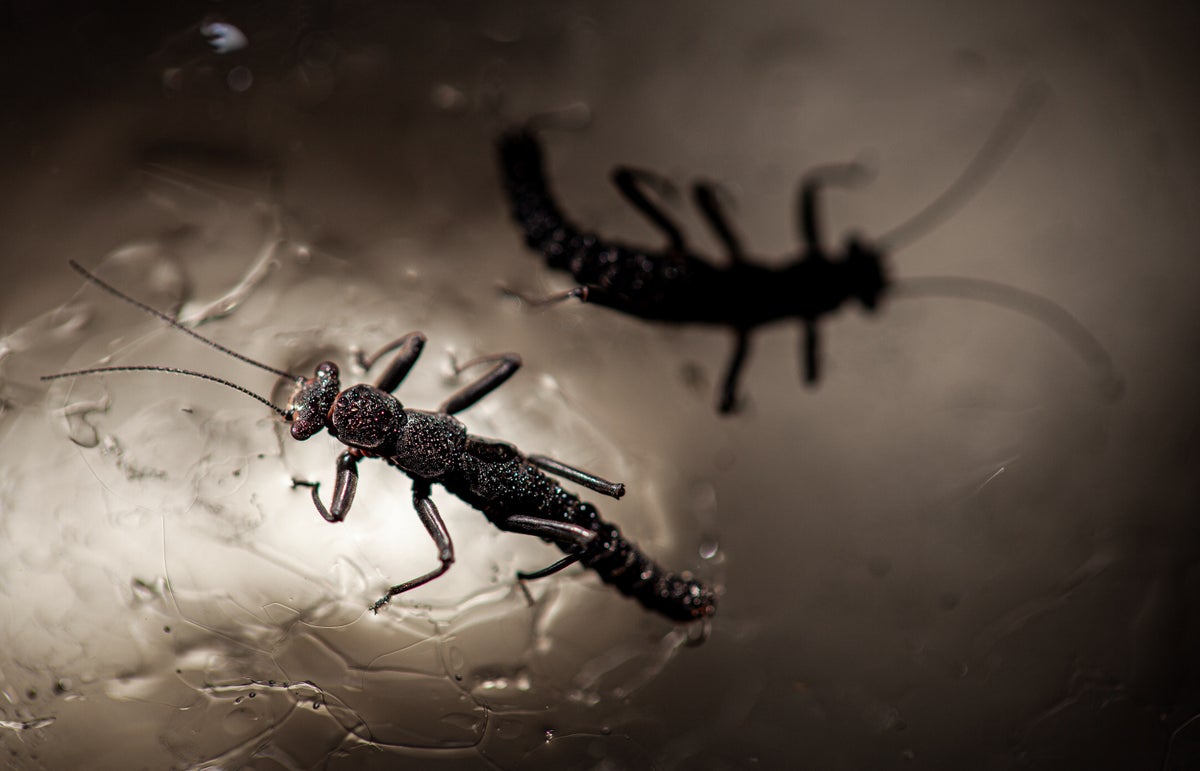
Glaciers are awe-inspiring, slow-moving rivers of ice powerful enough to reshape Earth—but for certain wee creatures, they’re also home.
New research has identified more than 150 different species that live on glaciers, with nearly half of these animals having only ever been reported at glacial sites. And these are true animals, not single-celled microbes. Even more intriguingly, these critters seem to show patterns in where they’re found, with different types of species turning up in specific types of glacier habitats, according to research published today in Proceedings of the National Academy of Sciences USA.
“People usually picture glaciers as all the same, a white field,” says co-author Andrea Simoncini, a Ph.D. student in environmental sciences at the University of Milan in Italy. But that isn’t true, he says. Some patches of ice are covered with fresh snow; others are covered with dirt that blew onto the surface or streams and pools that were formed by meltwater. Then there are “glacier mice,” tumbleweedlike balls of moss that scientists are only beginning to inspect for hidden residents, Simoncini says. Cryoconite holes, small pools of meltwater eaten into the glacier’s surface by debris heated by the sun, also provide habitats.
On supporting science journalism
If you’re enjoying this article, consider supporting our award-winning journalism by subscribing. By purchasing a subscription you are helping to ensure the future of impactful stories about the discoveries and ideas shaping our world today.
As Simoncini and his colleagues pored through more than 100 existing studies reporting animals that were found living in these various habitats, they were surprised to notice trends in what was found where. The inhabitants of cryoconite holes, for example, were dominated by puffy tardigrades, or “water bears,” and rotifers, tiny critters with a ring of hairlike extensions at their front. In contrast, debris on top of glaciers were home mostly to nematodes, or roundworms, and little, insectlike springtails.
Although individual research papers convey the wonders of, for example, discovering a species of ice worm that might teach scientists to make other species better able to tolerate extreme cold, the new study offers a global look at the marvels of glacier animals. It also shows how much we’re likely missing out on because of how difficult these habitats are to explore. What research there has been is unevenly distributed, Simoncini says, with exploration focused on western North America, Greenland, parts of Europe and the Himalayas.
And because glaciers are rapidly melting as Earth’s temperatures rise as a result of the burning of fossil fuels, these research gaps are urgent, Simoncini says. “We are probably losing each year, each month, species that we don’t even know exist,” he says.
It’s Time to Stand Up for Science
If you enjoyed this article, I’d like to ask for your support. Scientific American has served as an advocate for science and industry for 180 years, and right now may be the most critical moment in that two-century history.
I’ve been a Scientific American subscriber since I was 12 years old, and it helped shape the way I look at the world. SciAm always educates and delights me, and inspires a sense of awe for our vast, beautiful universe. I hope it does that for you, too.
If you subscribe to Scientific American, you help ensure that our coverage is centered on meaningful research and discovery; that we have the resources to report on the decisions that threaten labs across the U.S.; and that we support both budding and working scientists at a time when the value of science itself too often goes unrecognized.
In return, you get essential news, captivating podcasts, brilliant infographics, can’t-miss newsletters, must-watch videos, challenging games, and the science world’s best writing and reporting. You can even gift someone a subscription.
There has never been a more important time for us to stand up and show why science matters. I hope you’ll support us in that mission.