

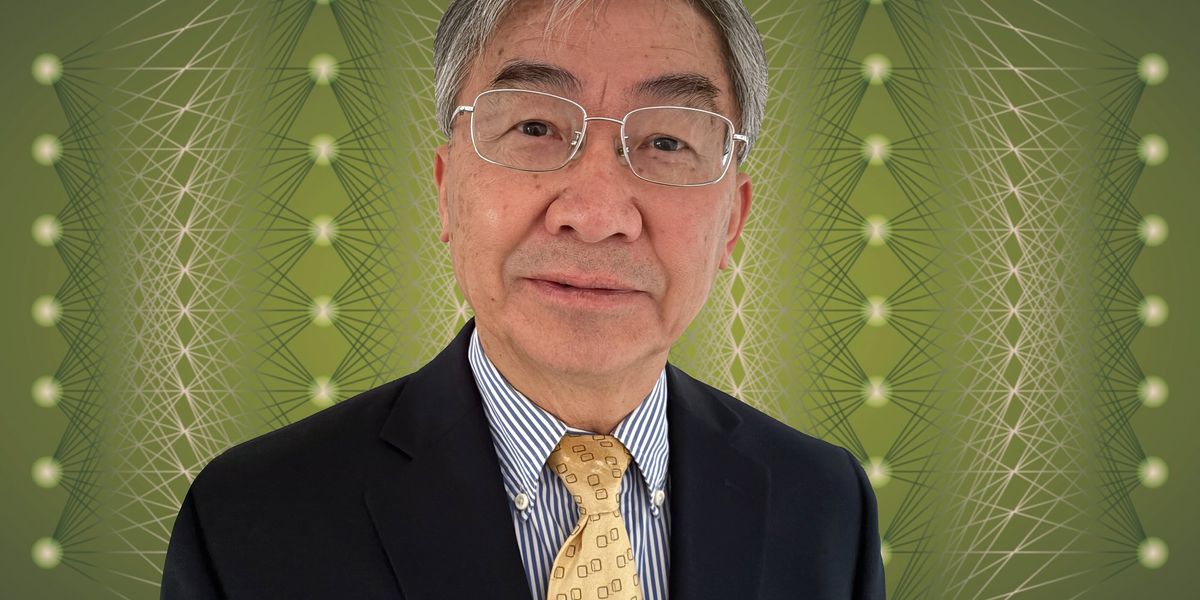
Hoang Pham has spent his career trying to ensure that some of the world’s most critical systems don’t fail, including commercial aircraft engines, nuclear facilities, and massive data centers that underpin AI and cloud computing.
A professor of industrial and systems engineering at Rutgers University in New Brunswick, N.J., and a longtime volunteer for IEEE, Pham, an IEEE Life Fellow, is internationally recognized for advancing the mathematical foundations of reliability engineering. His work earned him the IEEE Reliability Society’s Engineer of the Year Award in 2009. He was recognized for helping to shape how engineers model risk in complex, data-rich systems.
Hoang Pham
Employer
Rutgers University in New Brunswick, N.J.
Job title
Professor of industrial and systems engineering
Member grade
Life Fellow
Alma maters
Northeastern Illinois University, in Chicago; University of Illinois at Urbana-Champaign; and SUNY Buffalo.
The discipline that defines his career was forged long before equations, peer-reviewed journals, or keynote speeches. It began on an overcrowded fishing boat in 1979 when he was fleeing Vietnam after the war, when survival as one of the country’s “boat people” depended on endurance, luck, and the fragile reliability of a vessel never meant to carry so many lives. Like thousands of others, he fled from his war-torn country after the fall of Saigon, which was controlled by communist North Vietnamese forces.
To mark the 50th anniversary of the fall of Saigon in 1975, Pham and his son Hoang Jr.—a Rutgers computer science graduate turned filmmaker—produced Unstoppable Hope, a documentary about Vietnam’s boat people. The film tells the stories of a dozen refugees who, like Pham, survived perilous escapes and went on to build successful lives in the United States.
Pham was born in Bình Thuận, Vietnam. His parents had only a little formal education, having grown up in the 1930s, when schooling was rare. To support their eight children, his parents ran a factory making bricks by hand. Despite their limited means, his parents held an unshakable belief that education was the surest path to a better life.
From an early age, Pham gravitated toward mathematics. Computers were scarce, but numbers and logic came naturally to him. He imagined becoming a teacher or professor and gradually began thinking about how mathematics could be applied to practical problems—how abstract reasoning might improve daily life.
His intellectual curiosity unfolded amid frequent danger. He grew up during the Vietnam War, when dodging gunfire in his province was routine. The 1968 Tet Offensive exposed the full scale of the conflict, making it clear that violence was not an interruption to life but a condition of it.
Pham recalls that after the Communist takeover of South Vietnam in 1975, conditions worsened dramatically. Families without ties to the new government, especially those who operated small businesses, found it increasingly dangerous to work, study, or apply for jobs, he says. People began vanishing. Many attempted to escape by boat, knowing the risks: imprisonment if caught or potentially death at sea.
A successful escape
In June 1979, at the height of Vietnam’s typhoon season, Pham’s mother made an agonizing decision. She placed Pham, then 18 years old, onto a small, overcrowded fishing vessel in the hope that he might reach freedom.
The boat, which was designed to carry about 100 people, departed with 275.
Pham’s 12-day journey was harrowing. He was confined to the lower deck, which was packed so tightly that movement was nearly impossible. Seasickness overwhelmed many passengers, and he remembers losing consciousness shortly after departure. Food was scarce, and safe drinking water was nearly nonexistent. Violent storms battered the vessel, and pirates loomed.
“Every moment felt like a struggle against nature, fate, and internal despair,” Pham says.
The boat eventually washed ashore on a remote island off the Malaysian coast. Arriving at a refugee camp offered little relief; food and clean water were scarce, disease spread rapidly, and nearly everyone—including Pham—contracted malaria. Death came almost nightly.
After two weeks, Malaysian authorities transferred the refugees to a transit camp, where the United Nations provided basic rations. Still, the asylum seekers’ futures remained uncertain. It is estimated by the U.N. Refugee Agency that between 1975 and the early 1990s, roughly 800,000 Vietnamese people attempted to escape by boat. As many as 250,000 did not survive the harrowing journey, the agency estimates.
Starting over with nothing
In January 1980, at age 19, Pham learned that someone in the United States had agreed to sponsor him for entry, he says. He soon boarded an airplane for the first time and landed in Seattle.
His troubles weren’t over, however. He arrived in a city blanketed by snow, wearing thin clothing and carrying only a spare shirt. The frosty weather was not his greatest concern, though. During his first two months, he spent most of his time in a hospital, recovering from malaria and other diseases. And he spoke no English.
Still, Pham—who had been a first-year college student in Vietnam—refused to abandon his goal of becoming a teacher, he says. He enrolled at Lincoln High School in order to gain English proficiency and position himself to enter an American college. One teacher allowed him to test into a calculus class despite his limited English—which he passed.
“That moment told me I could survive here,” Pham says.
Within months, he learned he could attend college on a scholarship. He moved to Chicago in August 1980 to study at the National College of Education, then he transferred to Northeastern Illinois University, also in Chicago, earning bachelor’s degrees in mathematics and computer science in 1982.
Encouraged by mentors, he earned a master’s degree in statistics at the University of Illinois at Urbana-Champaign in 1984, followed by a Ph.D. in reliability engineering at the State University of New York at Buffalo in 1989.
When failure is not an option
Pham’s research direction crystallized in 1988 while searching for a dissertation topic. He was reading the January 1988 issue of IEEE Spectrum and had a flash of inspiration after seeing a classified ad posted by the U.S. Defense Department’s Naval Underwater System Center (now known as the Naval Undersea Warfare Center). The ad asked, “Can your theories solve the unsolvable?” It focused on the reliability of undersea communication and combat decision-making systems.
The ad revealed to him that institutions were actively applying mathematics and statistics to solve engineering problems. Pham says he still keeps a copy of that Spectrum issue in his office.
After completing his Ph.D., he joined Boeing as a senior specialist engineer at its Renton, Wash., facility, working on engine reliability for the 777 aircraft, which was under development.
He worked there for 18 months, then accepted a senior engineering specialist position at the Idaho National Laboratory, in Idaho Falls, where he worked on nuclear systems.
His desire to become an instructor never left him, however. In 1993 he joined Rutgers as an assistant professor of industrial and systems engineering.
Today his research focuses on reliability in modern, data-intensive systems, including AI infrastructure and global data centers.
“The problem now isn’t getting data,” he says. “It’s knowing which data to trust.”
Charting his IEEE journey
Pham joined IEEE in 1985 as a student member and credits the organization with shaping much of his professional life. IEEE provided a platform for scholarship, collaboration, and visibility at critical moments in his career, he says.
He served as associate technical editor of IEEE Communications Magazine from 1992 to 2000, was a guest editor for a special issue on fault-tolerant software in the June 1993 IEEE Transactions on Reliability, and was the program vice chair of the annual IEEE Reliability and Maintainability Symposium in 1994. In 2024 he returned to Vietnam as a plenary speaker at the 16th IEEE/SICE International Symposium on System Integration.
In addition to being named a distinguished professor at Rutgers, he served as chair of the industrial and systems engineering department from 2007 to 2013.
“If my journey holds one lesson,” he says, “it is this: Struggle builds resilience, and resilience makes the extraordinary possible. Even in darkness, perseverance lights the way.”
From Your Site Articles
Related Articles Around the Web