

Banking has existed since the earliest times and has taken many forms, from safe deposit boxes and money changers to merchants capable of moving money internationally and moneylenders. Some people wrongly assume that they can eliminate the business cycle by eliminating fractional banking. They believe that it will be possible to match lenders and borrowers to maturity contracts. They do not comprehend that this is the line of thinking that always leads to authoritarianism, all the way to communism.
The problem that will emerge from this matching of lenders and borrowers to a maturity contract is that the boom-bust cycle will still exist. There will always be the perpetual rise and fall in asset values caused by other factors (including human nature), not least of which will be changes in technology, no less civil unrest and war that can alter capital flows. History offers a catalogue of solutions. All we need to test such an idea is to open the books.

People assume the cause of the business cycle is the fractional banking issue, as if that were eliminated, then you would flat-line the business cycle, creating utopia. Be very careful. This was Karl Marx’s goal as well. The starting point is a fundamental question. Has fractional banking always existed? NO! Since the answer is no, did the boom-and-bust cycle in banking exist even without fractional banking? The stark answer – YES.
In ancient times, financial panics occurred without fractional banking. In Athens in 354 BC, people borrowed money from the Temple, unbeknownst to others. They were speculating in real estate. The real estate market collapsed without fractional banking, and then it was exposed that the money was borrowed behind the curtain, so to speak, from the temple. Corrupt priests had all this money donated to Athena. She obviously was very frugal since she never seemed to go on a spending spree to buy shoes, owls, or spears. She wore a helmet, so she didn’t need a hairdresser. The priests could not keep their hands out of the treasury and were caught lending it out to their buddies for spare change. There was no fractional banking involved. They had the money and lent it to their buddies. The assets collapse because, as always, the mood of people changes with the seasons.

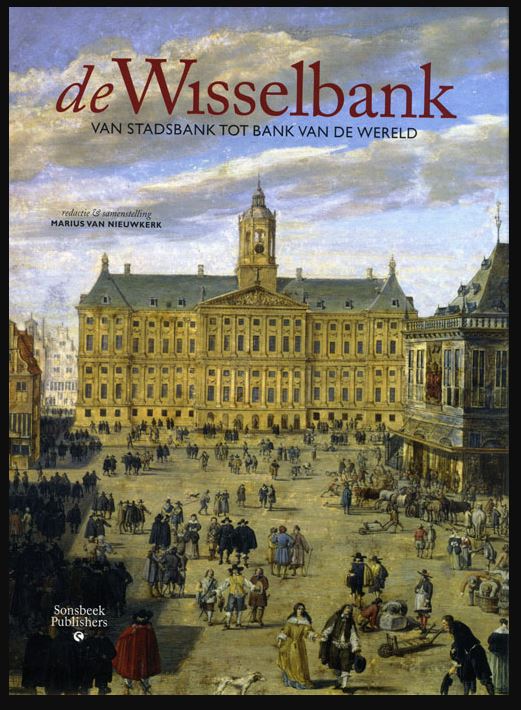
Fast forward to the 17th century, and we find the very same scheme played out by politicians. There was the collapse of Wisselbank in Amsterdam, where people had deposited their money and assumed the bank was strictly a safekeeping facility. They offered no loans and paid no interest. Little did they know that the government was using their deposits to fund its own trading.

The Wisselbank was founded in 1609. Upon first opening an account, a depositor paid a fee of ten guilders, three guilders, and three stuivers for each additional account. Two stuivers were paid for each transaction, excepting those of less than three hundred guilders, for which six stuivers were paid, in order to discourage the multiplicity of small transactions. A person who neglected to balance his account twice in the year forfeited 25 guilders. A person who ordered a transfer for more than what was upon his account was obliged to pay three per cent for the sum overdrawn. The bank made further profit by selling foreign coin and bullion, which fell to it by the expiration of receipts, and by selling bank money at five percent and buying it at four percent. These sources of revenue were more than enough to pay for the wages of bank officers, and defraying the expense of management. (Adam Smith)
In 1602, the United East India Company (VOC) was formed from six trading companies in the Netherlands and granted a trade monopoly over the Indies. The bank was administered by a committee of city government officials concerned to keep its affairs secret. It initially operated on a deposit-only basis, but by 1657, it was allowing depositors to overdraw their accounts and lending large sums to the Municipality of Amsterdam and the United East Indies Company (Dutch East India Company). Initially, this was kept confidential, but it had become public knowledge by 1790. The City of Amsterdam took over direct control in 1791 as a bailout, before finally closing it in 1819.
There is ample history of banking prior to fractional banking. Sorry, but that did not stop banking panics, nor did it stop the business cycle with the boom and bust events. The Tulip Bubble was not leveraged with fractional banking. Regardless, the boom-and-bust cycle is driven by human nature. We tend to change our minds about everything from fashion to money.
The idea that we can match lenders and borrowers sounds nice. However, that will not eliminate the cycle. I can find no instance of such a flat line except during a Dark Age, where there was no banking, private ownership, or any real economy. Coinage during the period is rare and is typically confined to the region where it was struck, demonstrating the lack of an economy or circulation due to trade.